1,2-Butanediol and 2,3-Butanediol
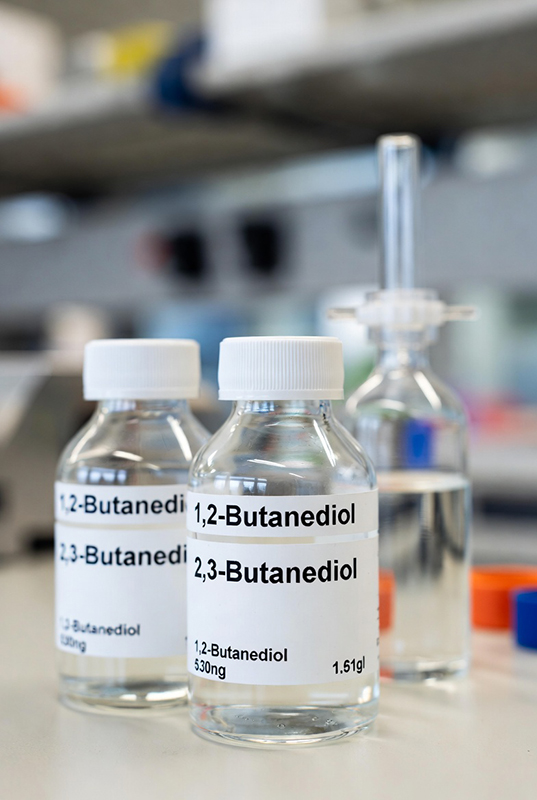
1,2-Butanediol and 2,3-Butanediol are isomers of 1,4-butanediol and 1,3-butanediol, respectively. Previously, their production and application were limited, but recently, large-scale production using bio-fermentation methods has become possible. For example, Changchun Dacheng Group uses corn fermentation to produce various small-molecule diols on a large scale.
1,2-Butanediol has the CAS number 584-03-2 (formerly 26171-83-5). Its freezing point is -50℃, boiling point is 195~197℃ or 94~96℃ (1.6kPa), relative density (25℃) is 1.006, viscosity is 73 mPa·s, flash point is 107℃, and refractive index (20℃) is 1.438. It is completely miscible with water, readily soluble in alcohols, slightly soluble in ethers and esters, and insoluble in hydrocarbons. 1,2-Butanediol has a low solidification rate and is mainly used as a solvent, organic synthesis intermediate, and cosmetic moisturizer. It can be used in the production of polyester resins, polyester plasticizers, polyester polyols, and polyurethanes.
2,3-Butanediol has the CAS number 513-85-9. It is a colorless crystalline solid or viscous liquid with a melting point of 23–27°C, a boiling point of 179–182°C, and a relative density (20°C) of 1.045. It is miscible with water, soluble in alcohols and ethers, and hygroscopic. 2,3-Butanediol can be used as a hygroscopic agent, plasticizer, and organic intermediate, as well as a solvent and raw material for synthetic resins.
PREVIOUS:1,3-Butanediol
NEXT:Trimethylpentanediol
CATEGORIES
LATEST NEWS
- Hydroxypentanoic acid neope...
- 1,2-Pentanediol
- 1,5-Pentanediol
- Back to Work at Jiaxin New ...
- Trimethylpentanediol
- 1,2-Butanediol and 2,3-Buta...
- 1,3-Butanediol
- 3-Methyl-1,5-Pentanediol
- Diethylpentanediol
- Butylethylpropanediol
CONTACT US
Tel:+8618688691634
Email:sam@1688pu.com
Add:No. 91 Central East Rd, Luxi village, Gaobu town, Dongguan city, Guangdong Province, China