Sorbitol
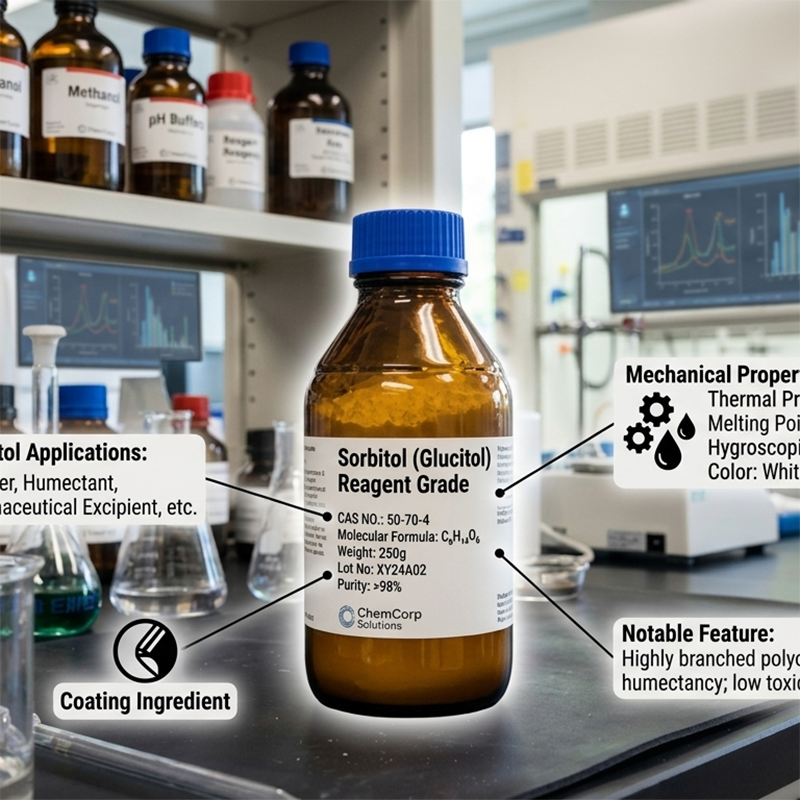
Synonyms: Sorbitol, Hexitol, etc.
Molecular Formula: C6H14O6
Molecular Weight: 182.18
CAS No.: 50-70-4
EINECS No.: 200-061-5
Structural Formula:
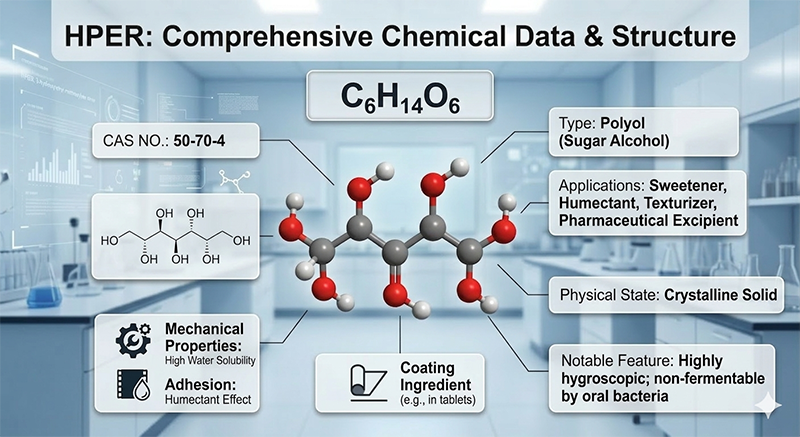
Physicochemical Properties:
A white crystalline powder with a melting point of 93–97°C. Its relative density is 1.489. It is odorless, soluble in water, glycerol, and propylene glycol; it has a sweet taste; it is slightly soluble in ethanol; and it is almost insoluble in most other organic solvents.
Depending on the crystallization conditions, sorbitol can exist in four crystalline forms: α, β, γ, and δ. Among these, the γ-form is the most stable; at ordinary temperatures, sorbitol containing 80% of the γ-form does not absorb moisture. Sorbitol exhibits excellent stability and can withstand high temperatures of up to 200°C without discoloration. Industrial-grade sorbitol is available in two forms: liquid (70% solution) and solid.
Characteristics and Applications:
Sorbitol is widely utilized across various industries, including pharmaceuticals, daily chemicals, light industry, and food manufacturing. As a chemical synthesis intermediate, it serves as a precursor for the production of various chemical products, such as Span and Tween surfactants, compound glycerol, alkyd resins, polyether resins, polyether polyols, and plasticizers.
Containing six hydroxyl groups, sorbitol is a hexitol (hexahydric alcohol). In the polyurethane industry, it is primarily employed as a starter polyol for the synthesis of polyether polyols used in the production of rigid foams. The resulting polyurethane foams possess numerous advantages, including high mechanical strength, excellent heat resistance, and superior dimensional stability.
PREVIOUS:Xylitol
NEXT:Mannitol
CATEGORIES
LATEST NEWS
- Polyether Polyol vs Polyest...
- What Is Polyester Polyol?
- What Is Polyether Polyol?
- What Is Polyol?
- Why Is Reaction Balance Cri...
- Blowing Reaction vs Gelling...
- How Molecular Structure Det...
- Soft Segment vs Hard Segmen...
- What Is Crosslinking in Pol...
- What Is Polyurethane Polyme...
CONTACT US
Tel:+86 18688691634
Email:sam@1688pu.com
Add:No. 91 Central East Rd, Luxi Village, Gaobu Town, Dongguan 523283, China.