Lysine Diisocyanate
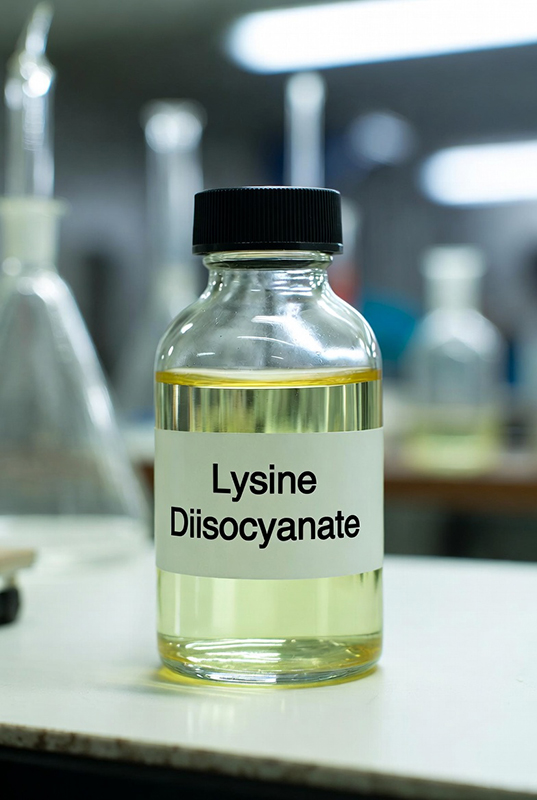
Several diisocyanates are derived from lysine [structural formula NH2(CH2)4CH(NH2)COOH], and the term “lysine diisocyanate (LDI)” is used, which seems somewhat confusing.
(1), (S)-2,6-Diisocyanatohexanoic acid, L-lysine diisocyanate.
Structural formula: OCN(CH2)4CH(NCO)COOH. Molecular formula: C8H10N2O4, molecular weight: 198.18. CAS number: 34050-00-5.
(2), 2,6-Hexanoic acid methyl ester diisocyanate, also known as lysine methyl ester diisocyanate.
Structural formula: OCN(CH2)4CH(NCO)COOCH3, molecular formula: C9H12N2O4, molecular weight: 212.20. CAS number: 4460-02-0, EINECS number: 224-712-8.
Appearance: Colorless to light yellow liquid, relative density approximately 1.157, refractive index (20℃) 1.4565, boiling point 123℃ (60Pa).
(3), 2,6-Hexanoic acid ethyl ester diisocyanate, also known as lysine ethyl ester diisocyanate, or simply lysine diisocyanate.
Structural formula: OCN(CH2)4CH(NCO)COOCH2CH3, molecular formula: C10H14N2O4, molecular weight: 226.2. CAS number: 45172-15-4. Appearance: Reddish-brown liquid.
Lysine diisocyanate is an aliphatic diisocyanate. Polyurethanes made from it are resistant to yellowing and have strong adhesion, making them suitable for applications such as polyurethane coatings.
PREVIOUS:Dimethyl diphenylmethane diisocyanate
NEXT:Other Diisocyanates
CATEGORIES
LATEST NEWS
- Polyether Polyol vs Polyest...
- What Is Polyester Polyol?
- What Is Polyether Polyol?
- What Is Polyol?
- Why Is Reaction Balance Cri...
- Blowing Reaction vs Gelling...
- How Molecular Structure Det...
- Soft Segment vs Hard Segmen...
- What Is Crosslinking in Pol...
- What Is Polyurethane Polyme...
CONTACT US
Tel:+86 18688691634
Email:sam@1688pu.com
Add:No. 91 Central East Rd, Luxi Village, Gaobu Town, Dongguan 523283, China.