Polymethylene Polyphenyl Isocyanate
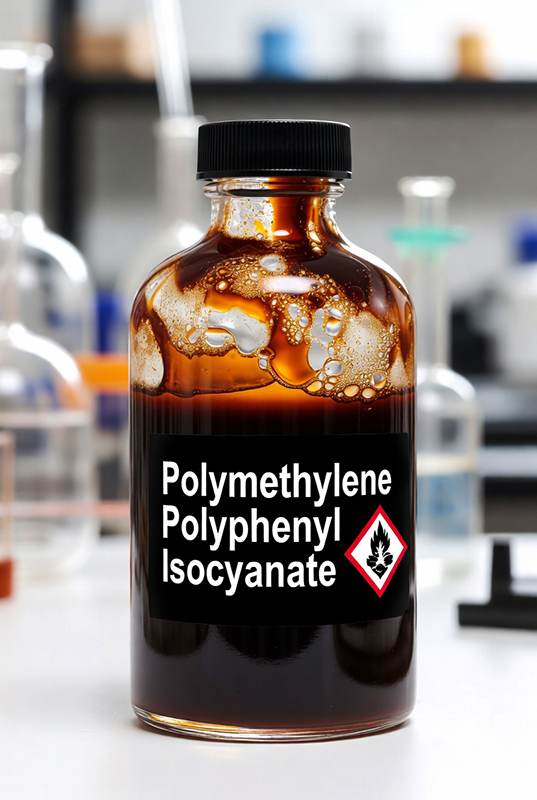
Abbreviation: PAPI, Crude MDI, Polymeric MDI, PMDI.
Synonyms: Polyaryl Polymethylene Isocyanate, Polyaryl Polyisocyanate, Polymethylene Polyphenyl Polyisocyanate, Polymethylene Polyphenyl Isocyanate.
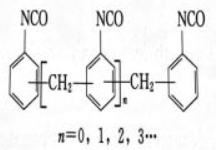
The CAS number for PAPI is 9016-87-9. It is actually a mixture of polymethylene polyphenyl polyisocyanates with different functionalities. Typically, monomeric MDI (the diisocyanate with n=0 in the structural formula below) accounts for about 50% of the total mixture, with the remainder being oligomeric isocyanates with 3-6 functionalities.
Structural Formula:
Physicochemical Properties
PAPI is a brown to dark brown, medium-to-low viscosity liquid at room temperature. It is soluble in solvents such as benzene, toluene, chlorobenzene, and acetone, and reacts with compounds containing hydroxyl and other active hydrogen groups. It is insoluble in water but reacts with water to produce carbon dioxide gas. Relative density (20℃) is approximately 1.23; viscosity (25℃) is 100–2000 mPa·s; vapor pressure (25℃) < 0.001 Pa, its vapor pressure is lower than that of monomeric MDI; saturated vapor concentration (calculated value at 25℃) < 0.15 mg/m³; flash point is approximately 230℃ (above 200℃); freezing point is approximately 5℃, and it may crystallize below 10℃; boiling point > 358℃ (DCS method), it can self-polymerize at high temperatures, decomposition temperature > 230℃.
The differences between various PAPI products mainly lie in the different proportions of 4,4′-MDI and 2,4′-MDI, as well as polymethylene polyphenyl polyisocyanates with various functionalities, resulting in different average functionalities and reactivities. Standard grade polymeric MDI has an average functionality of approximately 2.7, a viscosity of 100–300 mPa·s, and contains approximately 50% MDI by mass, most of which is the 4,4′-isomer. In addition, it contains approximately 30% triisocyanate, 10% tetraisocyanate, 5% pentaisocyanate, and about 5% higher functional homologues. Typical PAPI products have an NCO mass fraction of 31% to 32%. The average molecular weight is in the range of 300 to 400. This type of polymeric MDI is widely used in non-aqueous foaming self-skinning flexible and semi-rigid foams, as well as in combination with TDI and liquefied MDI to manufacture cold-curing high-resilience polyurethane foams. Low-viscosity PAPI generally has an average functionality between 2.5 and 2.6, and is mainly used in high-density flexible foams, self-skinning foams, and other fields.
The national standard GB 13658-1992 “Polymethylene Polyphenyl Isocyanate” specifies the physicochemical properties of first-grade PAPI products as follows: appearance is a brown liquid, NCO mass fraction is 30.0% to 32.0%, acidity (calculated as HCl mass fraction) ≤ 0.2%, hydrolyzable chlorine content ≤ 0.3 mg/kg, density (25℃) is 1.220 to 1.250 g/cm³, and viscosity (25℃) is 100 to 400 mPa·s.
Characteristics and Uses
PAPI molecules contain multiple rigid benzene rings and have a high average functionality, resulting in harder polyurethane products. The curing rate is faster than that of lower functionality MDI and TDI. PAPI is mainly used as a raw material for rigid polyurethane foams, semi-rigid polyurethane foams, molded high-resilience foams, adhesives, etc., and is also used in self-hardening sand resins in the foundry industry. High-functionality, low-acid-value PAPI is generally used in fast-curing systems and can also be used in coatings, etc.
Packaging and Storage
Packaged in galvanized iron drums, this product is non-volatile and can be transported according to the relevant regulations for general chemicals. Due to the active chemical nature of PAPI, it reacts readily with moisture, forming insoluble urea compounds and releasing carbon dioxide, causing drum swelling and increased viscosity. Therefore, during storage, the container must be strictly dry and sealed, and protected with dry nitrogen gas. PAPI should be stored in a well-ventilated indoor environment at room temperature (20-25°C) in a tightly sealed container. Storage at temperatures below 5°C may cause crystallization; therefore, freezing must be avoided. If crystallization occurs, it should be heated to 70-80°C to melt the crystals before use, and stirred thoroughly. Prolonged storage above 50°C should be avoided to prevent the formation of insoluble solids and an increase in viscosity. Under suitable storage conditions, PAPI has a shelf life of one year.
PREVIOUS:Other Diisocyanates
NEXT:Liquefied MDI
CATEGORIES
LATEST NEWS
- Polyether Polyol vs Polyest...
- What Is Polyester Polyol?
- What Is Polyether Polyol?
- What Is Polyol?
- Why Is Reaction Balance Cri...
- Blowing Reaction vs Gelling...
- How Molecular Structure Det...
- Soft Segment vs Hard Segmen...
- What Is Crosslinking in Pol...
- What Is Polyurethane Polyme...
CONTACT US
Tel:+86 18688691634
Email:sam@1688pu.com
Add:No. 91 Central East Rd, Luxi Village, Gaobu Town, Dongguan 523283, China.