Liquefied MDI
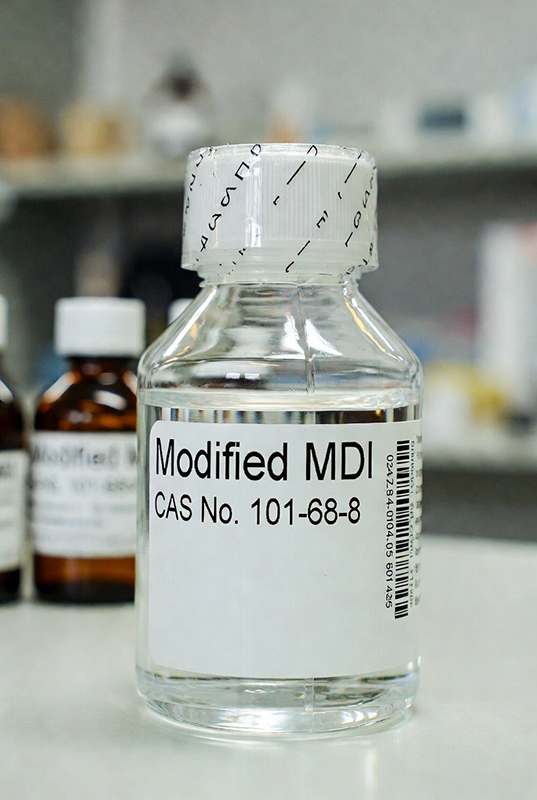
Also known as: Modified MDI.
Abbreviation: L-MDI, C-MDI.
Pure MDI is a solid at room temperature, making it inconvenient to use. 4,4′-MDI is also prone to dimerization during storage, resulting in poor storage stability. It must be heated and melted into a liquid before use. Repeated heating will affect the quality of MDI and complicate the operation. Therefore, MDI is generally not used directly in polyurethane foam plastics. Liquefied MDI is a modified MDI developed in the 1970s. It overcomes the above shortcomings and can be used in the manufacture of various polyurethane materials such as elastomers, adhesives, and microporous polyurethane products. It can also be used to manufacture polyurethane molded products with special performance requirements and increase the flame retardancy of the products.
The most commonly used MDI liquefaction technology involves introducing carbamate or carbodiimide groups into 4,4′-MDI through chemical reactions to obtain a liquid MDI modified product.
In addition, MDI can be made liquid by increasing the proportion of 2,4′-MDI during the manufacturing process (see the entry “Diphenylmethane Diisocyanate”), or by blending TDI with MDI to form a mixed diisocyanate with a low solidification point.
Physicochemical Properties
Carbodiimide-modified MDI is an important liquefied MDI product. This liquefied MDI has low viscosity, and its NCO content is similar to that of pure MDI. In addition, the carbodiimide group also enhances the hydrolysis resistance of polyurethane products.
The physical properties of products obtained from different manufacturers and different modification methods vary. See the relevant manufacturer’s product specifications for details.
Characteristics and Uses
Liquefied MDI is easy to use and has stable storage. With MDI as the basic component, it can be used in the manufacture of high-performance microporous polyurethane elastomers, cold-curing molded (high-resilience) flexible polyurethane foam plastics, self-skinning foam plastics, and semi-rigid foam products, including: shoe soles, solid tires, car bumpers, fenders, shock absorbers, spoilers, steering wheels, seat cushions, seat headrests, armrests, interior trim parts, etc. It is also used in the manufacture of adhesives, coatings, and textile finishing treatments.
It must be stirred well before use. If partial crystallization occurs due to low temperature or prolonged storage, it can be melted at 60-70°C and stirred until homogeneous before use.
PREVIOUS:Polymethylene Polyphenyl Isocyanate
NEXT:TDI Dimer
CATEGORIES
LATEST NEWS
- Polyether Polyol vs Polyest...
- What Is Polyester Polyol?
- What Is Polyether Polyol?
- What Is Polyol?
- Why Is Reaction Balance Cri...
- Blowing Reaction vs Gelling...
- How Molecular Structure Det...
- Soft Segment vs Hard Segmen...
- What Is Crosslinking in Pol...
- What Is Polyurethane Polyme...
CONTACT US
Tel:+86 18688691634
Email:sam@1688pu.com
Add:No. 91 Central East Rd, Luxi Village, Gaobu Town, Dongguan 523283, China.