TDI Dimer
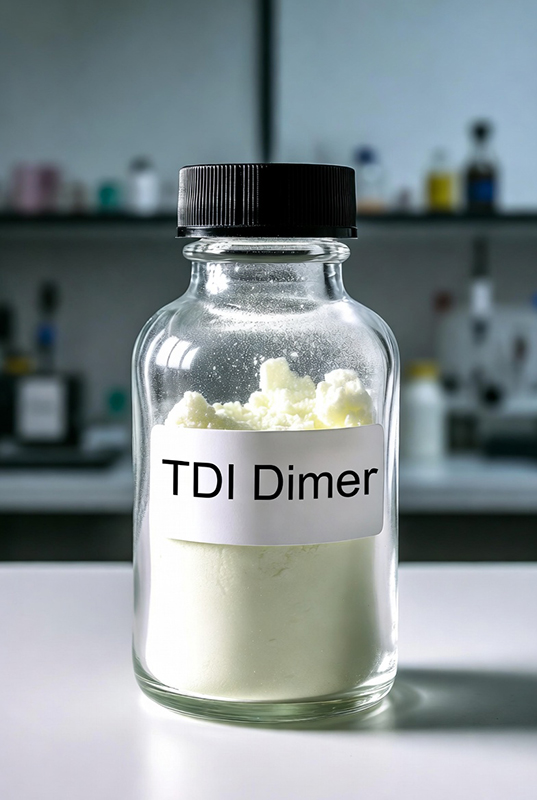
Abbreviation: TD, TT
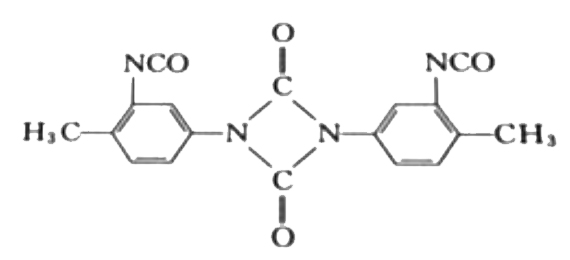
Chemical Name: 1,3-bis(3-isocyanato-4-methylphenyl)-1,3-diazetidine-2,4-dione.
TDI dimer is also known as 2,4-TDI dimer, and due to the presence of a uretidione four-membered heterocyclic ring, it is also called TDI uretidione.
Molecular Formula: C18H12N4O4, Molecular Weight: 348.3. 2,4-TDI dimer CAS numbers are 26747-90-0 and 3320-33-0, EINECS number is 247-953-0.
Structural Formula:
Physical and Chemical Properties
White to slightly yellowish solid powder, density (20℃) is 1.48 g/cm³, melting point >145℃, slowly decomposes above 100℃, and can be stably stored for 12 months in a dry and cool place. The theoretical free NCO content of TDI dimer is 24.1%. It is insoluble in water and slightly soluble in toluene (solubility at 23℃, 50℃, and 100℃ are 0.1%, 3%, and 18%, respectively).
Characteristics and Uses
TDI dimer is stable at room temperature and acts as a difunctional isocyanate under mild reaction conditions below 130℃. However, at high temperatures above 145℃, or in the presence of strong alkaline catalysts/above 90℃, the dimer depolymerizes into two TDI molecules during the curing process, doubling the number of reactive groups. In the presence of a trialkylphosphine catalyst, TDI dimer can be completely decomposed into TDI monomer in a benzene solution at 80°C.
TDI dimer was primarily used as a high-temperature vulcanizing agent (curing agent, crosslinking agent) for blended polyurethane elastomers. The NCO groups in TDI dimer have low reactivity, and due to its high melting point, it hardly reacts at storage and mixing temperatures. However, at vulcanization temperatures above 150°C, the dimer decomposes to form two TDI molecules, which are highly reactive and provide satisfactory crosslinking effects.
TDI dimer can also be used as a high-temperature crosslinking agent for room-temperature stable one-component polyurethane elastomers, coatings, and adhesives, for example, in automotive sealants. TDI dimer dispersed in an amino-terminated polyether oligomer polyol can be used to prepare room-temperature stable TDI dimer microcapsules.
TDI dimer can also be used in aqueous dispersions, for example, for the impregnation and finishing of polyester fabrics. It is also used as an adhesion promoter for vulcanized rubber to fabrics (especially polyester fibers). A 50% dispersion of TDI dimer in a plasticizer can be used to improve the adhesion between fabrics and PVC.
PREVIOUS:Liquefied MDI
NEXT:TDI Trimer
CATEGORIES
LATEST NEWS
- Polyether Polyol vs Polyest...
- What Is Polyester Polyol?
- What Is Polyether Polyol?
- What Is Polyol?
- Why Is Reaction Balance Cri...
- Blowing Reaction vs Gelling...
- How Molecular Structure Det...
- Soft Segment vs Hard Segmen...
- What Is Crosslinking in Pol...
- What Is Polyurethane Polyme...
CONTACT US
Tel:+86 18688691634
Email:sam@1688pu.com
Add:No. 91 Central East Rd, Luxi Village, Gaobu Town, Dongguan 523283, China.