Polyisocyanate Mixtures and Mixed Polymers
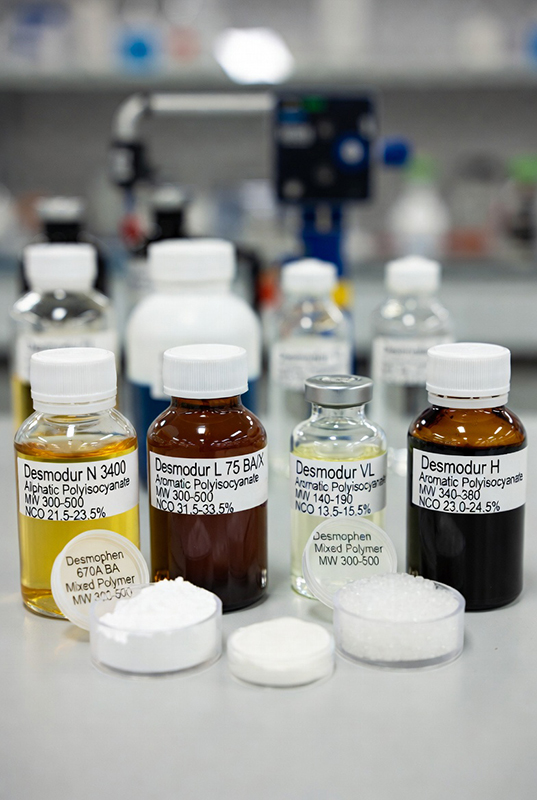
TDI-HDI Mixed Polymer
The CAS number for the polymer of 2,4-TDI and HDI (TDI-HDI mixed polymer) is 26426-91-5. The trimer formed from two HDI molecules and one 2,4-TDI molecule has a CAS number of 93859-05-3, and its chemical name is 1,3-bis(6-isocyanatohexyl)-5-(3-isocyanato-p-tolyl)-1,3,5-triazine-2,4,6-(1H,3H,5H)-trione. Products made with TDI-HDI mixed polyisocyanate have better weather resistance and light resistance than those made with TDI adducts and TDI trimer polyisocyanates. When formulated with hydroxyl-containing components such as polyester polyols to produce two-component polyurethane clear coats or colored paints, it exhibits fast drying and resistance to yellowing. Its rapid initial curing and early sandability are outstanding advantages for its use in wood coatings.
The curing rate of two-component coatings formulated with TDI-HDI mixed polyisocyanate is faster than that of TDI adduct polyisocyanate, and slightly slower than that of the TDI trimer curing system.
Preparation method: 170 parts by weight of 2,4-TDI and 300 parts by weight of HDI are added to a reactor, stirred, and heated to 60°C. 0.125 parts by weight of tributylphosphine are added, and the mixture is maintained at this temperature for 4.5 hours. When the NCO content drops to 36%, 0.1 parts by weight of methyl p-toluenesulfonate and 0.1 parts by weight of dimethyl sulfate are added, and the temperature is rapidly increased to 100°C. Unreacted isocyanate monomers are removed by vacuum distillation, yielding 180 parts by weight of a light yellow brittle resin (TDI-HDI mixed polymer). The isocyanate group content is 19.8%, and when diluted to a 67% ethyl acetate solution, the viscosity is 725 mPa·s (20°C). In the mixed trimer, HDI generally accounts for 40%.
Desmodur RN and JQ-RN are low-viscosity, light yellow, transparent liquids with a free monomer content of less than 0.5% and a flash point of -5°C. Desmodur RN is suitable for use as a crosslinking agent for thermoplastic polyurethane adhesives and rubber adhesives. It is resistant to discoloration and is particularly suitable for bonding light-colored materials. For hydroxyl-terminated polyurethane adhesives or neoprene adhesives with a solid content of 20%, the amount of RN used is 4-7 parts by weight per 100 parts by weight of adhesive.
HDI-IPDI Mixed Polymer
The HDI-IPDI mixed polymer combines the advantages of HDI trimer and IPDI trimer and other polyisocyanates. It is mainly used as a curing agent for yellowing-resistant (light-resistant) two-component polyurethane coatings, providing the paint film with chemical resistance, weather resistance, high gloss retention, and excellent mechanical properties. Polyacrylate polyols or polyester polyols are suitable hydroxyl components for these polyurethane coatings. These polyurethane coatings can be used in air-drying or forced-drying automotive OEM paints and refinish paints, industrial coatings, and plastic coatings. Bayer offers such products; Desmodur NZ 1 is a mixture of HDI and IPDI homopolymers in a 67/33 ratio. Desmodur XP 2748 is a solvent-based product, with the solvent being a 7/6 mixture of 100# naphtha and butyl acetate.
TDI/MDI Mixture
TDI/MDI Monomer Mixture
Bayer AG previously offered a TDI/MDI mixture product used as a raw material for polyurethane coatings. Its brand name was Desmodur TMM, a low-viscosity, slightly yellowish liquid with an NCO content of approximately 39.3%, an acidity (HCl) of approximately 70 mg/kg, a viscosity of approximately 6 mPa·s, a density (20°C) of 1.21 g/mL, and a flash point of 140°C. The ideal storage temperature is 15–25°C; temperatures below 15°C will cause crystallization, while storage at higher temperatures may lead to yellowing and the formation of insoluble precipitates.
Bayer also offers a TDI/MDI mixture product, branded as Mondur 445, with an NCO content of 44.5%–45.2%.
TDI/PAPI Mixture
TDI/PAPI mixtures are mainly used in the production of cold-curing high-resilience polyurethane foams. TDI has a very low viscosity, while PAPI has high functionality and high reactivity. The mixture of the two is more reactive than pure TDI, which is beneficial for the production of cold-curing flexible polyurethane foams, and the resulting foams have better hardness. Factories can generally prepare their own TDI/PAPI polyisocyanate mixtures in different proportions. Some raw material manufacturers also supply these polyisocyanates according to market requirements and customer needs.
KPX Fine Chemical Co., Ltd. of South Korea offers a mixed isocyanate product, TM-20, which is a brown, low-viscosity liquid with a viscosity of ≤15 mPa·s, an NCO content of 44.5% ± 0.5%, and a hydrolyzable chlorine content of ≤0.1%.
Yantai Wanhua Polyurethane Co., Ltd. supplies Wannate 7025 and 7028, which are TDI/MDI mixtures containing a small amount of TDI (components include MDI monomer, polymeric MDI, and TDI). They are brown, low-viscosity liquids with NCO contents of 35.7%–36.7% and 33.9%–34.9%, respectively, and viscosities of 5–25 mPa·s and 15–30 mPa·s, respectively. They are mainly used in the production of high-resilience polyurethane foams.
PREVIOUS:Water-Dispersible Polyisocyanates
CATEGORIES
LATEST NEWS
- Polyether Polyol vs Polyest...
- What Is Polyester Polyol?
- What Is Polyether Polyol?
- What Is Polyol?
- Why Is Reaction Balance Cri...
- Blowing Reaction vs Gelling...
- How Molecular Structure Det...
- Soft Segment vs Hard Segmen...
- What Is Crosslinking in Pol...
- What Is Polyurethane Polyme...
CONTACT US
Tel:+86 18688691634
Email:sam@1688pu.com
Add:No. 91 Central East Rd, Luxi Village, Gaobu Town, Dongguan 523283, China.