Polytetrahydrofuran Diol
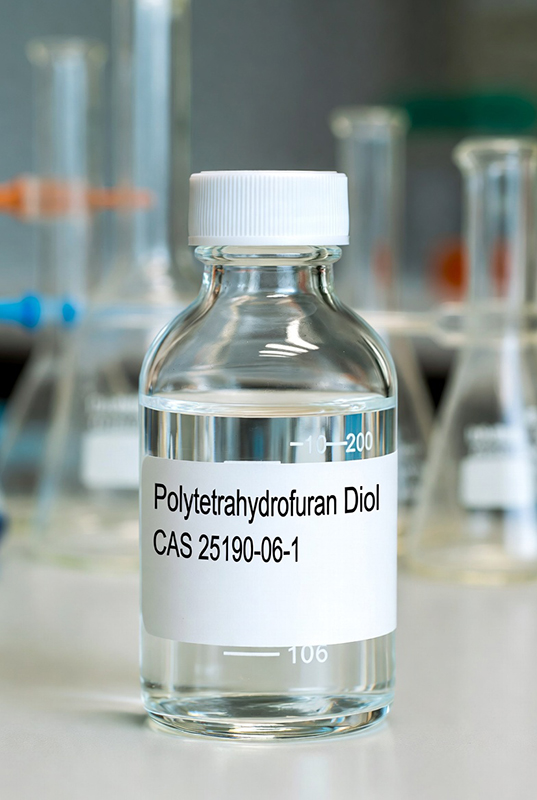
Abbreviations: PTMEG, PTG, PTMG, PTMO, PTHF.
Chemical Name: Polytetramethylene ether glycol.
Aliases: Tetrahydrofuran homopolymer ether, polybutylene glycol, polytetrahydrofuran ether diol, polyoxytetramethylene ether diol, α,ω-hydroxy polyoxybutylene, etc.
CAS Number: 25190-06-1, 24979-97-3.
Physicochemical Properties
At room temperature, most polytetrahydrofuran diols are white waxy solids, melting into a low-viscosity, colorless to light yellow transparent liquid at around 40°C. PTMEG with a molecular weight of 650-2900 has a flash point (PMCC) of 197-207°C, and a melting point (freezing point) of 11-38°C (see relevant manufacturer’s product data for detailed information). Molten PTMEG can be supercooled and crystallizes slowly. The refractive index of polytetrahydrofuran diol (25°C) is 1.464. It is insoluble in water, with a solubility in water of less than 1%, and is also insoluble in aliphatic hydrocarbons. It is soluble in aromatic hydrocarbons, chlorinated hydrocarbons, alcohols, esters, ketones, and other polar organic solvents. Polytetrahydrofuran diol is stable when stored under oxygen-free conditions; for example, it can be stably stored for at least one year at temperatures below 55°C under nitrogen protection. It can only be stored for a few days at 100°C. Prolonged exposure to air can lead to oxidation and degradation, resulting in yellowing, increased peroxide content, and increased acid value. Thermal degradation occurs at 210-220°C in the absence of air, producing tetrahydrofuran. To improve storage stability, industrial PTMEG generally contains a small amount of antioxidant. According to LyondellBasell Industries data, the relationship between the density d (g/ml) and temperature t (°C) for PTMEG-650 is d = 1.0047 – 0.0007t; the relationship between density and temperature for PTMEG-1000 and PTMEG-2000 is d = 1.0025 – 0.0007t.
Poly(tetramethylene ether) glycol is hygroscopic and can absorb up to 2% moisture in an open system, depending on the molecular weight. Most of the water can be removed by azeotropic distillation with toluene. To further reduce the water content, dehydration under reduced pressure at 120-150°C and a vacuum of less than 2.6 kPa is required.
Properties and Applications
Poly(tetramethylene ether) glycol is a homopolymer ether obtained by ring-opening polymerization of tetrahydrofuran (THF) under cationic initiation. It contains ether linkages and a considerable number of regularly arranged methylene groups, with primary hydroxyl groups as end groups. It is mainly used as the soft segment of polyurethane elastomers and is a high-grade raw material for polyurethanes. Non-polyurethane applications include copolyester elastomers and polyether amide engineering plastics.
PTMEG-type polyurethane elastomers have high modulus and strength, excellent hydrolysis resistance, wear resistance, mildew resistance, oil resistance, dynamic mechanical properties, electrical insulation properties, and low-temperature flexibility. It possesses certain characteristics that are not achievable with typical polyester-type polyurethane elastomers, particularly good water resistance.
PTMEG is a commonly used special polyether polyol, used in the manufacturing processes of injection and extrusion thermoplastic polyurethane elastomers (TPU), castable polyurethane elastomers, polyurethane fiber spinning, and compounded polyurethane elastomers. It is particularly suitable for spandex, automotive parts, cables, films, fabric coatings, synthetic leather, medical devices, high-performance rubber rollers, oil-resistant seals, adhesives, wear-resistant linings for metal parts, sports products, and products used in underwater, underground, mining, and low-temperature environments. The elastomer is often used in applications requiring high hydrolysis resistance. Toxicity
Polytetrahydrofuran diol has very low toxicity; the acute oral toxicity LD50 in rats is >11 g/kg. Molten PTMEG is moderately irritating to the skin.
PREVIOUS:Polyurea Polyol
CATEGORIES
LATEST NEWS
- Polyether Polyol vs Polyest...
- What Is Polyester Polyol?
- What Is Polyether Polyol?
- What Is Polyol?
- Why Is Reaction Balance Cri...
- Blowing Reaction vs Gelling...
- How Molecular Structure Det...
- Soft Segment vs Hard Segmen...
- What Is Crosslinking in Pol...
- What Is Polyurethane Polyme...
CONTACT US
Tel:+86 18688691634
Email:sam@1688pu.com
Add:No. 91 Central East Rd, Luxi Village, Gaobu Town, Dongguan 523283, China.