Polycarbonate Diol
Abbreviation: PCDL
Physicochemical Properties
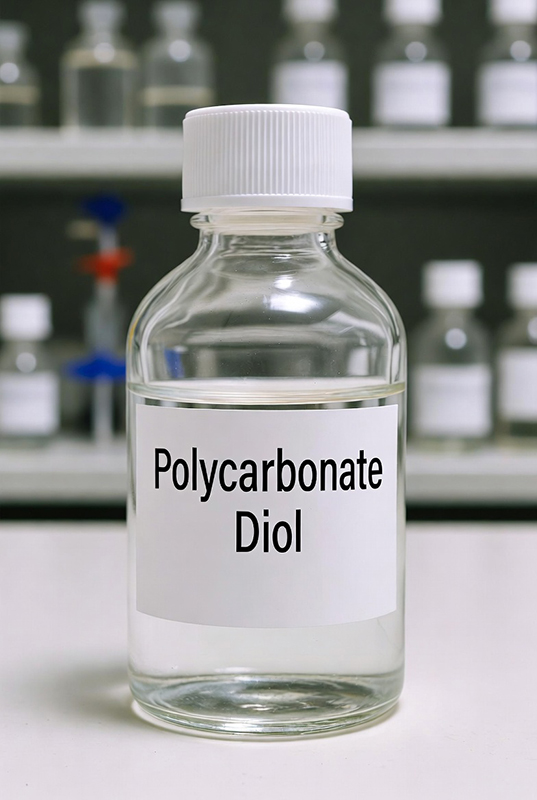
Polycarbonate diols synthesized from different raw materials are light-colored, transparent, viscous liquids or solids at room temperature. Polycarbonate diols are insoluble in water but soluble in esters, ketones, aromatic hydrocarbons, and ether-ester organic solvents.
Common poly(1,6-hexanediol carbonate) diol (polyhexamethylene carbonate diol, PHCD) is a white waxy solid at room temperature. A poly(hexamethylene carbonate) diol supplied by Sigma-Aldrich, with a molecular weight of approximately 860, has a viscosity of 350–850 mPa·s, a melting point of 40–50°C, and a density of 1.09 g/ml at 25°C.
Polycarbonate diols have slight hygroscopicity and can be stably stored in sealed containers below 30°C for more than 6 months. The initiator has a significant impact on the appearance and physical properties of PCDL. Some PCDL products are liquid at room temperature, while others crystallize at room temperature and can be used after heating and melting.
Viscosity, melting point, density, and other physical properties can be found in the product data sheets of relevant manufacturers.
Characteristics and Uses
Polyurethanes made from polycarbonate diols have excellent weather resistance, hydrolysis resistance, and abrasion resistance, making them one of the best performing oligomeric polyols. They can be used in thermoplastic polyurethane elastomers, films, high-grade PU leather, spandex, adhesives, water-based paints, and solvent-based polyurethane paints. They can also be used in flowable or non-sagging polyurethane sealants. Polycarbonate diols can be combined with aliphatic isocyanates to formulate coatings, adhesives, etc., exhibiting excellent weather resistance and hydrolysis resistance.
PREVIOUS:Polycaprolactone Diol and Polycaprolactone Triol
NEXT:Polyacrylate Polyols
CATEGORIES
LATEST NEWS
- Polyether Polyol vs Polyest...
- What Is Polyester Polyol?
- What Is Polyether Polyol?
- What Is Polyol?
- Why Is Reaction Balance Cri...
- Blowing Reaction vs Gelling...
- How Molecular Structure Det...
- Soft Segment vs Hard Segmen...
- What Is Crosslinking in Pol...
- What Is Polyurethane Polyme...
CONTACT US
Tel:+86 18688691634
Email:sam@1688pu.com
Add:No. 91 Central East Rd, Luxi Village, Gaobu Town, Dongguan 523283, China.