Castor Oil
Abbreviation: CAS
CAS NO.: 8001-79-4.
Castor oil is a glycerol ester of fatty acids, containing approximately 70% glyceryl triricinoleate and 30% glyceryl diricinoleate monolinoate, etc. The fatty acids produced by saponification of castor oil contain approximately 90% ricinoleic acid (chemical name: 9-octadecen-12-ol), and about 10% of non-hydroxylated components, including 3%–4% oleic acid, 3%–4% linoleic acid, and 0.5%–1% unsaponifiable components.
The equivalent weight (ratio of molecular weight to functionality) of castor oil is approximately 345, and the average hydroxyl functionality is approximately 2.7.
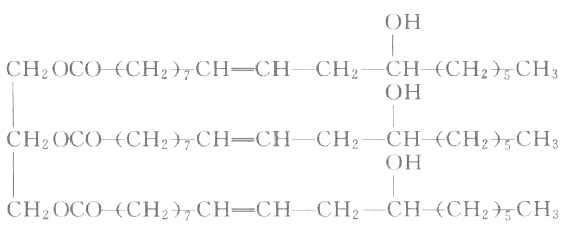
Castor oil does not have a definite molecular formula. The structural formula of its main component is as follows:
Physical and Chemical Properties
Castor oil is a pale yellow liquid with a slight characteristic odor. Its density (20℃) is 0.950–0.965 g/mL, viscosity (25℃) is 730 mm²/s, refractive index (20℃) is 1.475–1.480, melting point is -18–-10℃, and boiling point is 313℃. The flash point is 229℃. Castor oil is insoluble in water but miscible with alcohols, acetic acid, benzene, and chloroform.
The hydroxyl value of castor oil is greater than 160 mg KOH/g (typical value 163–164 mg KOH/g), the hydroxyl content is approximately 4.9%, the saponification value is 176–186 mg KOH/g, and the iodine value is 82–90 g I₂/100g. Untreated castor oil has an acid value of <5.0 mg KOH/g and a peroxide value of <5.0 meq/kg. Refined castor oil, bleached with activated clay, is a colorless or light yellow transparent liquid with an acid value of 1–2 mg KOH/g, moisture and volatile matter ≤0.2%, and free fatty acids ≤1.0%.
Properties and Uses
From the chemical structure of castor oil, it is a polyhydroxy compound with long-chain fatty groups. Therefore, polyurethane products made from it have good water resistance (hydrolysis resistance), flexibility, low-temperature performance, and electrical insulation. Castor oil can be directly used in the manufacture of polyurethane adhesives, coatings, and foams, or it can be used after modification.
In addition to its use in polyurethanes, castor oil has many other applications, including in soaps, lubricants, medical laxatives, and in the manufacture of sebacic acid, nylon 11, and castor oil polyoxyethylene ester surfactants.
PREVIOUS:Polystyrene Polyols
CATEGORIES
LATEST NEWS
- Polyether Polyol vs Polyest...
- What Is Polyester Polyol?
- What Is Polyether Polyol?
- What Is Polyol?
- Why Is Reaction Balance Cri...
- Blowing Reaction vs Gelling...
- How Molecular Structure Det...
- Soft Segment vs Hard Segmen...
- What Is Crosslinking in Pol...
- What Is Polyurethane Polyme...
CONTACT US
Tel:+86 18688691634
Email:sam@1688pu.com
Add:No. 91 Central East Rd, Luxi Village, Gaobu Town, Dongguan 523283, China.