Soybean Oil Polyols
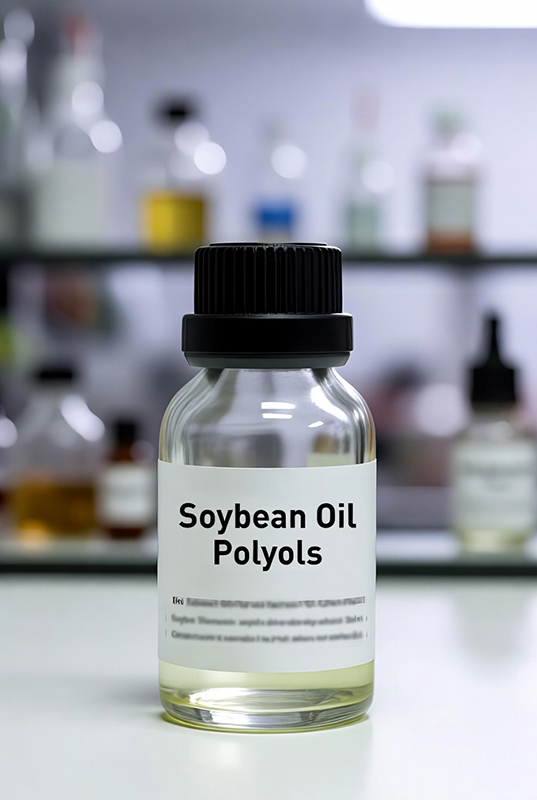
Soybean oil is a triglyceride containing 20%–30% oleic acid (C18:1, an eighteen-carbon fatty acid with one double bond), 45%–58% linoleic acid (C18:2), and 4%–10% linolenic acid (C18:3).
Soybeans are a widely cultivated edible oil crop in countries such as the United States and China, and are readily available, making them relatively inexpensive compared to petroleum-based products. Currently, many plant-based polyols use soybean oil as a raw material, undergoing epoxidation and hydroxylation to produce soybean oil polyols. Many manufacturers domestically and internationally are engaged in the research and development of soybean oil polyols and the corresponding polyurethane materials.
The United States has abundant soybean resources. Urethane Soy Systems Company (USSC), founded in 1998, developed polyols derived from soybean oil early on. Their applications are almost identical to those of polyether polyols produced from petroleum derivatives, with an annual production capacity of over 200,000 tons. The quality specifications of USSC’s Soyol series soybean oil polyols are shown in Table 4-22. Some grades with letter suffixes are low-odor, low-acid value, or low-viscosity products developed in recent years. These products are viscous yellow liquids with a slightly sweet and burnt odor. In addition, the company has a SoyOyl RS brand soybean oil product used in polyurethane carpet backing, but the product properties are not specified. SoyOyl is an early brand name for soybean oil polyols.
Cargill, Incorporated produces soybean oil polyols under the brand name BiOH polyols. They are reportedly suitable for various polyurethane applications. The Polyol X-0500 and Polyol X-0210 series are both 100% secondary hydroxyls with a flash point >130°C. Argill’s BiOH soybean oil polyols are primarily used in flexible and rigid polyurethane foams. They can replace 30%–35% of conventional polyether/polyester polyols in polyol blends, resulting in a 15%–20% bio-based content in the final polyurethane product.
Dow Chemical Company began developing natural oil polyols as early as the 1990s. Currently, their proprietary Renuva technology allows them to produce low-odor vegetable oil polyols comparable to petroleum-based polyols, increasing the content of natural resources in polyurethane products. According to reports, Renuva technology’s soybean oil polyols can be used in various polyurethane applications, including foams and CASE materials, meeting the growing demand for environmentally friendly products. The technology reportedly breaks down oils into aldehyde-containing intermediates, which are then converted into hydroxyl-containing intermediates. Dow’s technicians describe this process as breaking down natural oils into structural components and then reassembling them, thereby eliminating the common odor associated with soybean oil polyols.
Bayer MaterialScience’s Multranol 8160 is a polyether polyol derived from soybean oil and glycerol, containing 60% renewable resources. It can replace up to 50% of polyester polyols in the production of polyisocyanurate rigid foams without affecting performance. Multranol 8160’s physical properties include: hydroxyl value of 200–220 mg KOH/g, viscosity (25℃) of 50–250 mPa.s, water content of 0.1%, acid value of 0.3 mg KOH/g, relative density at 25℃ of 1.0174, and flash point >200℃. In addition, Bayer uses its Impact polyether production technology with less than 20% vegetable oil and alkylene oxides to produce low-hydroxyl-value natural oil-based flexible foam polyether polyols, comparable to conventional petrochemical polyether polyols.
Domestic companies researching and producing soybean oil polyols include Shandong Gaomi Minghuan Industry and Trade Co., Ltd., Shanghai Zhongke Hechen Co., Ltd., Shanghai Gaowei Industrial Co., Ltd., Laizhou Jintian Chemical Co., Ltd. of Shandong Province, and Guangzhou Hai’er Vegetable Oil Co., Ltd. Shandong Gaomi Minghuan Industry and Trade Co., Ltd.’s soybean oil polyol has a hydroxyl value between 100 and 400 mg KOH/g and a functionality between 1 and 3, and is produced according to user requirements for molecular weight, functionality, and hydroxyl value. The soybean oil polyol product is mainly used in the production of rigid polyurethane foam, flexible foam, adhesives, etc.
Shanghai Gaowei Industrial Co., Ltd., in cooperation with Shanghai Zhongke Hechen Co., Ltd., has developed a vegetable oil polyol, which is reportedly made from genetically modified soybeans.
Shandong Laizhou Jintian Chemical Co., Ltd.’s vegetable oil polyol JTM-4110 is mainly used in rigid polyurethane foam, with the following specifications: hydroxyl value (380±20) mg KOH/g, acid value ≤0.7 mg KOH/g, viscosity (25℃) (480±30) mPa·s, average functionality 4.2, pH value 7.5~8.5.
Guangzhou Hai’er Vegetable Oil Co., Ltd.’s bio-based polyol is a soybean oil polyol.
Pulsecam Co., Ltd. of South Korea’s wholly-owned subsidiary in China, Beijing Pulsecam Technology Co., Ltd., recently launched the soybean oil polyol Soyol 560. Its product technical specifications are shown in Table 4-26. In foam formulations, it is recommended that soybean oil polyol be 20% and ordinary polyether polyol be 80%. The company’s Soyol 5616 has a typical hydroxyl value of 56 mg KOH/g, a typical viscosity of 300 mPa·s, and an average molecular weight of 1600.
PREVIOUS:Preparation and Uses of Vegetable Oil Polyols
NEXT:Palm Oil Polyols
CATEGORIES
LATEST NEWS
- Polyether Polyol vs Polyest...
- What Is Polyester Polyol?
- What Is Polyether Polyol?
- What Is Polyol?
- Why Is Reaction Balance Cri...
- Blowing Reaction vs Gelling...
- How Molecular Structure Det...
- Soft Segment vs Hard Segmen...
- What Is Crosslinking in Pol...
- What Is Polyurethane Polyme...
CONTACT US
Tel:+86 18688691634
Email:sam@1688pu.com
Add:No. 91 Central East Rd, Luxi Village, Gaobu Town, Dongguan 523283, China.