Alkanolamine and Nitrogen-Containing Polyol Crosslinkers
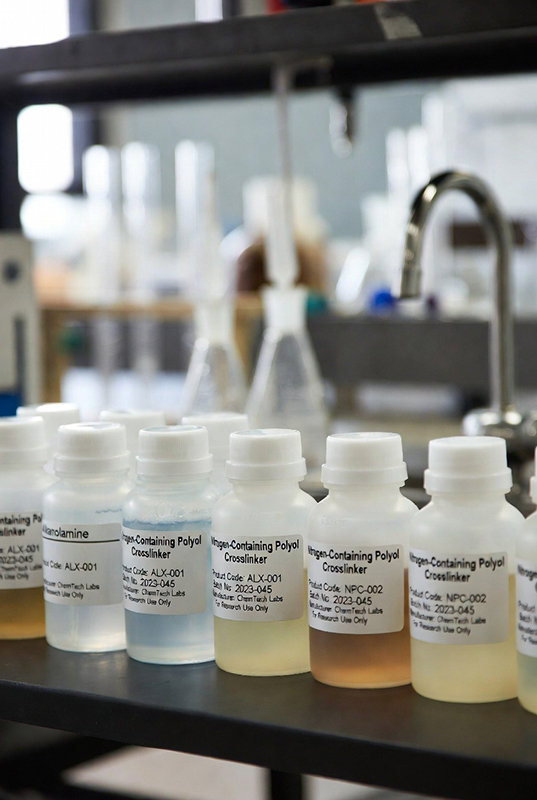
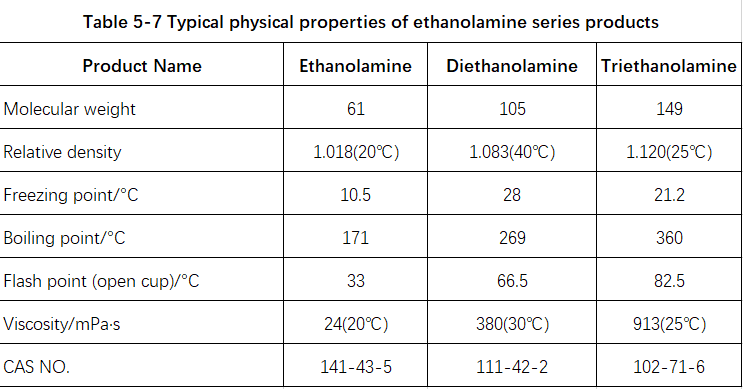
Compounds containing both hydroxyl and primary amino (or secondary amino) groups, and polyols containing tertiary nitrogen atoms, can all be used as polyurethane crosslinkers. The tertiary amino group also has a certain catalytic effect on the reaction between isocyanates and polyols. Commonly used alkanolamine crosslinkers include diethanolamine, triethanolamine, ethanolamine, and bis-2-(hydroxypropyl)aniline. Table 5-7 shows the typical physical properties of ethanolamine series products.
Triethanolamine, diethanolamine, and other amine compounds are commonly used crosslinkers in high-resilience foam and semi-rigid foam systems.
Air Products’ Dabco DEOA-LF is a crosslinker used in polyurethane foams, with a base composition of 85% diethanolamine and 15% water. The company’s Dabco 2035 is a “hardening additive” for low-density flexible foams, with a hydroxyl value of 620 mg KOH/g, a pH of 9.8, a viscosity of 650 mPa·s, and a relative density of 1.10. It can increase the hardness of polyether-type polyurethane flexible block foams by 20%–30%, and is suitable for liquid CO2 foaming technology.
Low-viscosity polyols with molecular weights in the hundreds, obtained by polymerizing ethylene oxide with small-molecule alkanolamines as initiators, can be used in RIM semi-rigid foam formulations.
Tertiary amine ether polyols containing benzene rings, with hydroxyl values in the range of 250–500 mg KOH/g, prepared from toluene diamine, aniline, and ethylene oxide or propylene oxide, are mainly used in RIM microporous elastomers, semi-rigid foams, high-resilience foams, and low-density temperature-resistant flame-retardant rigid foams. For example, polyoxyethylene aniline ether diol is prepared by the addition reaction of aniline and ethylene oxide in the presence of a catalyst. When the molar ratio of ethylene oxide to aniline is 6–7, a product with a hydroxyl value of approximately 315 mg KOH/g and a viscosity lower than 500 mPa·s is obtained. A special diol containing a tertiary amine and a benzene ring, synthesized from one aniline molecule and two olefin oxide molecules, is described in detail in Section 5.2.4, “Alcoholamine Diols and Polyols”.
The adduct of propylene oxide and ethylenediamine with a molar ratio of 4 is N,N,N’,N’-tetrakis(2-hydroxypropyl)ethylenediamine. BASF’s Quadrol, Arch Chemicals’ Poly Q40-770, and Air Products’ Dabco CL-485 are examples of this tertiary amine ether tetrol, with a molecular formula of C14H32N2O4, a nominal molecular weight of 292, a typical hydroxyl value of 770 mg KOH/g, a density (25℃) of 1.035 g/mL, a typical viscosity (25℃) of 50–52 Pa·s, and a water content of ≤0.1%.
Low molecular weight polyoxypropylene tetrols initiated with ethylenediamine can yield products of various molecular weights depending on the molar ratio of propylene oxide to ethylenediamine. These tertiary amine polyether tetrols are used as crosslinking agents for rigid and semi-rigid polyurethane foams and polyurethane coatings.
Arch Chemicals’ Poly Q40-800 is also a nitrogen-containing polyether tetrol, with a nominal molecular weight of 278, a typical hydroxyl value of 800 mg KOH/g, a density (25℃) of 1.055 g/mL, and a typical viscosity (25℃) of 17 Pa·s. The company also offers a highly reactive polyether triol, Poly G70-600, which can be used as a chain extender, with a nominal molecular weight of 280, a typical hydroxyl value of 595 mg KOH/g, a relative density (25℃) of 1.129, a typical viscosity (25℃) of 280 mPa·s, and a water content of ≤0.1%.
A highly reactive polyether triol with a molecular weight of approximately 265, prepared from triethanolamine and ethylene oxide, is mainly used as a crosslinking agent for rigid, semi-rigid, and high-resilience polyurethane foams. When selecting crosslinking agents and chain extenders, it is necessary to consider the requirements of the final product in terms of performance, processing, and cost.
CATEGORIES
LATEST NEWS
- Diethanolamine
- Triethanolamine
- Methyl Glucoside
- Mannitol
- Sorbitol
- Xylitol
- Pentaerythritol
- Trihydroxyethyl isocyanurate
- Trimethylolethane
- Glycerin
CONTACT US
Tel:+8618688691634
Email:sam@1688pu.com
Add:No. 91 Central East Rd, Luxi village, Gaobu town, Dongguan city, Guangdong Province, China