Amine Chain Extenders and Crosslinkers
Common diamine chain extenders and curing agents include aromatic diamines such as MOCA and DETDA, as well as aliphatic secondary amines and aliphatic secondary amines containing aromatic rings. Aliphatic primary diamines are too reactive and are generally not used as crosslinkers in aromatic isocyanate systems, only being used in small amounts in spray polyurea. Secondary amine chain extenders have lower reactivity and can be used in a variety of polyurethane materials, such as fine-tuning the reactivity of spray systems, controlling surface appearance, and improving physical properties.
DETDA and DMTDA are liquid hindered aromatic diamines, developed by Ethyl Corporation in the 1980s, under the brand names Ethacure 100 and Ethacure 300, respectively. These brands were later acquired by Albemarle Corporation. Both are liquid aromatic diamines, with DETDA reacting several times faster with NCO than DMTDA, and about 30 times faster than MOCA. In the polyurethane field, DETDA is mainly used in RIM processes; DMTDA can be used in castable polyurethane elastomers, etc. These two chain extenders are also used in spray polyurethane-urea systems.
Unilink diamine chain extenders are relatively well-known curing agents for polyurethane prepolymers. Unilink and Clearlink brand diamine chain extenders were developed by UOP Corporation and have been transferred to Dorf Ketal in India.
These diamine curing agents are secondary amine compounds. Unilink 4100 and Unilink 4200 will be described in detail in the “Aromatic Diamines” section. The characteristics and applications of other diamines are briefly introduced below.
Unilink 4102 has similar properties to Unilink 4100, but its curing rate is slower than Unilink 4100. Unilink 4230 is a mixture of a special diamine chain extender and the crosslinker tetra(2-hydroxypropyl)ethylenediamine. It has a viscosity (16℃) of 4000 mPa.s and an apparent hydroxyl value (amine value) of 432 mg KOH/g. It is recommended for TDI-based polyurethane CASE materials, offering a longer pot life and producing a softer cured product compared to MOCA-cured materials, resulting in elastomers with a hardness below Shore A60. Unilink 7100 is 1,4-bis(sec-heptylamino)benzene, with a similar structural formula to Unilink 4100. It is a brown liquid and can be used in various polyurethane products, offering a longer pot life. This product is currently unavailable.
Clearlink 1000 is 4,4′-bis(sec-butylamino)dicyclohexylmethane. It is a colorless liquid with low viscosity and a pour point of -42℃. It exhibits low moisture sensitivity and good compatibility with other polyurethane raw materials. It has low reactivity and is generally used with aliphatic isocyanates to formulate non-yellowing polyurethane ureas. Light-stable polyurethane and polyurea coatings can be obtained using conventional spraying techniques.
Clearlink 3000 is 3,3′-dimethyl-4,4′-bis(sec-butylamino)dicyclohexylmethane. It is a colorless liquid with low viscosity and a pour point of -30℃. It exhibits low moisture sensitivity and good compatibility with other polyurethane raw materials. Its reactivity is significantly lower than that of Clearlink 1000. It is mainly used in combination with aliphatic isocyanates to formulate light-stable polymers. Huntsman Corporation produces special aliphatic amines used as chain extenders for polyurethanes. Jefflink 754 is a cycloaliphatic secondary diamine (N,N’-bis(sec-pentyl)cyclohexane-1,4-diamine, CAS No. 156105-38-3), with a total amine content of 7.55–8.10 mmol/g (typical value 7.8 mmol/g), and a primary amine content of approximately 0.1 mmol/g. It is a low-viscosity, colorless, transparent liquid at room temperature, with a density (25℃) of 0.855 g/ml, a viscosity (25℃) of 13 mPa·s, a flash point of 104℃, and a solubility in water at 20℃ of 4.1 g/L. It has good compatibility with polyoxyalkylene amines, is insensitive to moisture, and has a low molecular weight. It is used as a chain extender in amine-curing systems requiring slower reaction rates, such as in light-stable aliphatic urea systems.
In addition, Huntsman previously introduced Jefflink 555 chain extender, which is a mixture of aliphatic amines with a total amine content of 7.5–8.2 mmol/g and containing hydroxyl groups. It is mainly used in fast-curing caulking polyurea elastomers and can be used in combination with amine-terminated polyethers for spray polyurea applications to reduce the curing rate. Jefflink 7027 is a low-viscosity, sterically hindered aliphatic amine mixture with a total amine content of approximately 4.4 mmol/g, containing a small amount of primary amine (0.54 mmol/g). It is used in aliphatic or aromatic polyurea systems, which can be used in industrial coatings, sealants, and encapsulants.
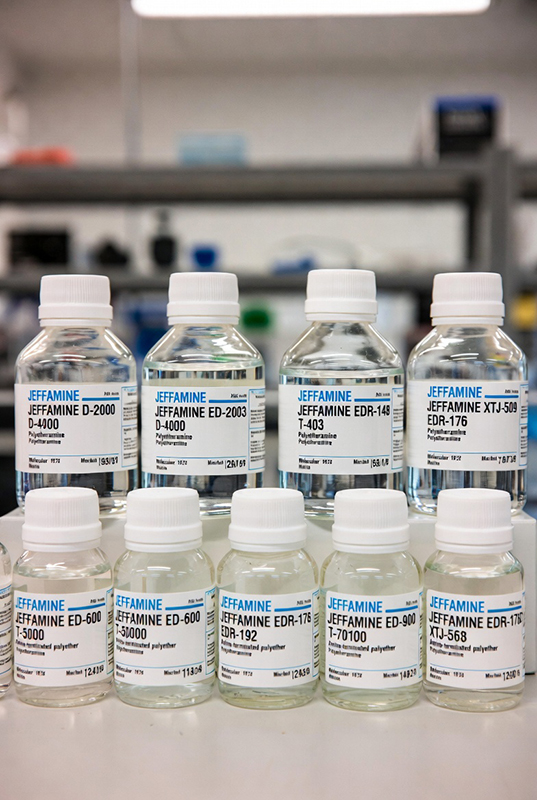
Huntsman’s low-molecular-weight primary or secondary amine-terminated polyethers include Jeffamine D-230, D-400, SD-231, SD-401, ST-404, T-403, and XTJ-582, XTJ-578, etc. Specific technical specifications can be found in Section 4.4 “Amine-Terminated Polyethers”. Some very low molecular weight diamine ether products can be used as chain extenders, see Table 5-4. These aliphatic primary diamines are colorless to light yellow, slightly turbid liquids with high reactivity. They are generally used as curing agents for epoxy resins and can also be used as chain extenders in special polyurethane-urea systems.
Jeffamine EDR-104 is 2,2′-oxybis(ethylamine), CAS number 2752-17-2. DR-148 (XTJ-504) is ethylene glycol bis(2-aminoethyl ether) (aminated triethylene glycol), CAS number 929-59-9. EDR-176 (XTJ-590) is diethylene glycol bis(3-aminopropyl) ether.
Jeffamine HK-511 is diethylene glycol bis(2-aminopropyl) ether, CAS number 194673-87-5, with a primary amine content of approximately 8.2 mmol/g. Its structural formula is as follows. The amino group is adjacent to a methyl group, making the reactivity of the amino group milder than that of the EDR series, and it can be used for chain extension in polyurethane CASE materials.

Diethylene glycol bis(3-aminopropyl) ether has a similar chemical structure to Jeffamine HK-511 and EDR-176, but without the steric hindrance of the adjacent methyl group. Its CAS number is 4246-51-9, molecular formula C10H24N2O3, and molecular weight is 220.3.
Bayer’s Hardener DT is a substituted aromatic diamine with a molecular weight of approximately 180. Its viscosity is (200±40) mPa·s. The amine value is (630±10) mg KOH/g, flash point >130℃, density (20℃) is approximately 1.02 g/mL, and moisture content <0.1%. It is mainly used in solvent-free polyurethane coatings, offering high flexibility, and can be used in concrete crack repair sealants, sprayable polyurethane elastomers, and one-component thixotropic coatings. German Performance Chemicals Handels GmbH produces a variety of diamine chain extenders (curing agents) that can be used in polyurethane and polyurea systems.
Air Products’ Versalink series of amine-terminated polyethers are crosslinking agents (curing agents) developed for room-temperature curing polyurethane elastomers, forming elastomer systems with TDI prepolymers or MDI prepolymers.
The Versalink P series is polytetrahydrofuran di-p-aminobenzoate. Versalink 740M is 1,3-propanediol di-p-aminobenzoate. The company’s Versalink MCDEA is 4,4′-methylenebis(3-chloro-2,6-diethylaniline).
Vestamin A139 is a blocked cycloaliphatic diamine produced by Evonik Degussa of Germany. It is a transparent liquid with a purity of ≥96%, APHA color ≤150, and amine value of (400±10) mg KOH/g. Its typical properties are: density (25℃) 0.86 g/cm³, viscosity (23℃) 20–30 mPa·s, amine equivalent weight approximately 140, flash point 77℃, and ignition temperature 240℃. This product is a blocked curing agent for NCO-terminated prepolymers; in its supplied form, it has very low reactivity with isocyanate groups. In the presence of moisture, the original diamine is released and immediately reacts with the isocyanate groups.
PREVIOUS:Alcohol-Based Chain Extenders and Crosslinkers
NEXT:Alkanolamine and Nitrogen-Containing Polyol Crosslinkers
CATEGORIES
LATEST NEWS
- Diethanolamine
- Triethanolamine
- Methyl Glucoside
- Mannitol
- Sorbitol
- Xylitol
- Pentaerythritol
- Trihydroxyethyl isocyanurate
- Trimethylolethane
- Glycerin
CONTACT US
Tel:+8618688691634
Email:sam@1688pu.com
Add:No. 91 Central East Rd, Luxi village, Gaobu town, Dongguan city, Guangdong Province, China