Dicyclohexylmethane Diisocyanate
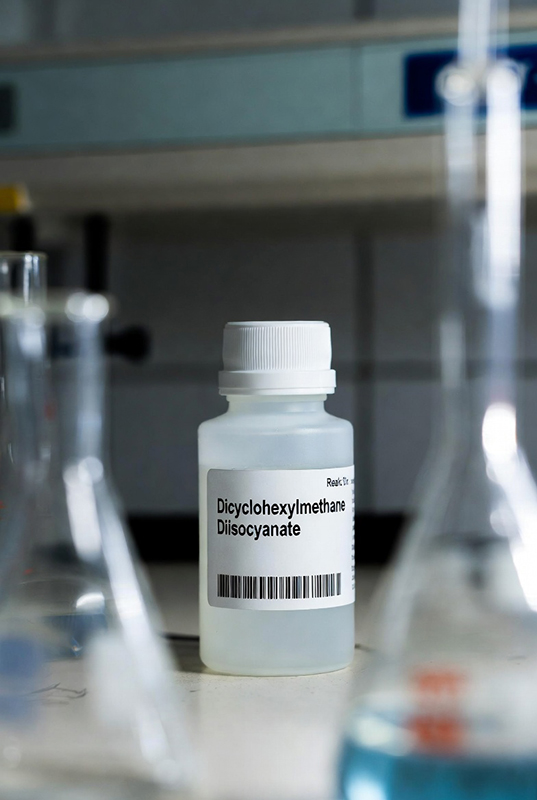
Abbreviations: HMDI, H12MDI, DMDI, Hydrogenated MDI
Chemical Name: 4,4′-Dicyclohexylmethane diisocyanate

Physical and Chemical Properties
At room temperature, it is a colorless to light yellow liquid with a pungent odor. It is insoluble in water but soluble in organic solvents such as acetone. It is sensitive to moisture and reacts with compounds containing active hydrogen. It may crystallize at temperatures below 25°C. The physical properties and quality indicators of HMDI are shown in Table 1-18.
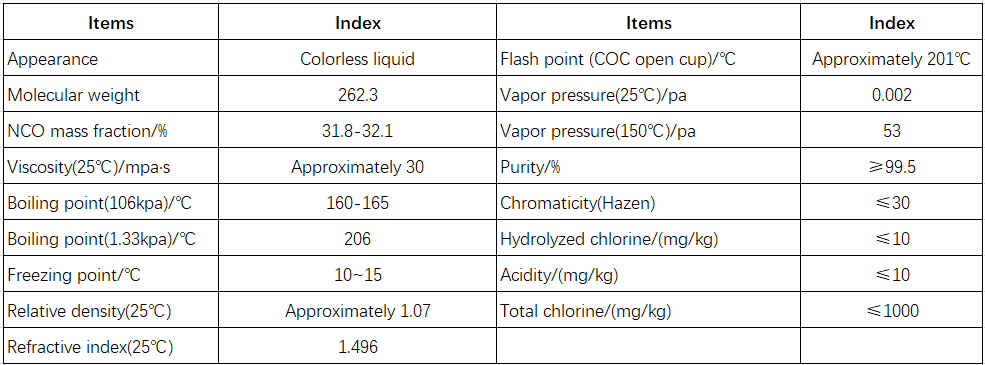
Note: Product specifications are mainly based on the specifications of Bayer’s Desmodur W.
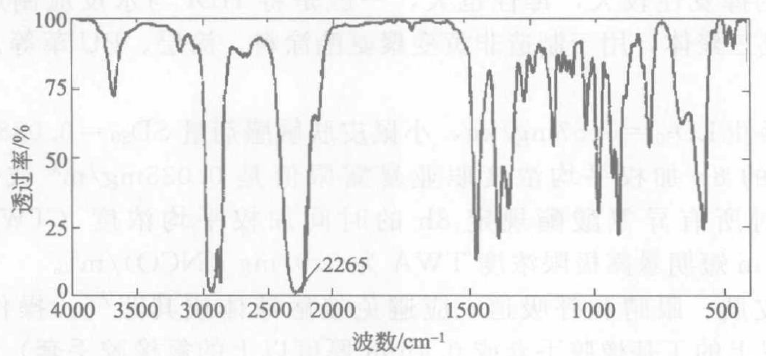
The infrared spectrum of HMDI is shown in Figure 1-5.
Characteristics and Uses
Toxicity and Protection
HMDI is similar in chemical structure to 4,4′-diphenylmethane diisocyanate, with a cyclohexyl six-membered ring replacing the benzene ring, belonging to the alicyclic diisocyanate group. It can be used to produce non-yellowing polyurethane products, suitable for the production of polyurethane materials with excellent light stability, weather resistance, and mechanical properties. It is particularly suitable for the production of polyurethane elastomers, water-based polyurethanes, fabric coatings, and radiation-curing polyurethane-acrylate coatings. In addition to excellent mechanical properties, IPDI also imparts outstanding hydrolysis resistance and chemical resistance to the products.
This diisocyanate has a higher vapor pressure than MDI and is irritating; protective equipment should be worn. The National Institute for Occupational Safety and Health (NIOSH) in the United States has established a recommended workplace exposure limit of 0.01 ppm (equivalent to 0.11 mg/m³); the American Conference of Governmental Industrial Hygienists (ACGIH) has set a minimum limit for HMDI under an 8-hour workday of 0.005 ppm (0.054 mg/m³); the German occupational exposure limit is 0.054 mg/m³ (8-hour workday average); and in the UK, for all isocyanates, expressed as NCO, the 8-hour TWA permissible concentration is 0.02 mg/m³ or a 10-minute short-term TWA of 0.07 mg/m³.
PREVIOUS:Hexamethylene Diisocyanate
CATEGORIES
LATEST NEWS
- Diethanolamine
- Triethanolamine
- Methyl Glucoside
- Mannitol
- Sorbitol
- Xylitol
- Pentaerythritol
- Trihydroxyethyl isocyanurate
- Trimethylolethane
- Glycerin
CONTACT US
Tel:+8618688691634
Email:sam@1688pu.com
Add:No. 91 Central East Rd, Luxi village, Gaobu town, Dongguan city, Guangdong Province, China