Diethanolamine
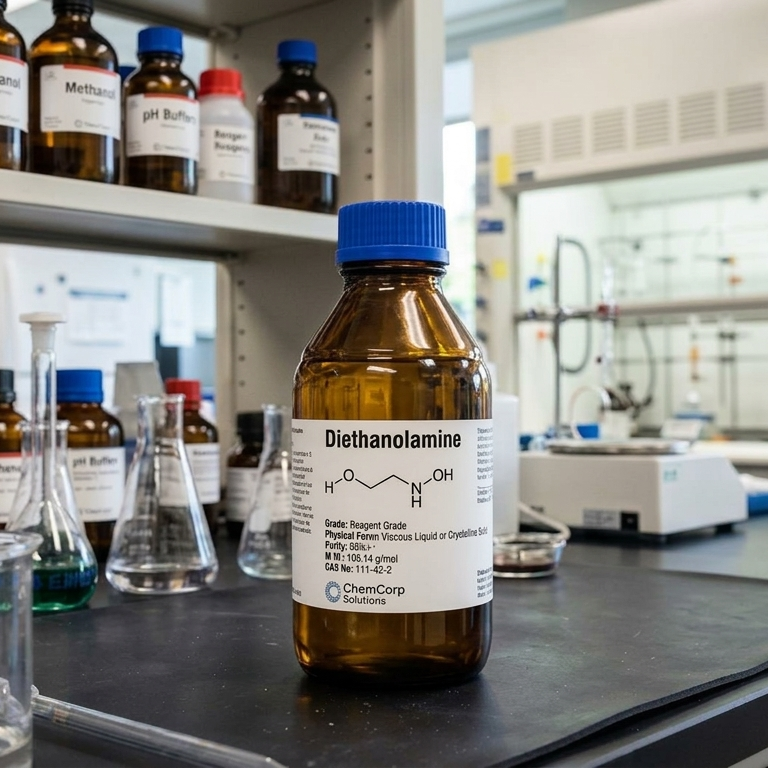
Abbreviation: DEOA, DEA.
Synonyms: 2,2′-Hydroxydiethylamine, Dihydroxyethylamine.
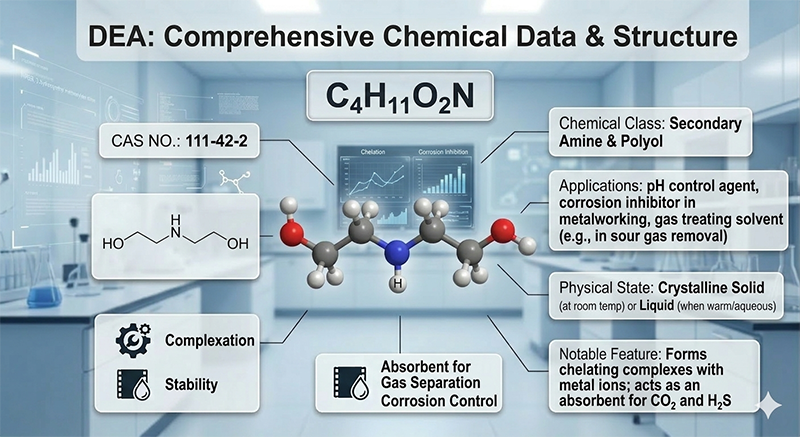
Molecular Formula: C₄H₁₁O₂N
Molecular Weight: 105.15
CAS No.: 111-42-2
Structural Formula:
Physicochemical Properties:
A colorless to pale yellow viscous liquid or a white crystalline solid, with a faint ammonia-like odor. Melting point: 28°C; Boiling point: 267–269°C (decomposes) or 138°C (at 5 × 133 Pa). Relative density (30°C): 1.08–1.09; Refractive index: 1.477; Flash point: 146°C; Vapor pressure (20°C): <1.3 Pa. It is hygroscopic. Easily soluble in water and ethanol. The pH of a 0.1 mol/L aqueous solution is approximately 11. It can corrode copper, aluminum, and their alloys.
Acute oral toxicity data for rats: LD₅₀ = 710 mg/kg. The liquid and vapor are corrosive to the skin and eyes.
The product specifications for Diethanolamine from Huntsman Corporation (USA) and Fushun Northern Chemical Co., Ltd. are as follows: Color (Pt-Co) ≤ 20; Diethanolamine content ≥ 99.0%; Monoethanolamine ≤ 0.5%; Triethanolamine ≤ 0.5%; Moisture ≤ 0.15%. Amine equivalent: 104.0–106.0.
Aqueous solutions of Diethanolamine with purities ranging from 80% to 95% are also available on the market. For example, Dabco DEOA-LF from Air Products (USA) consists of 85% Diethanolamine and 15% water; its vapor pressure (21°C) is 466.62 Pa, boiling point is 129°C, and relative density is 1.09.
Characteristics and Applications:
Diethanolamine is an important raw material for organic synthesis. It is used, for instance, in the production of surfactants for textiles; as an intermediate for pharmaceuticals, pesticides, and herbicides; in the synthesis of cosmetics; and as a petroleum demulsifier. It also serves as an acidic gas absorbent, a corrosion inhibitor, and for other applications. In the polyurethane industry, it serves as a crosslinking agent for the production of high-resilience and semi-rigid polyurethane foams, and can also be utilized as an initiator for polyether polyols. Due to the presence of secondary amine groups, it exerts a certain catalytic effect on polyurethane reactions; furthermore, within polyurethane foam formulations, it can neutralize acidic components and protect the primary catalyst.
PREVIOUS:Triethanolamine
CATEGORIES
LATEST NEWS
- Diethanolamine
- Triethanolamine
- Methyl Glucoside
- Mannitol
- Sorbitol
- Xylitol
- Pentaerythritol
- Trihydroxyethyl isocyanurate
- Trimethylolethane
- Glycerin
CONTACT US
Tel:+8618688691634
Email:sam@1688pu.com
Add:No. 91 Central East Rd, Luxi village, Gaobu town, Dongguan city, Guangdong Province, China