Dimethylbiphenyl Diisocyanate
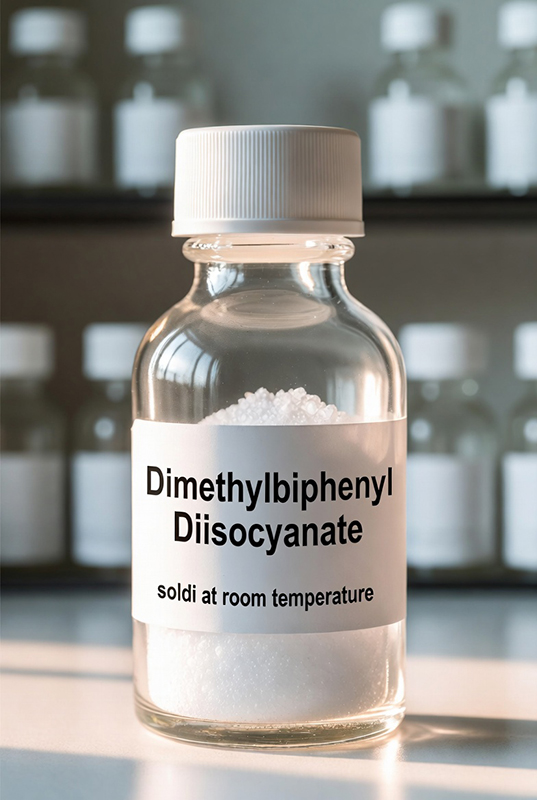
Abbreviation:TODI
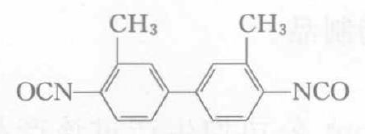
Chemical Name: 3,3′-Dimethyl-4,4′-biphenyl diisocyanate
Synonyms:o-Tolidine diisocyanate, Dimethylbiphenyl diisocyanate, etc.
Molecular Formula: C16H12N2O2
Molecular Weight: 264.28
CAS Number: 91-97-4
EINECS Number:202-112-7
Structural Formula:
Physical and Chemical Properties
At room temperature, it is a white solid granule with a purity of over 99.0%. Melting point is 70–72°C, boiling point (667 Pa) is 195–197°C, relative density (80°C) is 1.197, and flash point (COC open cup) is 218°C. It is insoluble in water and reacts slowly with water. Soluble in acetone, carbon tetrachloride, kerosene, benzene, chlorobenzene, etc. NCO content is approximately 31.8%.
Characteristics and Uses
The TODI molecule has a symmetrical structure with two benzene rings. Due to the steric hindrance effect of the ortho-methyl groups, its reactivity is lower than that of TDI and MDI. Polyurethane elastomers prepared from TODI, oligomeric polyols, and MOCA have similar physical properties to NDI elastomers, such as excellent heat resistance, hydrolysis resistance, and mechanical properties. Prepolymers made from TODI can be stored stably for a certain period, and due to their longer pot life (working time), they are easier to handle than NDI-type elastomer systems.
TODI can be used in many fields, including: seals (oil seals, piston rings, water seals, etc.), automotive parts (grilles, shock absorbers, roofs, doors, windows, etc.), industrial conveyor belts, rollers and casters, coatings for the electronics industry, and medical devices (artificial organs, etc.).
PREVIOUS:Norbornane Diisocyanate
CATEGORIES
LATEST NEWS
- Diethanolamine
- Triethanolamine
- Methyl Glucoside
- Mannitol
- Sorbitol
- Xylitol
- Pentaerythritol
- Trihydroxyethyl isocyanurate
- Trimethylolethane
- Glycerin
CONTACT US
Tel:+8618688691634
Email:sam@1688pu.com
Add:No. 91 Central East Rd, Luxi village, Gaobu town, Dongguan city, Guangdong Province, China