Hexamethylene Diisocyanate
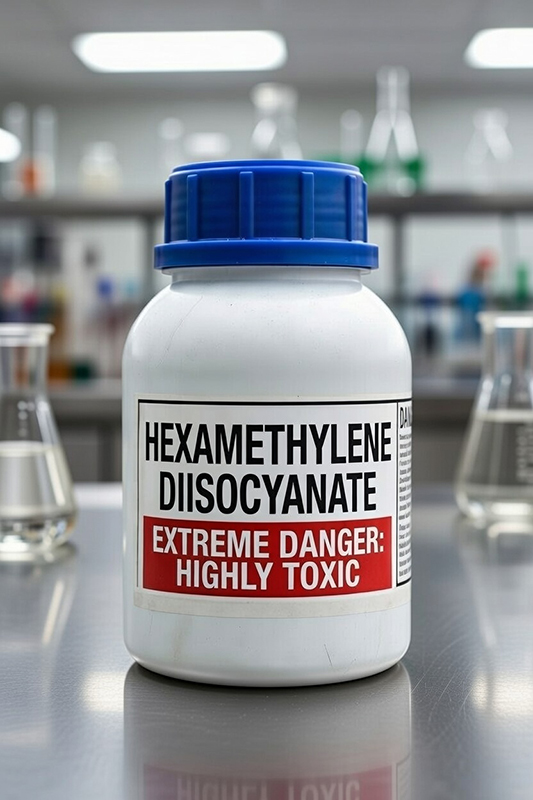
Abbreviation: HDI
Names: 1,6-hexamethylene diisocyanate; 1,6-diisocyanatohexane; isocyanic acid, hexamethylene ester; hexane 1,6-diisocyanate; 1,6-hexylene diisocyanate; hexamethylene-1,6-diisocyanate, etc.
Molecular formula: C8H12N2O2, Molecular weight: 168.19.
CAS number: 822-06-0, EINECS number: 212-485-8.
Structural formula: OCN—CH2CH2CH2CH2CH2CH2—NCO
Physical and Chemical Properties
A colorless or slightly yellowish liquid with a pungent odor. Slightly soluble in water, reacting slowly in water. Relative density at room temperature is approximately 1.05, boiling point is approximately 255–261℃, melting point (freezing point) is -67–-55℃. Saturated vapor concentrations at 20℃ and 30℃ are 46 mg/m3 and 137 mg/m3, respectively.
Typical physical properties and quality indicators of HDI products are shown in Table 1-17.
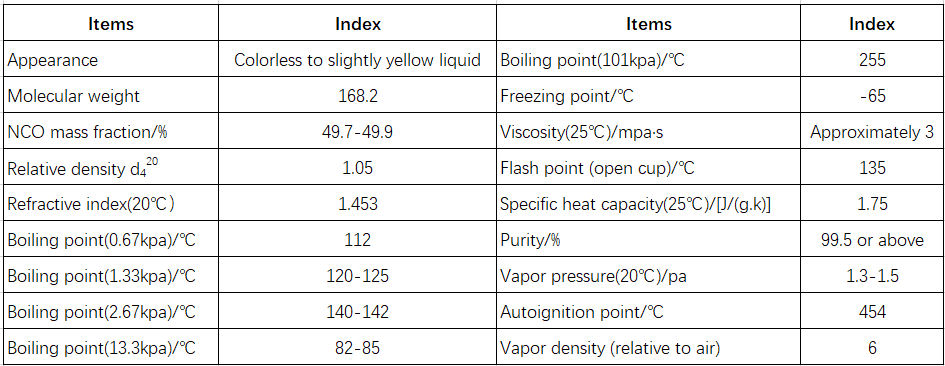
Regarding the vapor pressure of HDI, different sources provide varying data. Perstorp’s HDI product specifications state that the vapor pressure of HDI at 20℃ and 30℃ is 0.22 Pa and 0.72 Pa, respectively. Bayer’s Desmodur H product specifications state that it is 1.4 Pa at 25℃. Some sources state that the vapor pressure at 25℃ is 6.7 Pa (or 0.05 mmHg), and the vapor pressure at 20℃ is 1.3–1.5 Pa. According to Asahi Kasei’s data, the vapor pressure of HDI at 25℃ is 1.65 Pa.
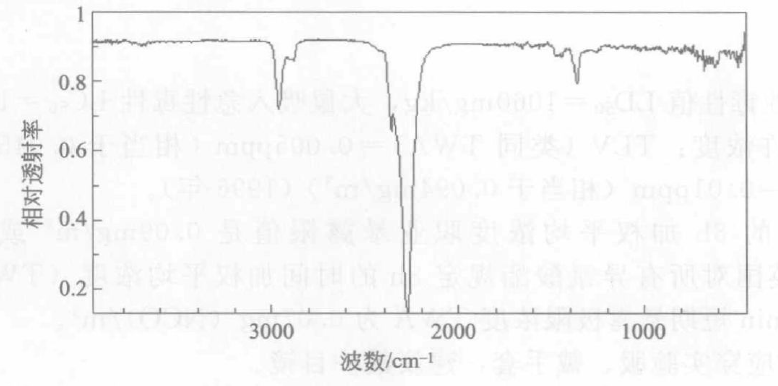
The infrared spectrum of HDI is shown in Figure 1-4.
Characteristics and Uses
HDI is an aliphatic polyisocyanate, and the resulting polyurethane products have the characteristic of not yellowing. Its reactivity is lower than that of aromatic diisocyanates. Because HDI does not contain an aromatic ring, the hardness and strength of the polyurethane elastomer are not very high, but it has good flexibility. HDI (Hexamethylene Diisocyanate) is highly volatile and toxic. It is typically reacted with water to form biuret diisocyanate, or catalytically polymerized to form a trimer, which is used in the manufacture of non-yellowing polyurethane coatings, paints, and PU leather.
Toxicity and Protection
The acute dermal toxicity LD50 in rabbits is 0.57 mg/kg, and the skin sensitization dose SD50 in mice is 0.088 mg/kg. In Germany, the occupational exposure limit for HDI is 0.035 mg/m³ or equivalent to 0.005 mL/m³ (ppm) as an 8-hour time-weighted average concentration. In the UK, the 8-hour time-weighted average concentration (TWA) for all isocyanates is specified as 0.02 mg/m³ (calculated as NCO), and the 10-minute short-term exposure limit TWA is 0.07 mg(NCO)/m³.
HDI can irritate the skin, eyes, and respiratory tract. Contact with the liquid or its vapors should be avoided. Protective gloves (butyl rubber gloves with a thickness of 0.5 mm or more, or fluororubber gloves with a thickness of 0.4 mm or more) and safety goggles should be worn during handling. If HDI splashes into the eyes, rinse immediately with tap water or a special eyewash solution and seek medical attention as soon as possible. If it comes into contact with the skin, immediately wash with plenty of soap and water, or wipe with an aqueous solution of polyethylene glycol.
PREVIOUS:Isophorone Diisocyanate
CATEGORIES
LATEST NEWS
- Diethanolamine
- Triethanolamine
- Methyl Glucoside
- Mannitol
- Sorbitol
- Xylitol
- Pentaerythritol
- Trihydroxyethyl isocyanurate
- Trimethylolethane
- Glycerin
CONTACT US
Tel:+8618688691634
Email:sam@1688pu.com
Add:No. 91 Central East Rd, Luxi village, Gaobu town, Dongguan city, Guangdong Province, China