High Functionality Polyether Polyols
Polyethers with a functionality greater than 4 are called high-functionality polyethers. A few high-functionality polyether polyols are manufactured using single polyhydroxyl initiators such as xylitol, sorbitol, and sucrose. High-functionality polyether polyols have very high viscosity and poor miscibility with other components. To reduce the viscosity of the polyether, industrial preparation usually employs a mixture of high-functionality and low-functionality polyol (amine) initiators, such as sorbitol-glycerol, sorbitol-propylene glycol, sucrose-glycerol, and sucrose-toluene diamine mixed initiators. By adjusting the amount of each initiator, or by using a small amount of EO and PO copolymerization, various polyether polyols with different viscosities and compositions can be synthesized. The resulting polyether polyols have a functionality between 3 and 8, with the actual functionality mostly between 3 and 6. Most high-functionality polyether polyols have a molecular weight between 300 and 600.
Polyether pentol can be prepared by ring-opening polymerization of propylene oxide using diethylenetriamine or xylitol as an initiator.
Hexahydroxy polyethers can be obtained using sorbitol or mannitol as initiators.
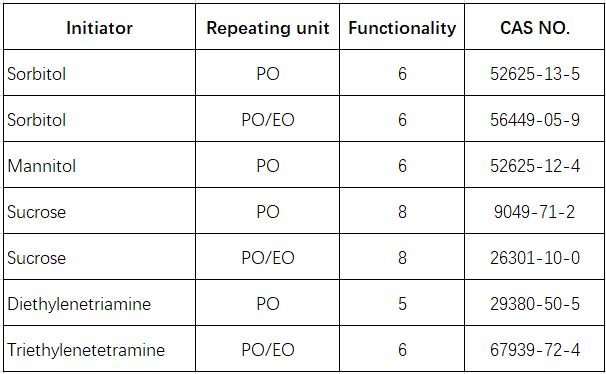
The CAS numbers of high-functionality polyether polyols with different compositions are as follows:
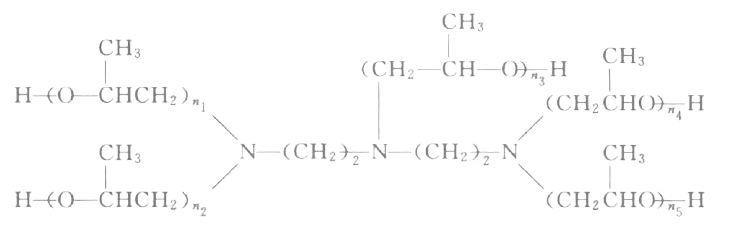
The structural formula of diethylenetriamine polyether is as follows:
The structural formula of xylitol polyether is as follows:
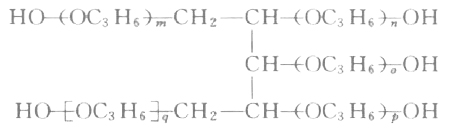
In the formula, m, n, o, p, and q represent the degree of polymerization.
Physicochemical Properties, Preparation, and Uses
A light yellow to light brown viscous liquid, used as a basic raw material for rigid foams. Its characteristics are that the resulting rigid polyurethane foam has good high-temperature resistance and good dimensional stability.
Most high-functionality polyether polyol products are used to prepare rigid polyether-type polyurethane foams, such as ordinary rigid foams, wood-like materials, rigid foam sandwich panels, and refrigerator insulation materials.
(1) Polyether pentol prepared with diethylenetriamine as an initiator is a transparent, highly viscous liquid. For example, a polyether pentaol with an average molecular weight of 398 and a hydroxyl value of 648 mg KOH/g has a viscosity of approximately 100 Pa·s (at 30°C), a color (APHA) of less than 200, and a water content of less than 0.1%. Because this polyether structure contains tertiary amino groups, it can be used as a catalytic crosslinking agent for rigid and semi-rigid foams. When mixed with low-functionality polyethers such as triols or tetraols, it can produce rigid foams with good dimensional stability and high compressive strength, and is particularly suitable for in-situ spray foaming formulations.
(2) The preparation conditions for xylitol polyoxypropylene pentaol are similar to those for glycerol polyoxypropylene. Due to the strong hygroscopicity of xylitol, further dehydration under reduced pressure is necessary before polyether synthesis; otherwise, the quality of the polyether will be severely affected. By polymerizing 100 parts by weight of propylene oxide and 40-42 parts by weight of xylitol under the catalysis of 0.5 parts by weight of potassium hydroxide at 100-110°C, a xylitol polyoxypropylene pentaol can be obtained with a hydroxyl value of (500±20) mg KOH/g, an average molecular weight of 550±50, an acid value of less than 0.15 mg KOH/g, and a water content of less than 0.1%. This polyether polyol is a light yellow viscous liquid. Xylitol polyoxypropylene pentaol is mainly used as a basic raw material for rigid foams. Its characteristic is that the resulting rigid polyurethane foam has good high-temperature resistance (150°C) and good dimensional stability.
Rigid foams made from polyether pentaols have higher temperature resistance and dimensional stability than rigid foams based on polyether triols and polyether tetraols.
(3) Using sorbitol or mannitol as an initiator, propylene oxide is introduced into a reaction vessel and polymerized under pressure at 100-110°C with a KOH catalyst to obtain a polyether hexaol. Because this type of polyether contains six hydroxyl groups and has a high functionality, the resulting rigid polyurethane foam has a high degree of crosslinking, and the product has good oil resistance, heat oxidation resistance, and dimensional stability. High-quality mannitol polyether can be used to produce rigid polyurethane foam that can withstand temperatures up to 180°C.
Sorbitol polyoxypropylene hexanol with hydroxyl values of 654 mg KOH/g and 488 mg KOH/g (average theoretical molecular weights of 514 and 691, respectively) have viscosities of 134 Pa·s and 131 Pa·s, APHA color values of 240 and 200, water content of 0.02%, and unsaturation of 0.02 mmol/g.
Due to its high functionality and high viscosity, hexahydroxy polyether has poor compatibility with other foaming components (isocyanates, blowing agents, catalysts, etc.), which causes significant difficulties in foaming applications. Polyethers are generally prepared from sorbitol or mannitol mixed with diol or triol initiators.
(4) If sucrose is used as the sole initiator for the ring-opening polymerization of propylene oxide, an octafunctional sucrose polyether is obtained. This is a high-viscosity, light brown liquid. The resulting rigid polyurethane foam exhibits good heat resistance, high compressive strength, and dimensional stability. However, in the preparation of octahydroxy sucrose polyether, since sucrose is crystalline and incompatible with propylene oxide, and pure sucrose polyether has high functionality and high viscosity, resulting in poor compatibility with other foaming components, mixed initiators are generally used in practical polymerization. For example, glycerol or other low-functionality polyhydroxy compounds are mixed with sucrose as initiators. Sucrose-glycerol polyether is actually a blend of octahydroxy and trihydroxy polyoxypropylene. The amount of glycerol in the mixed initiator significantly affects the physical properties of the rigid polyurethane foam. To obtain rigid foam with good dimensional stability and high heat resistance, the molar ratio of glycerol to sucrose is generally controlled at 0.5 when preparing sucrose-glycerol polyether polyol. Sucrose-containing polyether polyols can be collectively referred to as “sucrose polyether polyols.” Examples of polyoxypropylene polyols using sucrose as an initiator include grade 8010. Polyether polyols synthesized using sucrose and diols such as diethylene glycol or propylene glycol as initiators include grades 4110 and 8205. Polyether polyols synthesized using a mixture of sucrose and glycerol as initiators include grades 835 and 8305.
PREVIOUS:Polyether Tetrol
NEXT:Polymer Polyol
CATEGORIES
LATEST NEWS
- Diethanolamine
- Triethanolamine
- Methyl Glucoside
- Mannitol
- Sorbitol
- Xylitol
- Pentaerythritol
- Trihydroxyethyl isocyanurate
- Trimethylolethane
- Glycerin
CONTACT US
Tel:+8618688691634
Email:sam@1688pu.com
Add:No. 91 Central East Rd, Luxi village, Gaobu town, Dongguan city, Guangdong Province, China