Hydroxyl-terminated Polybutadiene-Acrylonitrile
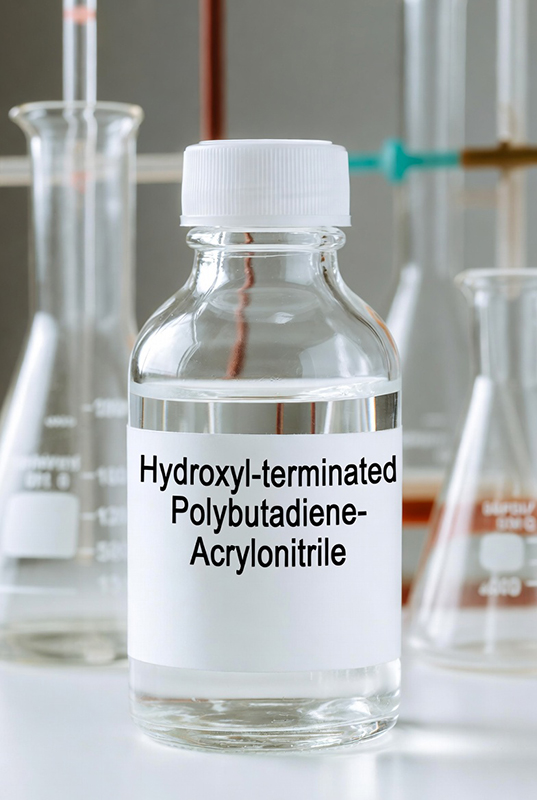
Abbreviation: HTBN
Alias: Polybutadiene-acrylonitrile copolymer diol, Hydroxyl-terminated butadiene-acrylonitrile liquid rubber.
The chemical structure of HTBN is as follows:

In the formula, the molar ratio of α/b is generally 0.85/0.15, and n = 55–65.
Physicochemical Properties
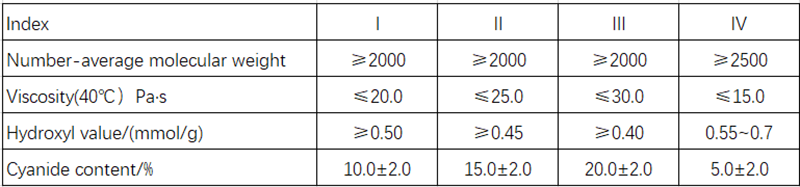
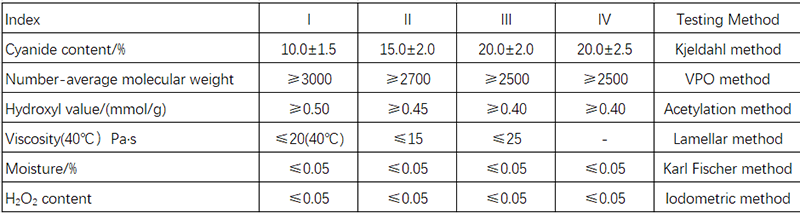
Hydroxyl-terminated polybutadiene-acrylonitrile is a light yellow transparent viscous liquid. Its viscosity, hydroxyl value, and other physical and quality indicators are shown in Tables 4-15 and 4-16.
Characteristics and Uses
Due to the presence of polar nitrile groups in the HTBN molecular chain, hydroxyl-terminated butadiene-acrylonitrile liquid rubber, in addition to the general characteristics of hydroxyl-terminated polybutadiene, also possesses excellent oil resistance, adhesion, aging resistance, and low-temperature performance.
HTBN can be used in the coating or insulation layer of solid rocket propellant grains, exhibiting good mechanical properties; HTBN can be used to produce polyurethane adhesives for bonding rubber, polyester, and metals. Its characteristics include solvent-free application and room-temperature curing; it can be used to manufacture corrosion-resistant coatings suitable for acidic environments; HTBN can replace hydroxyl-terminated butadiene-acrylonitrile as a toughening agent for epoxy resins, modifying epoxy resins and improving their aging resistance.
Hydroxyl-terminated butadiene-acrylonitrile liquid rubber is mainly used in the manufacture of polyurethane adhesives and sealants, and its products have excellent oil resistance, low-temperature resistance, and electrical insulation properties.
For the preparation of polyurethane elastomers using HTBN, diols are commonly used as chain extenders, and catalysts such as dibutyltin dilaurate and dibutyltin dioctoate can be used.
PREVIOUS:Hydroxyl-Terminated Epoxidized Polybutadiene Resin
NEXT:Polystyrene Polyols
CATEGORIES
LATEST NEWS
- Diethanolamine
- Triethanolamine
- Methyl Glucoside
- Mannitol
- Sorbitol
- Xylitol
- Pentaerythritol
- Trihydroxyethyl isocyanurate
- Trimethylolethane
- Glycerin
CONTACT US
Tel:+8618688691634
Email:sam@1688pu.com
Add:No. 91 Central East Rd, Luxi village, Gaobu town, Dongguan city, Guangdong Province, China