Isophorone Diisocyanate
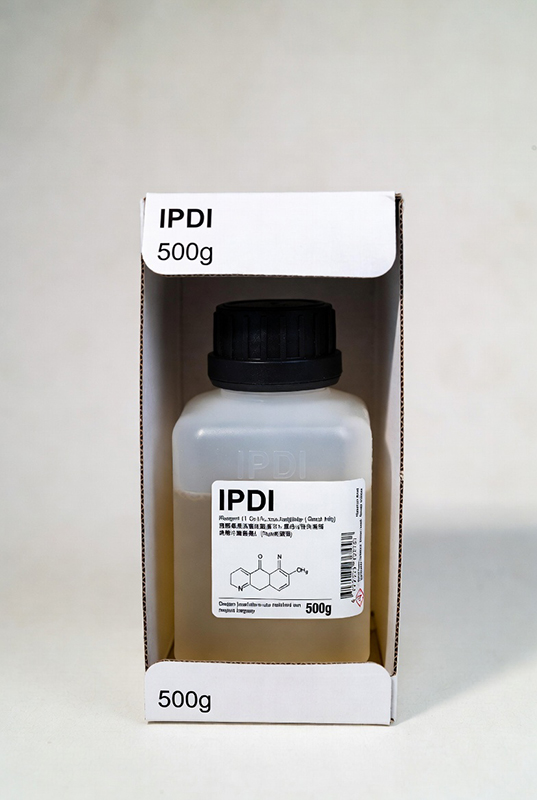
Abbreviation: IPDI.
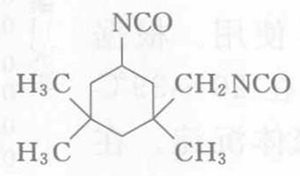
Chemical name: 3-Isocyanatomethyl-3,5,5-trimethylcyclohexyl isocyanate.
IPDI is a mixture containing 75% cis and 25% trans isomers.
Molecular formula: C12H18N2O2, molecular weight: 222.29. CAS number: 4098-71-9, EINECS number: 223-861-6.
Structural formula:
Physical and Chemical Properties
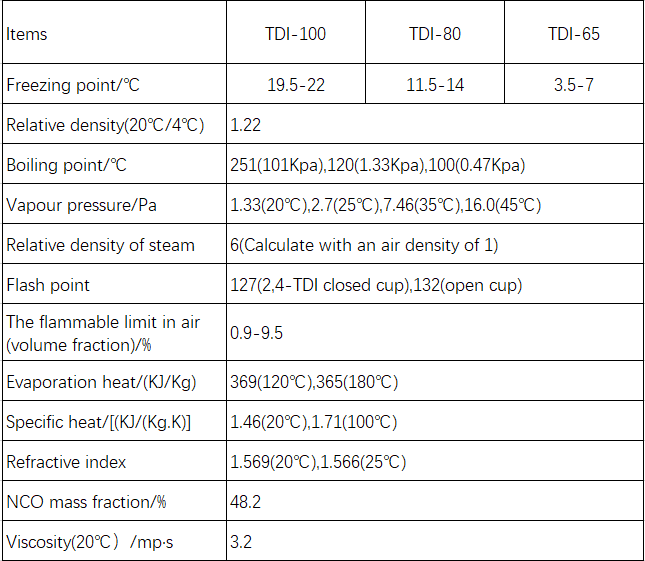
Colorless or light yellow liquid with a slight camphor-like odor, completely miscible with organic solvents such as esters, ketones, ethers, aromatic hydrocarbons, and aliphatic hydrocarbons. Typical physical properties of IPDI are shown in Table 1-16.
Table 1-16 Typical Physical Properties of Isophorone Diisocyanate
Product Grades and Performance Indicators
The IPDI product (brand name Vestanat IPDI) from Evonik Industries AG (formerly Degussa) has the following specifications: purity ≥99.5%, NCO content 37.5%-37.8%, hydrolyzable chlorine content ≤200 mg/kg, total chlorine ≤400 mg/kg, color (APHA) ≤30.
The IPDI product (brand name Desmodur I) from Bayer AG has the following specifications: purity ≥99.5%, NCO content ≥37.5%, color (Hazen) ≤30, hydrolyzable chlorine ≤200 mg/kg, total chlorine ≤400 mg/kg, viscosity (25℃) approximately 10 mPa·s.
The IPDI product from Perstorp AB (formerly owned by Rhodia, manufactured in France) has the following technical specifications: purity >99.5%, NCO content 37.5%-37.8%, hydrolyzable chlorine content <200 mg/kg, total chlorine <400 mg/kg, color (APHA) ≤30.
Properties and Applications
IPDI is an aliphatic isocyanate, specifically a cycloaliphatic isocyanate. Its reactivity is lower than that of aromatic isocyanates, and it also has a lower vapor pressure. The two NCO groups in the IPDI molecule have different reactivities because the primary NCO group is sterically hindered by the cyclohexane ring and the α-substituted methyl group. This makes the secondary NCO group attached to the cyclohexane ring 1.3 to 2.5 times more reactive than the primary NCO group.
Polyurethane resins made from IPDI have excellent light stability and chemical resistance. They are generally used in the manufacture of high-grade polyurethane resins such as light-resistant and weather-resistant polyurethane coatings and wear-resistant and hydrolysis-resistant polyurethane elastomers. They can also be used to manufacture non-yellowing microporous polyurethane foams.
Toxicity and Protection
The acute dermal toxicity value (LD50) for rats is 1060 mg/kg, and the acute inhalation toxicity (LC50) for rats is 123 mg/(m³.4h).
Occupational exposure limits: TLV (similar to TWA) = 0.005 ppm (equivalent to 0.045 mg/m³) (ACGIH 1998); MAK = 0.01 ppm (equivalent to 0.094 mg/m³) (1996).
In Germany, the 8-hour time-weighted average concentration occupational exposure limit for IPDI is 0.09 mg/m³ or equivalent to 0.01 mL/m³ (0.01 ppm). In the UK, the 8-hour time-weighted average concentration (TWA) for all isocyanates is specified as 0.02 mg/m³ (calculated as NCO), and the 10-minute short-term exposure limit TWA is 0.07 mg(NCO)/m³.
When using IPDI, wear laboratory coats and gloves, and eye protection is recommended.
PREVIOUS:Toluene Diisocyanate
CATEGORIES
LATEST NEWS
- Diethanolamine
- Triethanolamine
- Methyl Glucoside
- Mannitol
- Sorbitol
- Xylitol
- Pentaerythritol
- Trihydroxyethyl isocyanurate
- Trimethylolethane
- Glycerin
CONTACT US
Tel:+8618688691634
Email:sam@1688pu.com
Add:No. 91 Central East Rd, Luxi village, Gaobu town, Dongguan city, Guangdong Province, China