Norbornane Diisocyanate
Abbreviation:NBDI
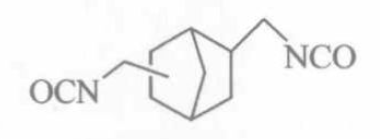
Chemical Name: 2,5(2,6)-bis(isocyanatomethyl)bicyclo[2.2.1]heptane
Synonyms: Norcamphane diisocyanate, Norbornene diisocyanate.
This diisocyanate is a mixture of 2,5-NBDI and 2,6-NBDI isomers.
Molecular Formula: C11H14N2O2
Molecular Weight: 206.27
CAS Number: 74091-64-8
EINECS Number: 411-280-2
Structural Formula:
Physical and Chemical Properties
A colorless to slightly yellowish transparent low-viscosity liquid with a slight characteristic odor. The vapor pressure at room temperature is lower than that of TDI and HDI. Boiling point is 135℃/266Pa or 159℃/800Pa, freezing point <-30℃, flash point (COC) is 172℃. Viscosity (25℃) is approximately 9.0 mPa·s, relative density is 1.14~1.15 (20℃) or 1.07 (25℃), NCO content is approximately 40.8%.
Mitsui Chemicals’ Cosmonate NBDI product has a purity of over 99.5%, hydrolyzable chlorine content below 0.03%, and color (APHA) below 10.
Characteristics and Uses
NBDI is a new type of cycloaliphatic diisocyanate. The two isocyanate groups have equal activity, and the reactivity is similar to HDI, and higher than IPDI.
Due to the rigid bicyclic structure in the NBDI molecule, compared with linear diisocyanates such as HDI, the resulting polyurethane elastomers have higher thermal stability and hardness. NBDI can be used to produce light-stable, heat-resistant, and weather-resistant polyurethane, polyurea, and polyisocyanurate resins. It can be used in the form of prepolymers, blocked isocyanates, or trimers, primarily in coatings, offering non-yellowing, fast-drying properties, toughness, and chemical resistance. It is also used in adhesives, sealants, leather coatings, and castable polyurethane elastomers.
Toxicity
Acute oral toxicity in rats: LD50 = 1201 mg/kg (female), 1842 mg/kg (female). Inhalation toxicity in rabbits: LC50 = 54 mg/m³/4h.
PREVIOUS:Tetramethyl-m-xylylene diisocyanate
CATEGORIES
LATEST NEWS
- Diethanolamine
- Triethanolamine
- Methyl Glucoside
- Mannitol
- Sorbitol
- Xylitol
- Pentaerythritol
- Trihydroxyethyl isocyanurate
- Trimethylolethane
- Glycerin
CONTACT US
Tel:+8618688691634
Email:sam@1688pu.com
Add:No. 91 Central East Rd, Luxi village, Gaobu town, Dongguan city, Guangdong Province, China