Other Bio-based Polyols
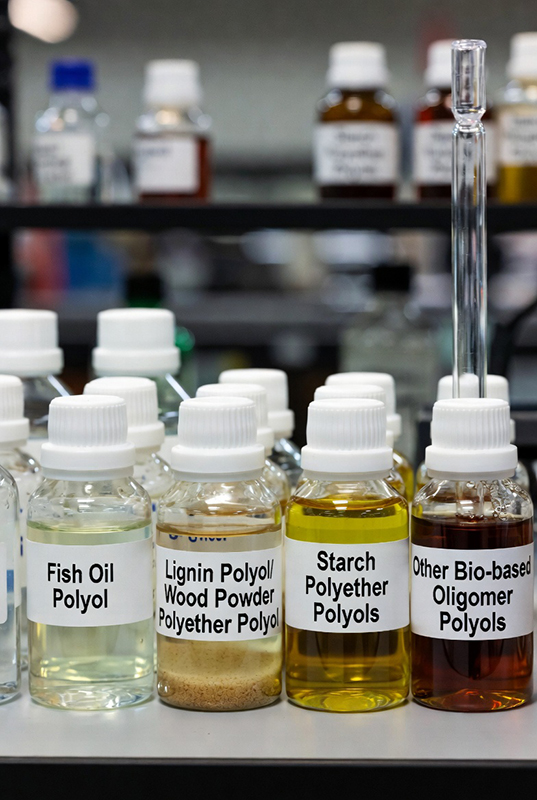
(1) Fish Oil Polyol: Iceland, a Western European island nation in the North Atlantic, is rich in fish oil, with an annual production of up to 100,000 tons of this fishery byproduct. According to a 2006 report, the Icelandic Technological Institute (IceTec) and Icelandic Polyol Co. Ltd (Icepol), with the assistance of Maskimi Polyol Company in Malaysia, produced fish oil polyol using an esterification process. They built a polyol plant with a capacity of 1500-2000 tons/year, which was used in the production of polyurethane foam. This fish oil polyol has a hydroxyl value of approximately 350 mg KOH/g, a functionality of approximately 3.7, a typical molecular weight of approximately 634, a density of 0.95-1.05 g/mL, a viscosity (25℃) of 450-600 mPa.s, and a moisture content of ≤0.40%. Due to the high degree of unsaturation in fish oil, Icepol had previously explored the use of epoxidation technology to produce fish oil polyol.
(2) Lignin Polyol/Wood Powder Polyether Polyol: Natural cellulose and starch-based agricultural and forestry byproducts such as sawdust, straw, bagasse, corn cobs, and starch can generally be liquefied under certain conditions using sulfuric acid or other catalysts. Polyether diols can be used as auxiliary liquefaction raw materials to obtain natural plant polyols.
In earlier years, Zhengzhou University used waste materials from wood processing, such as sawdust, wood shavings, and wood chips, as starting materials. These were crushed, sieved, and dried into 60-80 mesh wood powder. Under Lewis acid catalysis, at normal pressure and a certain temperature, the wood powder reacted with polyols to synthesize wood powder polyether polyol. This process involved grafting copolymerization reactions between the cellulose, hemicellulose, and lignin components of the disintegrated wood powder and the polyols. This wood powder polyether polyol was used to prepare rigid polyurethane foam, reducing costs. However, no industrialized product has been reported.
In 2008, Fujian Xinda Thermal Insulation Materials Co., Ltd. announced the successful development of a plant-based polyol. This polyol is synthesized from crushed agricultural and forestry byproducts such as fir wood, bamboo, and tobacco stalks through esterification and etherification processes. It is used in the production of rigid polyurethane foam insulation materials, reducing costs. The company has built a production line with an annual capacity of 2500 tons of plant-based polyols, using a mixture of fir wood powder and bamboo. These plant-based polyols can be used in combination with polyethers and polyesters in varying proportions, with a maximum usable amount of approximately 60%. Studies have shown that fir wood powder-based polyurethane foam is more easily biodegradable than bamboo powder-based foam after several years of landfilling.
These lignin-based polyols are darker in color. The lignin-type polyether polyol (environmentally friendly) supplied by Changzhou Shanfeng Chemical Co., Ltd. is a brownish-yellow viscous liquid with a viscosity (25℃) of 7000-10000 mPa·s, a hydroxyl value ≥420 mg KOH/g, a functionality >3, and a water content <0.5%.
(3) Starch Polyether Polyols: Starch polyether polyols have been developed for some time. Starch contains a large number of hydroxyl groups and can theoretically be used to prepare polyols. The main method involves the saccharification and fermentation of starch to produce methyl glucoside or other liquefied products, which are then subjected to ring-opening polymerization with propylene oxide/ethylene oxide in the presence of a catalyst to synthesize polyether polyols. The starch polyether polyol developed by Sichuan University is a light yellow, translucent, viscous liquid at room temperature. Its hydroxyl value and viscosity can be adjusted according to actual needs, and it is mainly used in the preparation of rigid polyurethane foam.
(4) Other Bio-based Oligomer Polyols: Broadly speaking, polyester and polyether polyols can be produced from bio-derived diols, triols, sucrose, etc., and can all be called bio-based oligomer polyols. For example, various polyols or other small molecule compounds can be obtained from the fermentation of starch such as corn. Changchun Dacheng Group uses corn starch as a raw material to industrially produce bio-based polyols on a large scale, building a bio-chemical alcohol plant with an annual output of over 200,000 tons, and also using corn stalks for fermentation to produce polyols. The bio-based polyols produced include ethylene glycol, propylene glycol, 1,2-butanediol, and 2,3-butanediol. In addition, many plants and animals can produce glycerol through biological methods, and bio-glycerol can be used to produce polyether polyols, etc. The Cerenol series of poly(1,3-propanediol), launched by DuPont in 2007, is a bio-based polyether diol derived from the polymerization of Bio-PDO, a fermentation product of corn.
CATEGORIES
LATEST NEWS
- Diethanolamine
- Triethanolamine
- Methyl Glucoside
- Mannitol
- Sorbitol
- Xylitol
- Pentaerythritol
- Trihydroxyethyl isocyanurate
- Trimethylolethane
- Glycerin
CONTACT US
Tel:+8618688691634
Email:sam@1688pu.com
Add:No. 91 Central East Rd, Luxi village, Gaobu town, Dongguan city, Guangdong Province, China