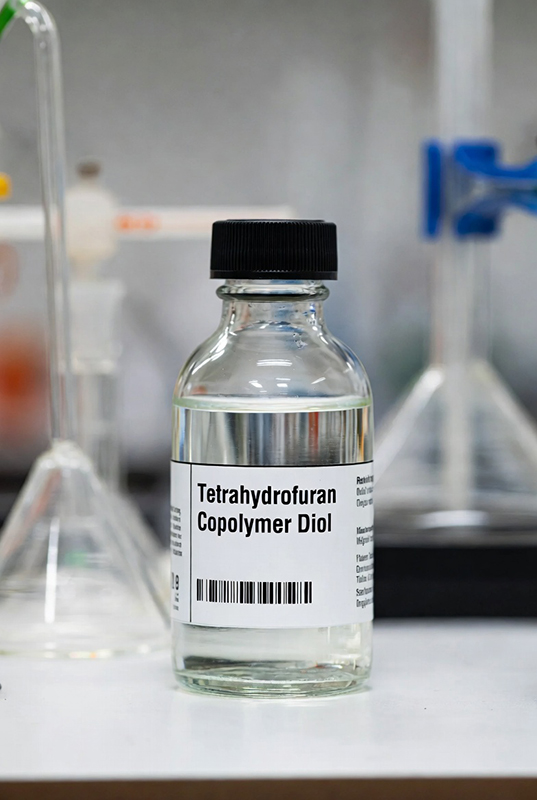
Tetrahydrofuran Copolymer Diol
Branched Poly(tetrahydrofuran) Diol (PTG-L)
PTG-L series from Hodogaya Chemical Co., Ltd. (Japan) is a modified poly(tetrahydrofuran) diol obtained by copolymerizing tetrahydrofuran and side-chain substituted tetrahydrofuran. This diol possesses the unique physical properties of PTG products while improving the room-temperature crystallinity of ordinary PTG products. It is a liquid at room temperature, and the resulting polyurethane elastomer exhibits high elasticity. It can be used in high-performance spandex, polyurethane elastomers, coatings, etc. The company has been producing this series of products since 1990.
The structural formula of PTG-L is as follows:

Figure 2-2 shows the effect of PTG-L series liquid poly(tetrahydrofuran) diol and poly(tetrahydrofuran) diol (PTG) on the low-temperature hardness of polyurethane elastomers. It can be seen that elastomers made from ordinary PTG show significant low-temperature crystallization, and the hardness increases with decreasing temperature; while the hardness of PTG-L-based elastomers is less dependent on temperature.
Branched Poly(tetrahydrofuran) Diol (PTXG)
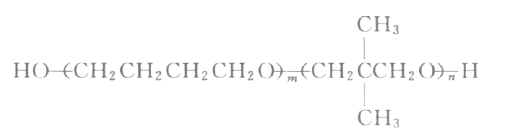
Asahi Kasei Corporation (Japan) produces a type of PTXG copolymer diol obtained from tetrahydrofuran and neopentyl glycol. The structural formula is as follows:
PTXG copolymer diol is a transparent light yellow liquid at room temperature with a narrow molecular weight distribution. The relative density at 25℃ is 0.975, the specific heat capacity is 1.92 J/(g·k), and the flash point is >200℃.
Tetrahydrofuran-Propylene Oxide Copolymer Ether Diol
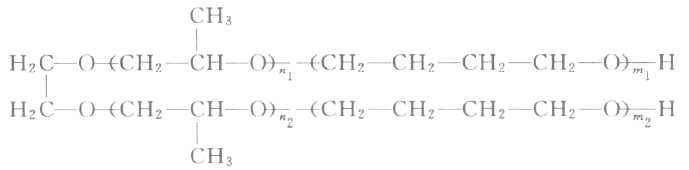
The copolymer ether diol of tetrahydrofuran and propylene oxide combines the characteristics of PTMEG and PPG, and its elastomer offers a balance of cost and performance.
The structural formula of tetrahydrofuran-propylene oxide copolymer diol is as follows:
Physicochemical Properties
Tetrahydrofuran-propylene oxide copolymer ether is a pale yellow liquid at room temperature. Properties and Applications
This product, like polyester polyols, polytetrahydrofuran diols, and polypropylene oxide polyols, can be used in polyurethane foams, elastomers, adhesives, and coatings. Due to its special structure, its performance is similar to PTMEG, giving its products excellent properties such as high strength, oil resistance, and low-temperature resistance. It is particularly suitable for manufacturing special low-temperature resistant polyurethane elastomers and polyurethane adhesives, with cold resistance down to -200°C.
Tetrahydrofuran-propylene oxide copolymer triols from the Oil & Fats Division of Nippon Oil & Fats Co., Ltd. (now NOF Corporation) in Japan, formerly branded as Unisafe DCB-1000, DCB-2000, and DCB-4000, are now branded as Polycerine DCB-1000, DCB-2000, and DCB-4000. Their solidification point is below 0°C, but specific specifications are not available and can be produced on order. There is also a tetrahydrofuran-propylene oxide copolymer diol with a molecular weight of 1000, named Ng210, but the manufacturer is currently unknown.
In China, there have been some research reports on this copolymer ether. The Synthetic Materials Factory of Shanxi Provincial Chemical Research Institute and Jiangsu Yangzhou Synthetic Chemical Plant (now closed) previously produced tetrahydrofuran-propylene oxide copolymers with molecular weights of 1000-2000. Currently, there appear to be no industrialized products in China.
Tetrahydrofuran-ethylene oxide copolymer diols
NOF Corporation produces tetrahydrofuran (THF)-ethylene oxide (EO) random copolymer diols. The Polycerin DC-1100, DC-1800E, and DC-3000E tetrahydrofuran-ethylene oxide copolymer diols are all liquids at room temperature, with corresponding molecular weights of 1000, 1800, and 3000, respectively. Additionally, data indicates that the company’s original products, Unisafe DC-1000, DC-1800, and DC-3000, are tetrahydrofuran-ethylene oxide random copolymer diols with EO/THF molar ratios of approximately 65/35, 50/50, and 50/50, respectively, and corresponding EO/THF mass ratios of 50/50, 40/60, and 35/65.
This copolymer ether diol combines the advantages of PTMEG and PEG, resulting in polyurethane elastic materials with flexibility, hydrophilicity, moisture permeability, and low-temperature elasticity. It can be used in materials such as athletic shoes and PU leather, and provides excellent low-temperature flexibility in synthetic leather coatings, maintaining softness even at -20°C.
PREVIOUS:Polytetrahydrofuran Diol
CATEGORIES
LATEST NEWS
- Diethanolamine
- Triethanolamine
- Methyl Glucoside
- Mannitol
- Sorbitol
- Xylitol
- Pentaerythritol
- Trihydroxyethyl isocyanurate
- Trimethylolethane
- Glycerin
CONTACT US
Tel:+8618688691634
Email:sam@1688pu.com
Add:No. 91 Central East Rd, Luxi village, Gaobu town, Dongguan city, Guangdong Province, China