Toluene Diisocyanate
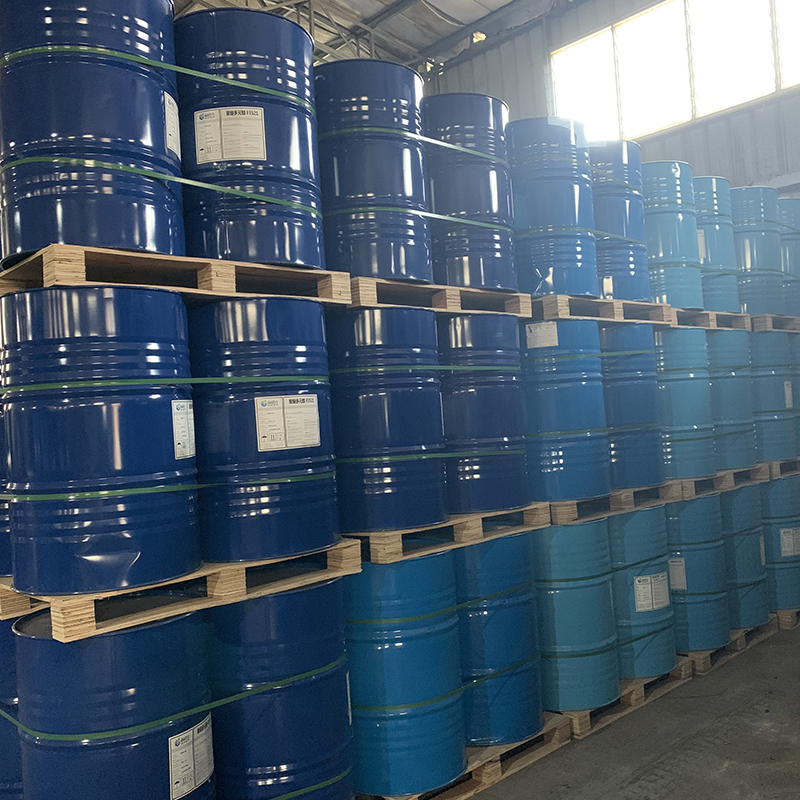
Abbreviation: TDI
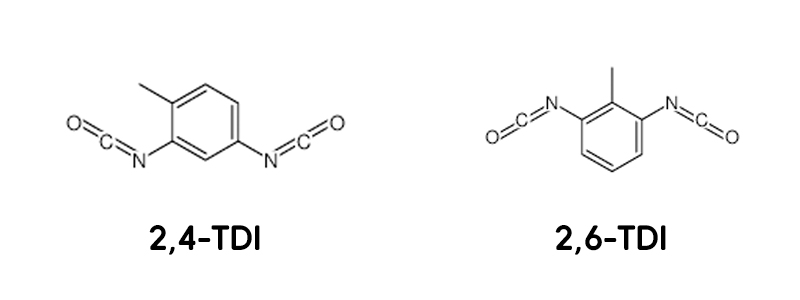
TDI has two isomers: 2,4-TDI and 2,6-TDI. Industrial TDI is mainly a mixture of 2,4-TDI and 2,6-TDI in a mass ratio of 80:20 (referred to as TDI-80 or TDI-80/20), but pure 2,4-TDI (also known as TDI-100) and TDI-65 (a mixture of 2,4-TDI and 2,6-TDI isomers in a mass ratio of approximately 65:35) are also available.
The molecular formula of TDI is C₉H₆N₂O₂, and its molecular weight is 174.15.
The CAS number for TDI (isomer mixture) is 26471-62-5, and the EINECS number is 247-722-4; the CAS number for 2,4-TDI is 584-84-9, and the EINECS number is 209-544-5; the CAS number for 2,6-TDI is 91-08-7, and the EINECS number is 202-039-0.
Structural formula:
Physical and Chemical Properties: At room temperature, TDI is a colorless or light yellow transparent liquid with a characteristic pungent odor. Its color may turn yellow upon prolonged exposure to light. It is insoluble in water but reacts chemically with water to produce CO2 gas. It is soluble in acetone, ethyl acetate, toluene, and halogenated hydrocarbons. TDI-80 will produce white crystals when stored below 10°C. Typical physical properties of TDI are shown in Table 1-1.
Table 1-1 Typical Physical Properties of Toluene Diisocyanate (TDI)
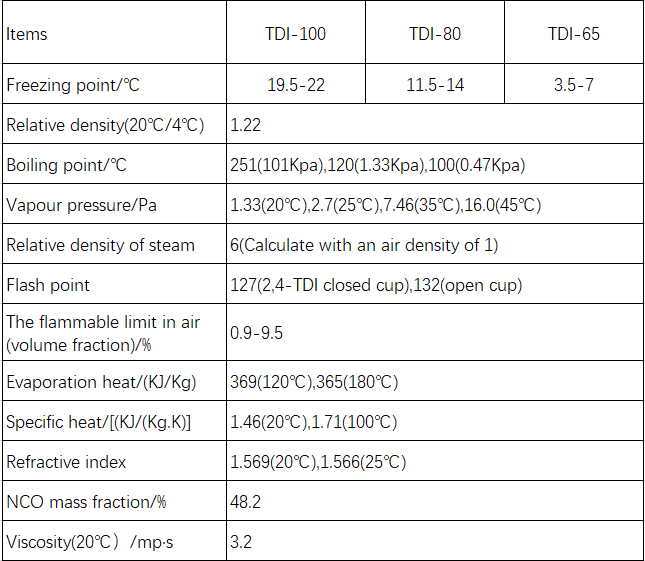
Note: Most of the data in the table comes from the BASF TDI manual; the vapor pressure of TDI-65 (25℃) is 3.3 Pa.
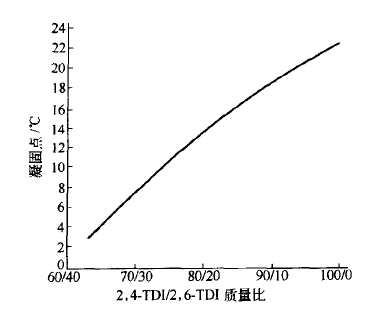
Figure 1-1 Relationship between TDI Isomer Ratio and Freezing Point
The melting point (freezing point) of 2,4-TDI is approximately 21℃, the boiling point is 252-254℃, and the boiling point measured by the DCS method is approximately 249℃. The relative density (25℃) is 1.214. The melting point (freezing point) of 2,6-TDI is 8-10.5℃, the boiling point is 247-249℃, the boiling point measured by the DSC method is 244℃, the boiling point under reduced pressure is 130℃/2.4 kPa, 96℃/200 Pa, and the relative density (20℃) is 1.226.
TDI-80 saturated vapor concentration: approximately 13 ppm at 20℃, approximately 26 ppm at 25℃; the saturated vapor concentration of TDI-65 is approximately 33 ppm at 25℃ (conversion relationship between volume fraction and mass-volume concentration: 1 ppm = 7.11 mg/m³, or 1 mg/m³ = 0.14 ppm).
The ratio of 2,4- and 2,6-isomers in TDI affects its physical properties, such as freezing point and viscosity. As the content of the 2,4-isomer increases, the freezing point of the TDI product increases, as shown in Figure 1-1.
The content (or ratio) of 2,4-TDI and 2,6-TDI isomers can be determined by the peak heights at wavelengths of 12.25 μm and 12.75 μm in their infrared absorption spectra.
The infrared spectrum of 2,4-TDI is shown in Figure 1-2.
TDI readily reacts with compounds containing active hydrogen atoms, such as amines, water, and alcohols, releasing a large amount of heat. The reaction of TDI with water to produce carbon dioxide is one of the key reactions in the manufacturing process of flexible polyurethane foam. Because TDI deteriorates upon contact with moisture, contact with moisture and water should be avoided. It reacts with strong oxidizing agents and is flammable. Heating to high temperatures causes it to decompose, releasing toxic cyanides and nitrogen oxides.
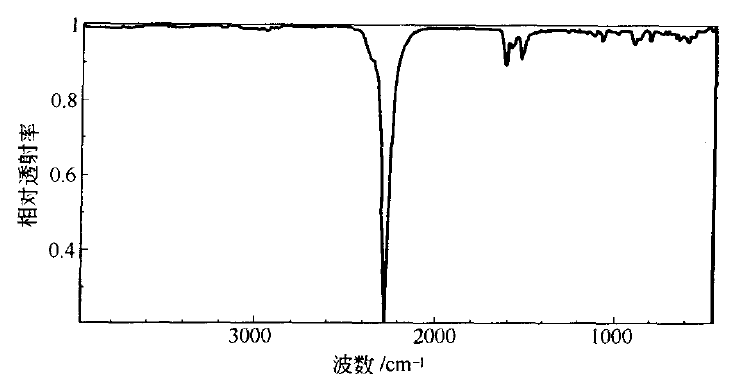
Figure 1-2 Infrared spectrum of 2,4-TDI (Source: NIST Chemistry WebBook)
PREVIOUS:Polyester Polyol Raw Materials
CATEGORIES
LATEST NEWS
- Diethanolamine
- Triethanolamine
- Methyl Glucoside
- Mannitol
- Sorbitol
- Xylitol
- Pentaerythritol
- Trihydroxyethyl isocyanurate
- Trimethylolethane
- Glycerin
CONTACT US
Tel:+8618688691634
Email:sam@1688pu.com
Add:No. 91 Central East Rd, Luxi village, Gaobu town, Dongguan city, Guangdong Province, China