Triethanolamine
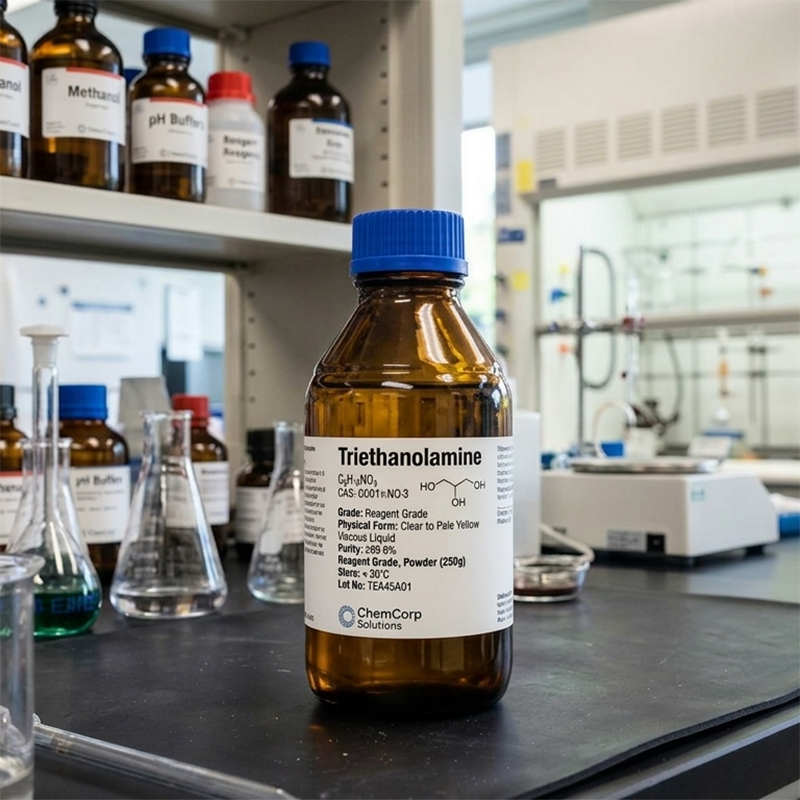
Abbreviations: TEOA, TEA
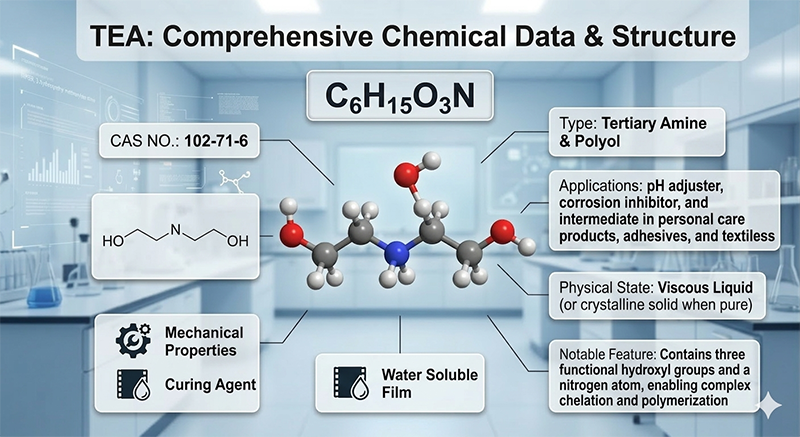
Synonyms: 2,2′,2”-Hydroxytriethylamine, Trihydroxyethylamine
Molecular Formula: C6H15O3N
Molecular Weight: 149.19
CAS No.: 102-71-6
Structural Formula:
Physicochemical Properties:
A colorless to pale yellow viscous liquid with a faint ammonia-like odor; readily soluble in water and ethanol. It is alkaline, with an aqueous solution pH of approximately 10.5. It can corrode copper, aluminum, and their alloys.
Melting Point: 18–21°C; upon cooling, it can form a supercooled liquid. Relative Density: approx. 1.12. Boiling Point: 190–193°C (at 5 × 133 Pa); decomposes at approximately 335°C under atmospheric pressure. Vapor Pressure: approx. 1.3 Pa. Flash Point: 185°C. Autoignition Temperature: 315°C.
Both the liquid and its vapors are corrosive to the skin and eyes. It reacts with various acids to form esters and amide salts.
It is considered practically non-toxic; acute oral toxicity data for rats indicates an LD50 of 8 g/kg.
Commercially available TEOA products range from high-purity grades (over 99% purity) to grades containing 95%, 90%, 85%, etc., of TEOA; these typically contain water and small amounts of diethanolamine. First-grade products generally possess a purity of ≥98.5% and a moisture content of ≤0.3%.
Characteristics and Applications:
Triethanolamine is a widely utilized chemical raw material. It serves as a vulcanization activator for non-carbon-black-reinforced rubber compounds, an emulsifier for oils and waxes, a coolant for metal cutting, a rust inhibitor, a cement early-strength agent, a neutralizing agent, an absorbent for acidic gases, and a humectant in daily chemical products, among other applications.
In the field of polyurethanes, it functions as an initiator for polyethers, as well as a crosslinking agent and co-catalyst for polyurethane foams and elastomers. Due to the presence of tertiary amine groups, it exhibits catalytic activity; furthermore, it can neutralize acidic components, thereby protecting the primary tertiary amine catalysts present in polyurethane foam formulations.
PREVIOUS:Methyl Glucoside
NEXT:Diethanolamine
CATEGORIES
LATEST NEWS
- Diethanolamine
- Triethanolamine
- Methyl Glucoside
- Mannitol
- Sorbitol
- Xylitol
- Pentaerythritol
- Trihydroxyethyl isocyanurate
- Trimethylolethane
- Glycerin
CONTACT US
Tel:+8618688691634
Email:sam@1688pu.com
Add:No. 91 Central East Rd, Luxi village, Gaobu town, Dongguan city, Guangdong Province, China