Triphenylmethane Triisocyanate
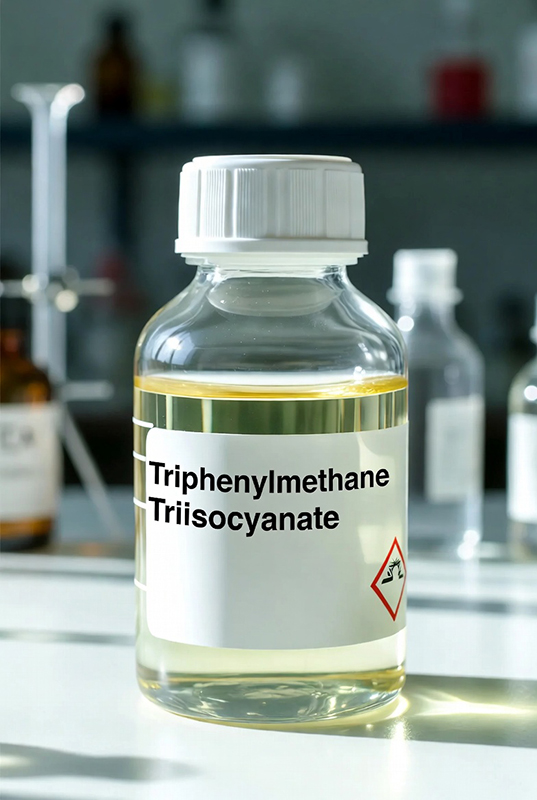
Abbreviation: TTI, JQ-1, Desmodur R, Desmodur RE, Leiknonat
Chemical Name: Triphenylmethane-4,4′,4”-triisocyanate
Molecular formula: C22H13N3O3
Molecular weight: 367.36
CAS number: 2422-91-5
EINECS number: 219-351-8.
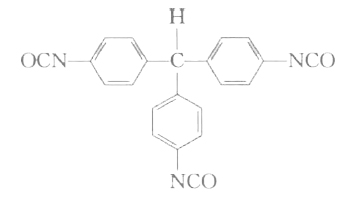
Structural Formula:
Physicochemical Properties
Pure triphenylmethane-4,4′,4”-triisocyanate (TTI) is a solid at room temperature, with a melting point of 89–90°C, a boiling point of 240°C/100Pa, and a theoretical NCO content of 34%. TTI is easily soluble in organic solvents such as toluene, chlorobenzene, chlorinated hydrocarbons, and ethyl acetate.
Commercial TTI products are generally sold as solutions. The solvents used vary depending on the manufacturer and the time period. TTI solutions are generally viscous, yellowish-brown, brown to purplish-red liquids, and the color gradually deepens with storage time. This does not affect the adhesive performance of the product. This type of adhesive is used for bonding rubber to steel or aluminum alloys at room temperature, and its strength is generally greater than 4 MPa.
In the early days, Bayer AG in Germany launched a TTI solution under the brand name Desmodur R, using dichloromethane as the solvent, with a solid content of 20%, a density (20°C) of 1.31–1.32 g/cm³, an NCO content of (7.0±0.2)%, and a viscosity (20°C) of (3±1) mPa·s. As early as 1956, Dalian Dyestuff Factory and Chongqing Changfeng Chemical Plant in my country began mass production of TTI solutions, under the brand name JQ-1, also known as Leiknonat (a transliteration of the Soviet product name Leiknonat), using chlorobenzene as the solvent. Currently, Bayer’s TTI uses ethyl acetate as the solvent, which has low volatile toxicity, and the non-volatile content has been increased from 20% in Desmodur R to 27%, and the brand name has been changed to Desmodur RE. Its main indicators are as follows: TTI content (non-volatile content) is approximately 27%, NCO content is (9.3±0.2)%, density (20℃) is 1.0 g/cm³, viscosity (20℃) is approximately 3 mPa·s, and flash point is -4℃. In addition, the mass fractions of other substances in Desmodur RE are: ethyl acetate approximately 70%, chlorobenzene <2.5%, 4,4′-MDI less than 0.1%, and phenyl isocyanate <0.05%. The curing agent Verstuker RE from Cont-iTech GmbH in Germany has similar composition and technical specifications to Desmodur RE.
The JQ-1 adhesive from Chongqing Changfeng Polyurethane Adhesive Factory has a solid content of 19%–20% and appears as a light red to purplish-red liquid. The TTI solution products (named JQ-1, JQ-RB, and RE) from Changzhou Hengbang Chemical Co., Ltd. in Jiangsu Province have solid contents of (20±1)%, (23±1)%, and (27±1)%, respectively, and their NCO mass fractions are (7.0±0.2)%, (7.5±0.2)%, and (9.3±0.2)%, respectively.
Toxicity
Desmodur RE acute oral toxicity (rat) LD50 >2500 mg/kg.
Properties and Uses
Triphenylmethane triisocyanate is one of the earliest organic polyisocyanates developed in the world, and also the earliest polyisocyanate product developed in my country. As early as World War II, Bayer AG in Germany launched Desmodur R, used for bonding metals and rubber and other materials.
TTI contains extremely active NCO functional groups, which can react with hydroxyl, amino, mercapto and other groups containing active hydrogen, as well as various compounds containing double bonds. Through the resulting chemical and physical interactions, substances are firmly bonded together, so it is widely used as an adhesive and curing agent, mainly as a crosslinking agent for chloroprene rubber adhesives and polyurethane adhesives used in footwear. Generally, for neoprene or polyurethane adhesives with a solid content of 20%, the recommended amount of Desmodur RE or JQ-1 is 4-7 parts by weight per 100 parts by weight of the 20% solid content solvent-based polyurethane or neoprene rubber adhesive. After adding this crosslinking agent, the working life of the adhesive is typically several hours.
CATEGORIES
LATEST NEWS
- Polyether Polyol vs Polyest...
- What Is Polyester Polyol?
- What Is Polyether Polyol?
- What Is Polyol?
- Why Is Reaction Balance Cri...
- Blowing Reaction vs Gelling...
- How Molecular Structure Det...
- Soft Segment vs Hard Segmen...
- What Is Crosslinking in Pol...
- What Is Polyurethane Polyme...
CONTACT US
Tel:+86 18688691634
Email:sam@1688pu.com
Add:No. 91 Central East Rd, Luxi Village, Gaobu Town, Dongguan 523283, China.