Fatty Acid Dimer Diols and Dimer Polyester Diols
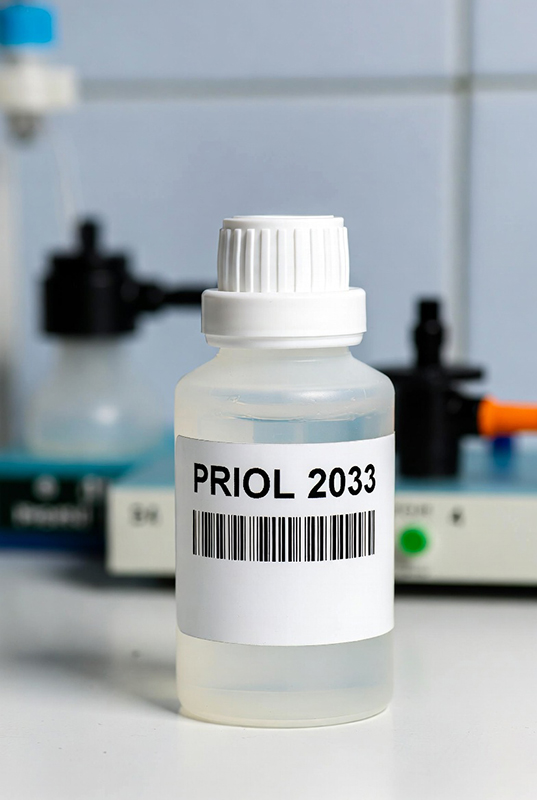
Dimer diols are products derived from natural oils and fats, belonging to the category of bio-based diols.
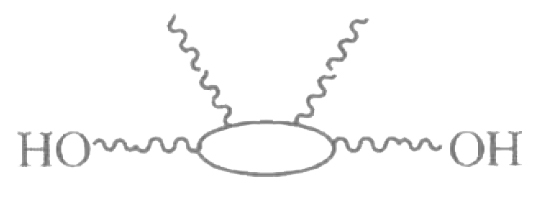
Croda International Plc’s Pripol 2033 (formerly from Uniqema, USA) is a special dimer diol, obtained by the reduction of fatty acid dimers. It contains 36 carbon atoms, is branched, and contains no double bonds. Its structural formula is shown below:
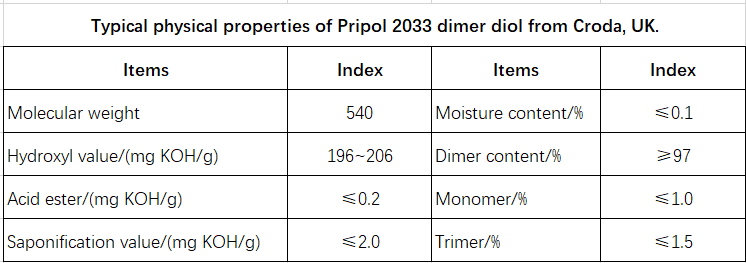
Dimer diols do not contain ester groups and are liquid at room temperature. They are used in CASE polyurethane elastomers, significantly improving the hydrolysis stability, fluidity, and glass transition temperature range of polyurethanes. Typical physical properties are shown in Table 4-31. Jarchem Industries’ dimer diol DD36 has a relative molecular weight of 0.90, a viscosity of 2500 mPa·s, a hydroxyl value of 185–210 mg KOH/g, an acid value of approximately 0.4 mg KOH/g, and a saponification value of 1.3–5 mg KOH/g.
Croda’s Pripol 2030 is also an amorphous dimer diol with a relative molecular weight of 570, used in the manufacture of CASE polyurethane materials, engineering plastics, etc., and exhibits hydrolysis resistance, chemical resistance, and UV resistance. Croda also produces the Priplast series of polyester polyols based on natural products such as dimers (acids/alcohols), as described in Section 3.1.5.
In 2004, the Research Institute of Forest Products Chemistry Industry of the Chinese Academy of Forestry Science was the first in China to achieve the co-production of fatty acid dimers (dimer acids) while producing biodiesel from natural oils and fats (rapeseed oil, acidified oil, waste cooking oil, and seaside mallow oil, etc.). Researchers used dimer acids to replace conventional dicarboxylic acids to prepare dimer acid polyester diols, and established a pilot production line with an annual output of 500 tons of oil-based polyester polyols.
PREVIOUS:Rosin Ester Polyols
CATEGORIES
LATEST NEWS
- Polyether Polyol vs Polyest...
- What Is Polyester Polyol?
- What Is Polyether Polyol?
- What Is Polyol?
- Why Is Reaction Balance Cri...
- Blowing Reaction vs Gelling...
- How Molecular Structure Det...
- Soft Segment vs Hard Segmen...
- What Is Crosslinking in Pol...
- What Is Polyurethane Polyme...
CONTACT US
Tel:+86 18688691634
Email:sam@1688pu.com
Add:No. 91 Central East Rd, Luxi Village, Gaobu Town, Dongguan 523283, China.