Methyl Glucoside
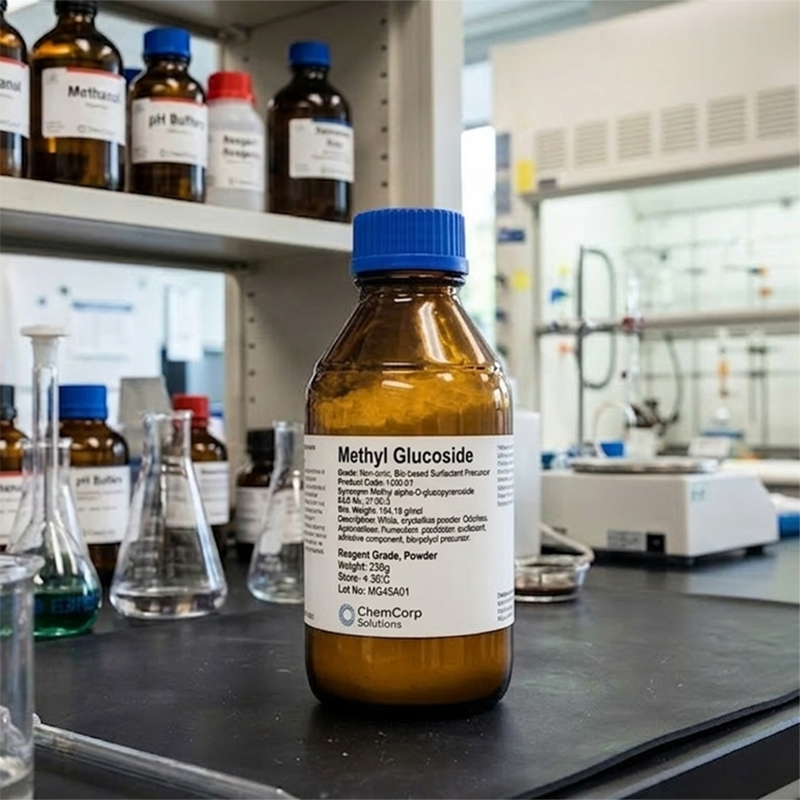
Synonym: α-Methyl Glucoside
Abbreviation: MeG
Molecular Formula: C7H14O6
Molecular Weight: 194.18
CAS No.: 97-30-3
Structural Formula:
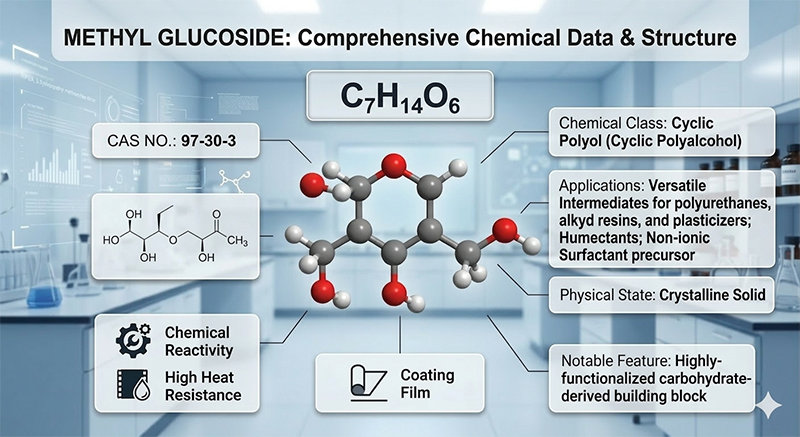
Physicochemical Properties:
Appearance: A white or slightly yellowish crystalline powder with a faintly sweet taste. It is non-toxic, readily soluble in water, hygroscopic (easily absorbs moisture), and chemically stable. Melting Point: 169–171°C. Relative Density: 1.46.
Product Purity: Generally not less than 98.0%; Glucoside content: not greater than 1.5%; Loss on Drying: not greater than 1.2%.
Characteristics and Applications:
Methyl glucoside is a non-reducing derivative of glucose. Glucose is an aldose; its aldehyde group is prone to redox reactions, which can result in product discoloration and high acid values, making it unsuitable for direct use in medium-to-high temperature synthesis processes. The chemical stability of glucose is significantly enhanced only after it undergoes condensation with fatty alcohols to form glucosides. Methyl glucoside contains no aldehyde groups and is cost-effective.
Methyl glucoside is a tetrahydroxy polyol featuring a cyclic structure. It serves as an initiator for polyether polyols used in rigid polyurethane foams and can also be utilized in small quantities for the synthesis of polyester polyols. It is employed as a raw material for non-ionic surfactants in daily chemical products and finds application in the pharmaceutical industry. Furthermore, it acts as a modifier for thermosetting urea-formaldehyde and phenol-formaldehyde resins, and is utilized in various industrial sectors such as textile finishing, adhesives, coatings, and cosmetics.
PREVIOUS:Mannitol
NEXT:Triethanolamine
CATEGORIES
LATEST NEWS
- Polyether Polyol vs Polyest...
- What Is Polyester Polyol?
- What Is Polyether Polyol?
- What Is Polyol?
- Why Is Reaction Balance Cri...
- Blowing Reaction vs Gelling...
- How Molecular Structure Det...
- Soft Segment vs Hard Segmen...
- What Is Crosslinking in Pol...
- What Is Polyurethane Polyme...
CONTACT US
Tel:+86 18688691634
Email:sam@1688pu.com
Add:No. 91 Central East Rd, Luxi Village, Gaobu Town, Dongguan 523283, China.