What Is a Two-Component PU System?
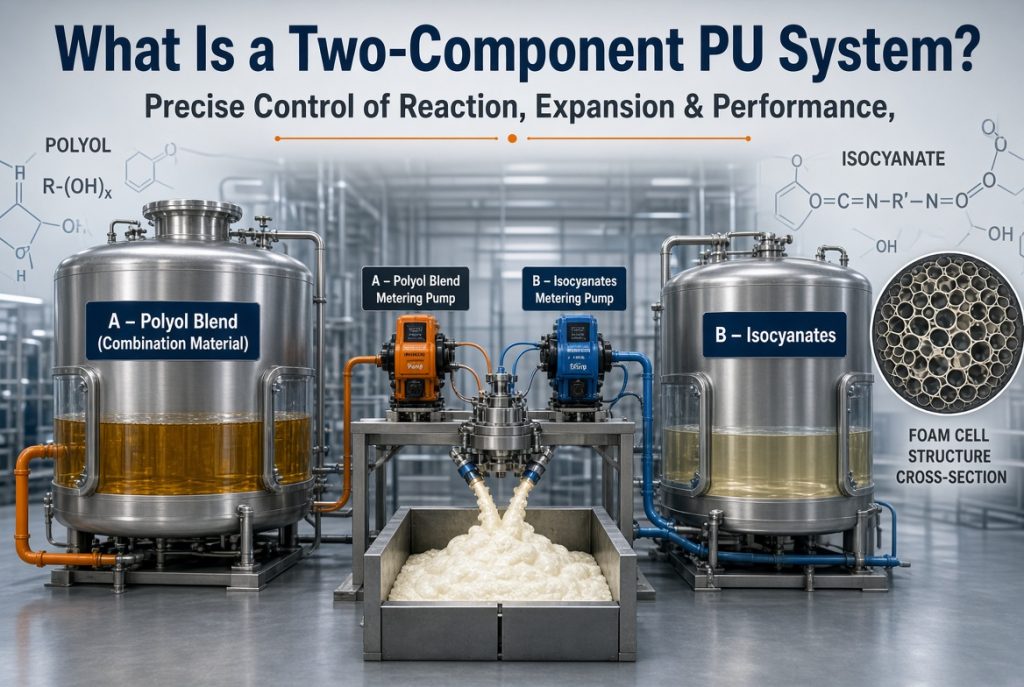
Why do most polyurethane foam manufacturers use a two-component system?
The reason is simple: polyurethane production requires precise control of chemical reactions, foam expansion, and final material properties.
A Two-Component PU System makes it possible to manage these factors through two separately stored components that are mixed during production.
Let’s explore how it works, why it matters, and how to choose the right system for your application.
1. What Is a Two-Component PU System?
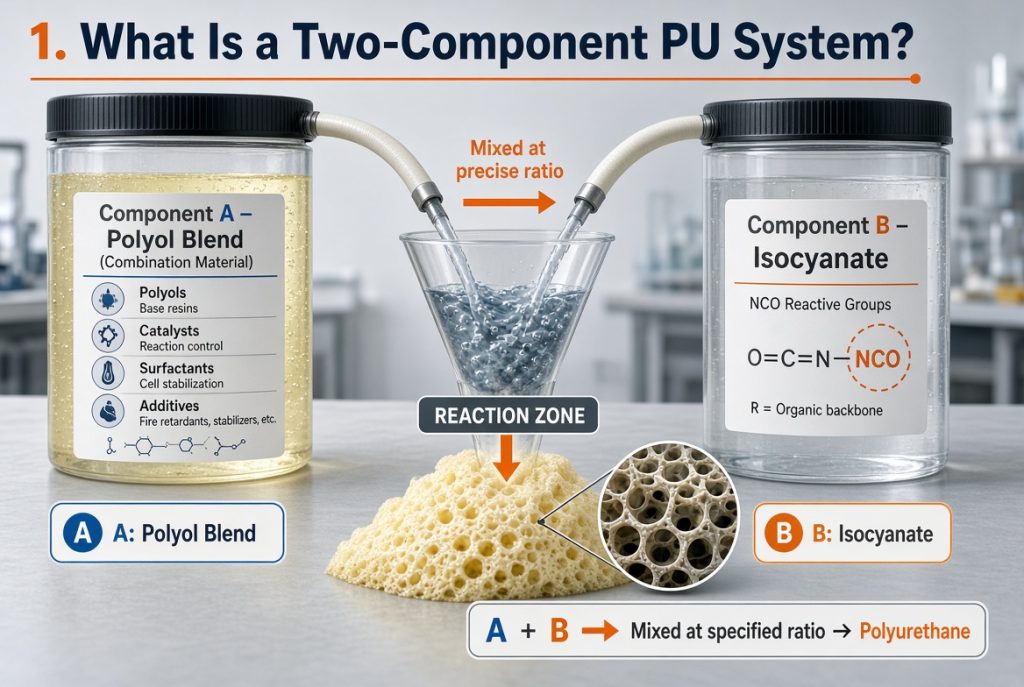
A Two-Component Polyurethane (PU) System is a formulation consisting of two main components:
Component A – Isocyanate
Usually contains an isocyanate such as MDI or TDI, depending on the application and formulation. It provides the reactive NCO groups needed to form polyurethane.
Component B – Polyol Blend
Usually contains polyols, catalysts, silicone surfactants, blowing agents, and other additives. It is carefully formulated to control foaming behavior and final product properties.
During production, Component A and Component B are mixed at a specified ratio. They react to form polyurethane materials, including flexible foam, rigid foam, memory foam, self-skinning foam, and other products.
In many commercial applications, Component B is supplied as a pre-formulated PU combination material, helping manufacturers simplify raw material handling and production.
2. Why Do Manufacturers Need a Two-Component PU System?
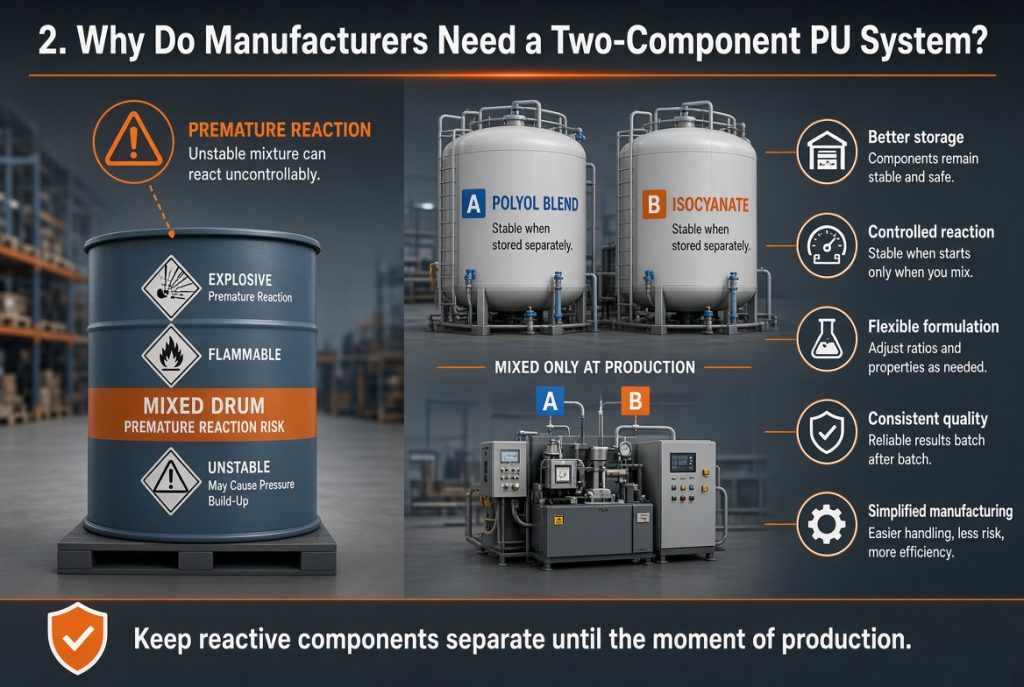
Why not mix all the raw materials together in advance?
Because the reactive ingredients need to remain separated until production.
A two-component system offers several important advantages:
- Better storage and handling: Separating the reactive components helps prevent premature reactions during storage.
- Controlled chemical reactions: The components react when mixed, allowing the foaming or curing process to begin at the right time.
- Flexible formulation design: The B-side formulation can be developed for different applications and performance requirements.
- Consistent production: A properly designed system and accurate metering help improve batch-to-batch consistency.
- Simplified manufacturing: Pre-formulated combination materials reduce the need to weigh and mix multiple additives individually.
The real advantage is the ability to design a complete material system around the manufacturer’s production requirements.
3. How Does a Two-Component PU System Work?
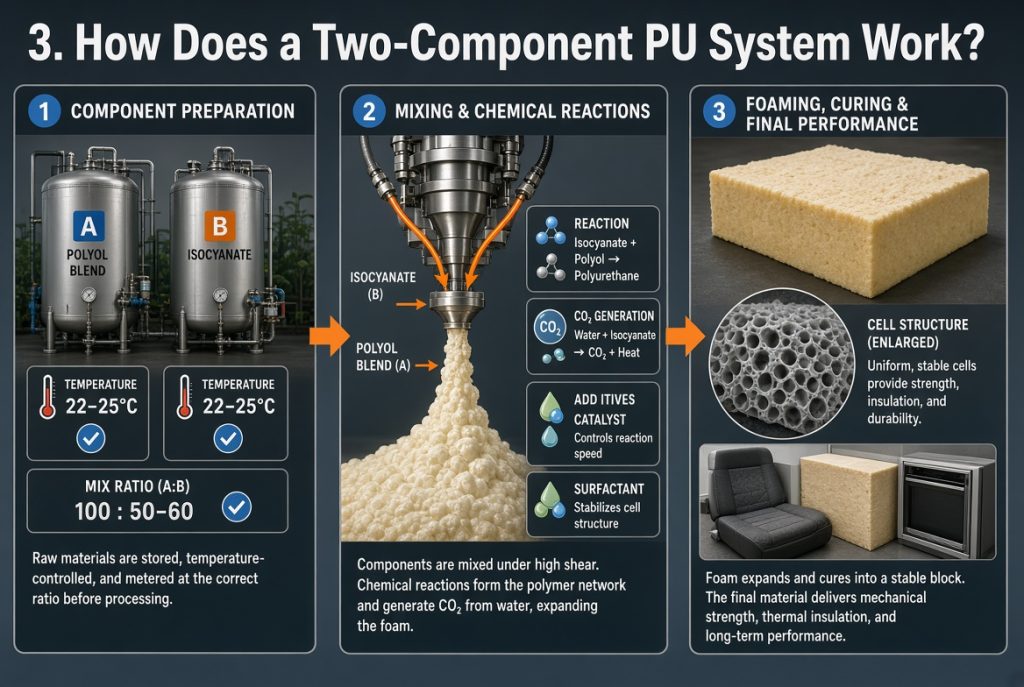
The working process involves three main stages.
Step 1: Component Preparation
Component A and Component B are stored separately and prepared according to the supplier’s recommendations. Material temperature, mixing ratio, and equipment conditions should be checked.
Step 2: Mixing and Chemical Reactions
When A and B are mixed at the specified ratio, the isocyanate reacts with the polyol to form polyurethane.
If water is included in the formulation, it also reacts with isocyanate to generate carbon dioxide (CO₂), which helps the foam expand.
At the same time:
- Catalysts regulate the blowing and gelling reactions.
- Silicone surfactants help stabilize the foam cells.
- Other additives provide specific properties, such as flame retardancy or improved processing behavior.
Step 3: Foaming, Curing, and Final Performance
The foam expands, develops its cell structure, and gradually cures into the required material.
The final result depends on the complete formulation, mixing ratio, equipment, processing conditions, and curing environment.
A good two-component system is designed to keep these factors working together.
4. Common Problems in Two-Component PU Systems
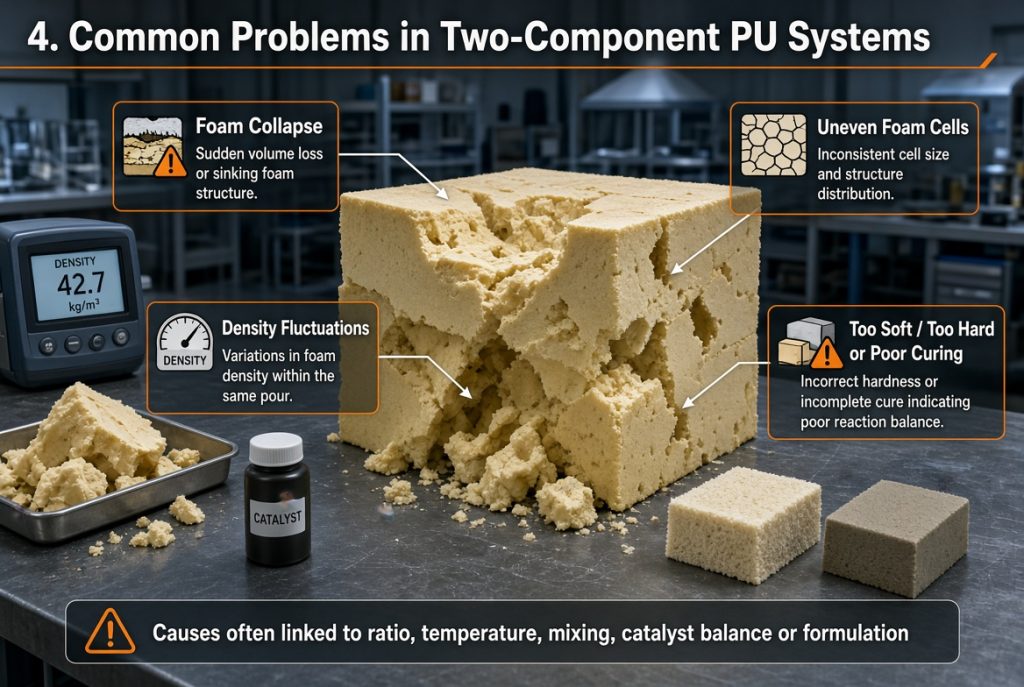
Even with a properly designed system, production problems can occur.
Here are some common issues:
Foam Collapse
Possible causes include an imbalance between blowing and gelling reactions, poor cell stability, incorrect mixing ratios, or unsuitable processing conditions.
Uneven Foam Cells
Poor mixing, incorrect surfactant selection, contamination, or unstable raw material conditions may affect cell structure.
Density Fluctuations
Incorrect metering, inconsistent component temperatures, equipment problems, or changes in processing conditions can lead to density variations.
Foam Too Soft or Too Hard
The formulation may not match the target application. The polyol composition, isocyanate index, and crosslinking structure should be evaluated.
Poor Curing or Slow Reaction
Possible causes include incorrect catalyst balance, low material temperature, inaccurate metering, or unsuitable formulation design.
5. How Can These Problems Be Solved?
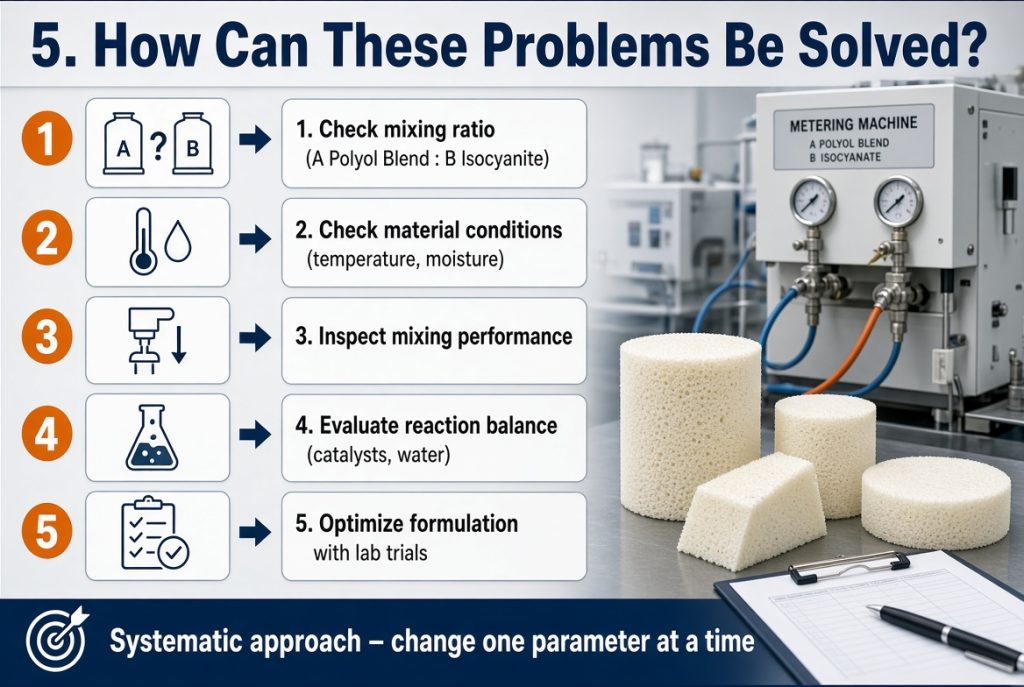
The first step is to identify whether the problem comes from the formulation, raw materials, equipment, or production conditions.
A practical troubleshooting process includes:
- Check the mixing ratio: Confirm that Component A and B are supplied and metered at the specified ratio.
- Check material conditions: Review storage, temperature, moisture exposure, and raw material quality.
- Inspect mixing performance: Make sure the mixing equipment is operating correctly and providing sufficient mixing.
- Evaluate reaction balance: Review catalyst levels, water content, and blowing/gelling behavior.
- Optimize the formulation: Conduct laboratory trials and adjust the formulation based on actual test results.
Avoid changing several parameters at once. A systematic approach makes it easier to identify the real cause and improve production stability.
6. How GST Supports Your Two-Component PU System
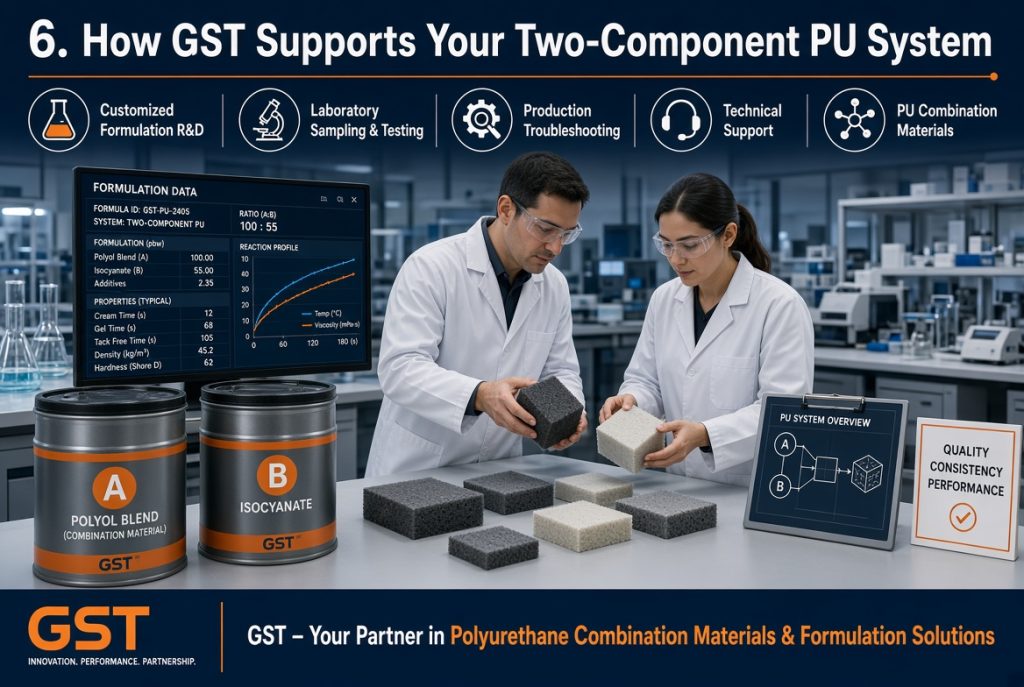
Choosing a two-component PU system is not simply about purchasing Component A and Component B. The key is finding a formulation that matches your product, equipment, and production process.
GST is a polyurethane combination material supplier with an independent R&D laboratory and professional engineering team.
We provide customized solutions for different polyurethane applications, including:
- PU Combination Materials: Flexible foam, high-resilience foam, memory foam, rigid foam, self-skinning foam, GEL systems, and more.
- Customized Formulation R&D: Develop and adjust B-side formulations according to target density, hardness, resilience, processing requirements, and other product specifications.
- Laboratory Sampling and Testing: Evaluate foaming behavior and material properties before production trials.
- Production Troubleshooting: Help investigate foam collapse, uneven cells, density fluctuations, and curing problems.
- Technical Support: Provide material recommendations, trial guidance, and remote technical assistance.
Whether you are developing a new polyurethane product or improving an existing production process, GST can help you find a suitable combination material and formulation solution.
Conclusion
A Two-Component PU System is the foundation of many polyurethane manufacturing processes.
By keeping isocyanate and polyol blend separate until production, manufacturers can control when the reaction begins and develop materials for different applications.
However, consistent foam quality requires more than the correct A/B ratio. Formulation design, raw material compatibility, equipment, and processing conditions all matter.
Looking for a reliable PU combination material supplier or customized formulation solution?
Contact GST to discuss your application and polyurethane production requirements.
GST – Your Partner in Polyurethane Combination Materials & Formulation Solutions.
Tags: Isocyanate, MDI, Polyol, Polyol Blend, Polyurethane, Polyurethane A Side and B Side, Polyurethane Combination Material, Polyurethane Combination Materials, Polyurethane Formulation, Polyurethane System Supplier, PU A B System, PU Combination Material, PU Combination Materials, TDI, Two Component Polyurethane System, Two-Component PU System
PREVIOUS:What Is Polyol Blend?
CATEGORIES
LATEST NEWS
- What Is a Two-Component PU ...
- What Is Polyol Blend?
- What Is a Polyurethane System?
- How to Select Catalysts for...
- What Are Flame Retardants i...
- What Is a Silicone Surfactant?
- What Are Delayed-Action Cat...
- Balanced Catalysts for Poly...
- Blowing Catalysts in PU Foam
- Gelling Catalysts in PU Foam
CONTACT US
Tel:+86 18688691634
Email:sam@1688pu.com
Add:No. 91 Central East Rd, Luxi Village, Gaobu Town, Dongguan 523283, China.