What Are Flame Retardants in PU Foam?
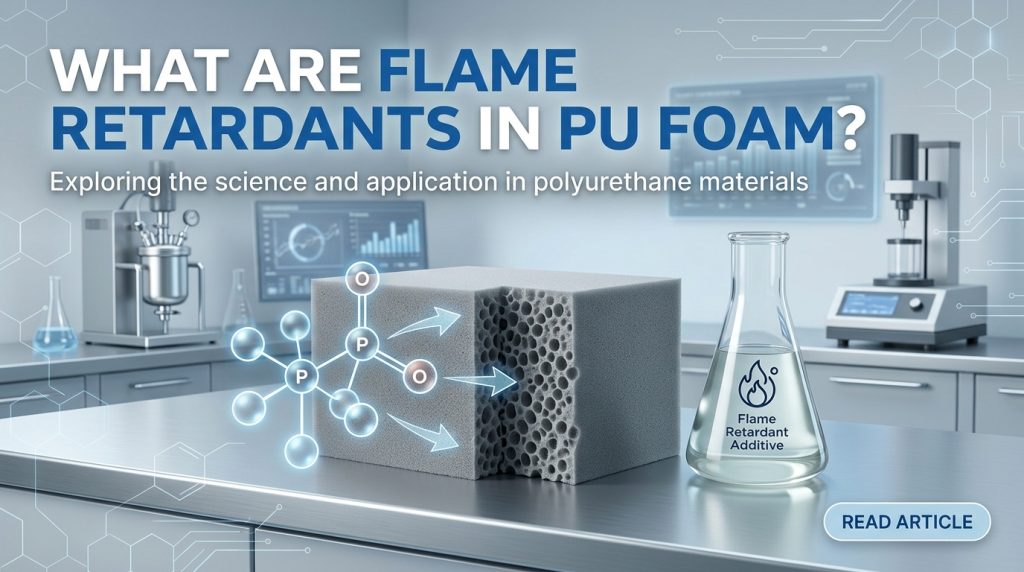
Polyurethane (PU) foam is widely used in furniture, automotive interiors, construction insulation, and many industrial applications. However, like many organic polymer materials, PU foam can burn under certain conditions.
Flame retardants help reduce the flammability of PU foam and improve its fire performance when properly selected and formulated. But adding a flame retardant is not simply a matter of choosing an additive. The right solution depends on the foam type, formulation, processing conditions, and required fire-safety standards.
1. What Are Flame Retardants in PU Foam?
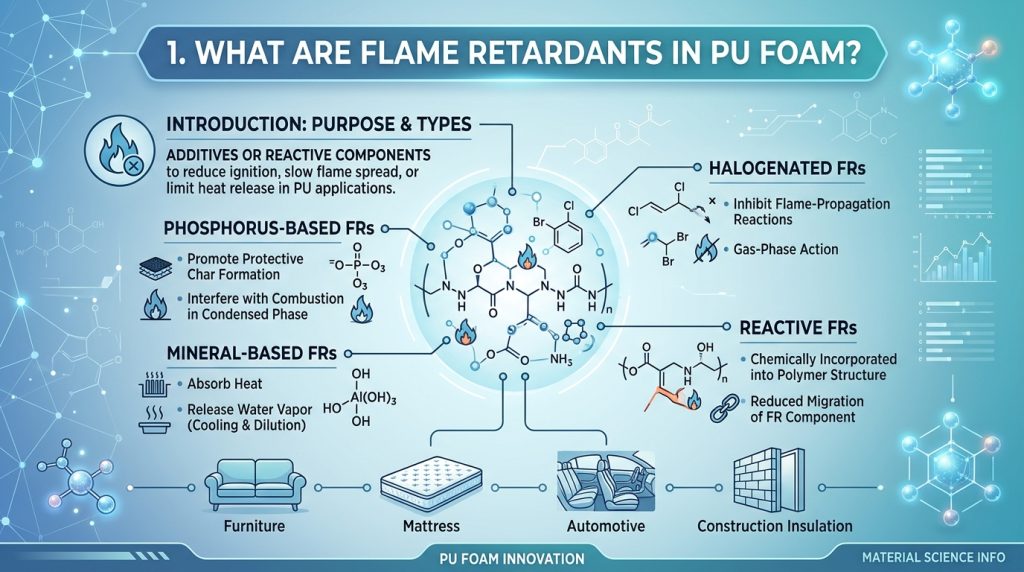
Flame retardants are additives or reactive components incorporated into polyurethane formulations to help reduce the material’s tendency to ignite, slow flame spread, or limit heat release.
Depending on their chemistry, they may be used in flexible foam, rigid insulation foam, molded foam, and other PU applications.
Common categories include:
- Phosphorus-based flame retardants: May promote protective char formation or interfere with combustion processes, depending on their chemistry.
- Halogenated flame retardants: Can inhibit certain flame-propagation reactions, although their suitability depends on regulatory and environmental requirements.
- Mineral-based flame retardants: Such as aluminum trihydrate (ATH), which can absorb heat and release water vapor when heated.
- Reactive flame retardants: Chemically incorporated into the polymer structure in selected formulations, helping reduce the migration of the flame-retardant component.
Different chemistries have different advantages and limitations. There is no single flame retardant suitable for every PU foam system.
2. Why Does PU Foam Need Flame Retardants?
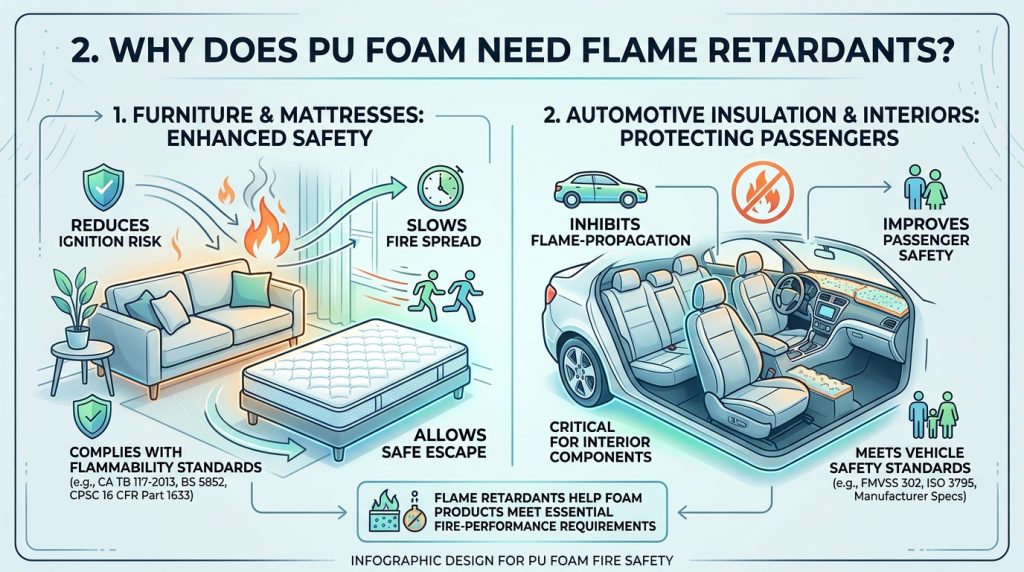
Flame retardants may be necessary when a foam product must meet specific fire-performance requirements.
Typical applications include:
- Furniture and mattresses: Foam may need to comply with applicable flammability requirements.
- Automotive interiors: Materials may need to meet vehicle-specific flammability standards.
- Building insulation: Fire performance must be evaluated alongside thermal insulation and other applicable building-code requirements.
- Industrial applications: Specific equipment or end-use environments may require defined fire-performance characteristics.
The important point is that flame retardants do not automatically make PU foam fireproof. The finished product must be tested against the relevant standard for its intended application.
3. How Do Flame Retardants Work?
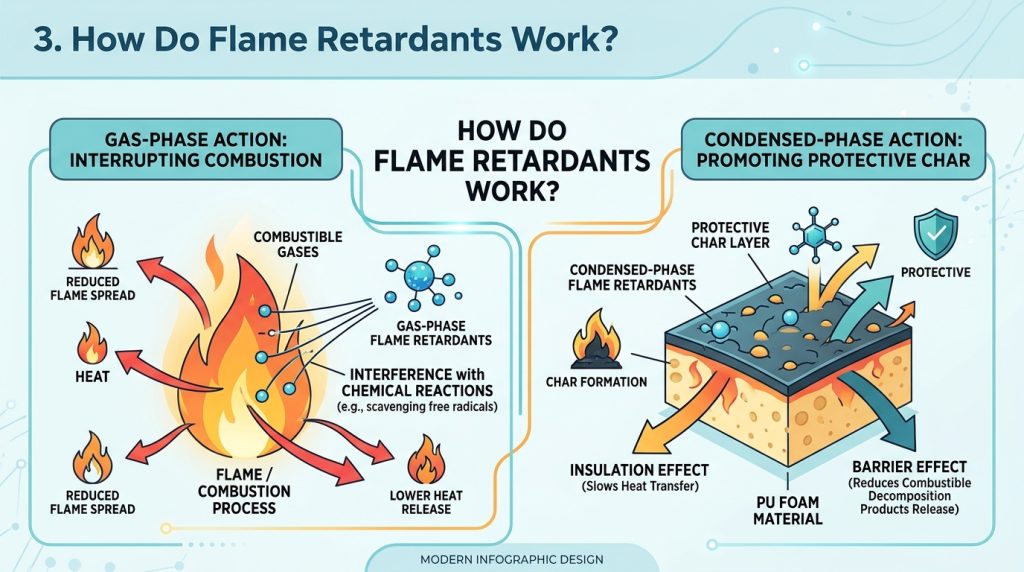
Flame retardants can influence combustion through several mechanisms, depending on their chemical structure.
Gas-phase action: Some flame retardants interfere with the chemical reactions that sustain a flame.
Condensed-phase action: Some promote the formation of a protective char layer that can slow heat transfer and reduce the release of combustible decomposition products.
Heat absorption and dilution: Certain mineral-based additives absorb heat as they decompose and release water vapor or other non-combustible gases, helping reduce local temperature or dilute combustible gases.
In practice, a flame-retardant PU formulation must balance fire performance with foam formation, cell structure, mechanical properties, and processing requirements.
4. Common Problems with Flame-Retardant PU Foam
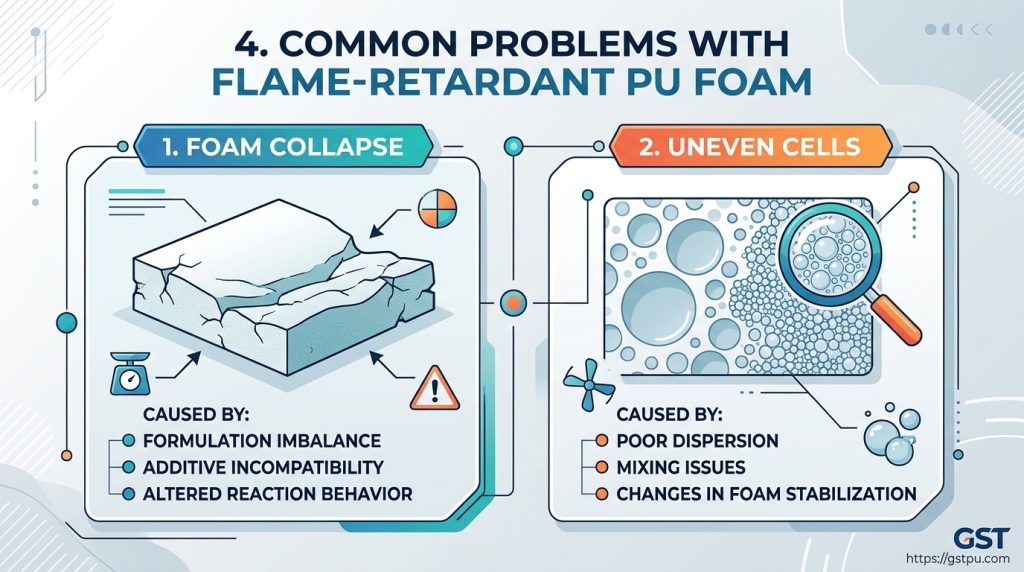
Adding a flame retardant can affect more than fire performance. Poor compatibility or an unsuitable formulation may introduce production challenges.
| Common problem | Possible causes | What to check |
| Foam collapse or poor rise | Formulation imbalance, additive incompatibility, or altered reaction behavior | Catalyst balance, additive compatibility, water level, and processing conditions |
| Uneven cells or inconsistent foam | Poor dispersion, mixing issues, or changes in foam stabilization | Mixing procedure, surfactant selection, and additive distribution |
| Reduced mechanical properties | Excessive additive loading or changes to the polymer network and cell structure | Additive dosage, formulation balance, and target foam properties |
| Fire-test results below target | Unsuitable flame-retardant chemistry, insufficient loading, or differences in the finished product | Applicable test standard, formulation, specimen conditions, and processing consistency |
These symptoms can have multiple causes. Testing and systematic troubleshooting are more reliable than simply increasing the flame-retardant dosage.
5. How Can These Problems Be Solved?
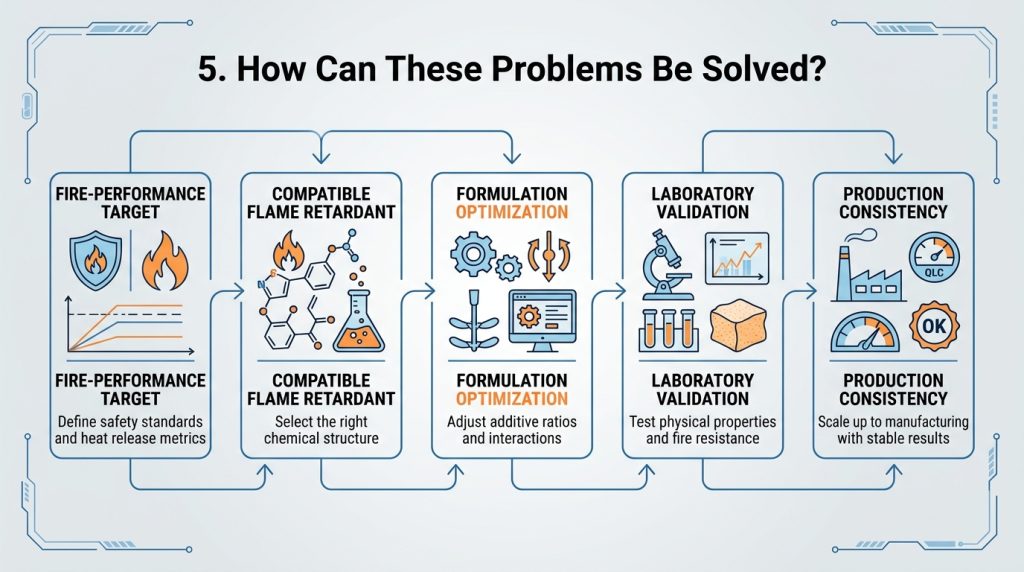
A practical approach starts with the end-use requirement and works backward to the formulation.
- Define the fire-performance target. Identify the applicable standard and testing method before selecting additives.
- Choose a compatible flame retardant. Consider the PU system, foam type, processing method, mechanical requirements, and relevant regulatory restrictions.
- Optimize the complete formulation. Evaluate interactions among the flame retardant, polyols, isocyanates, catalysts, surfactants, blowing agents, and other additives.
- Validate through laboratory testing. Check foam rise, cell structure, dimensional stability, and relevant mechanical properties, then arrange appropriate fire-performance testing.
- Confirm production consistency. Laboratory results should be followed by process validation under representative production conditions.
The goal is not simply to add more flame retardant. It is to develop a formulation that meets the required fire-performance target while maintaining acceptable foam quality and manufacturability.
6. How Can GST Support Your Flame-Retardant PU Foam Project?
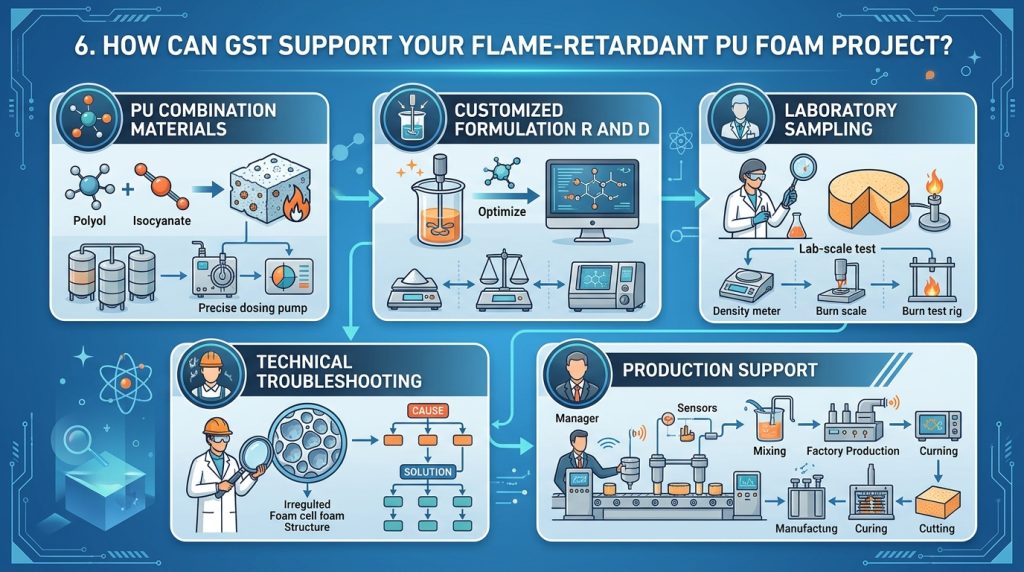
At GST, we understand that flame-retardant foam development requires more than an additive supplier. It requires coordination between material selection, formulation design, and production conditions.
As a polyurethane combination-material supplier with an independent laboratory and an experienced engineering team, GST can support customers through:
- PU combination materials: Flame-retardant system solutions for suitable flexible or rigid foam applications.
- Customized formulation R&D: Evaluating additive compatibility and balancing fire-performance targets with foam processing and physical properties.
- Laboratory sampling and testing: Assessing foam rise, cell structure, and selected physical properties, with appropriate fire testing arranged according to project requirements.
- Technical troubleshooting: Helping investigate collapse, uneven cells, dimensional instability, and other formulation-related challenges.
- Production support: Providing guidance on process optimization and helping customers evaluate the transition from laboratory samples to production trials.
Every application has different requirements. GST works with customers to understand their product, process, and target performance before evaluating a suitable material solution.
Conclusion
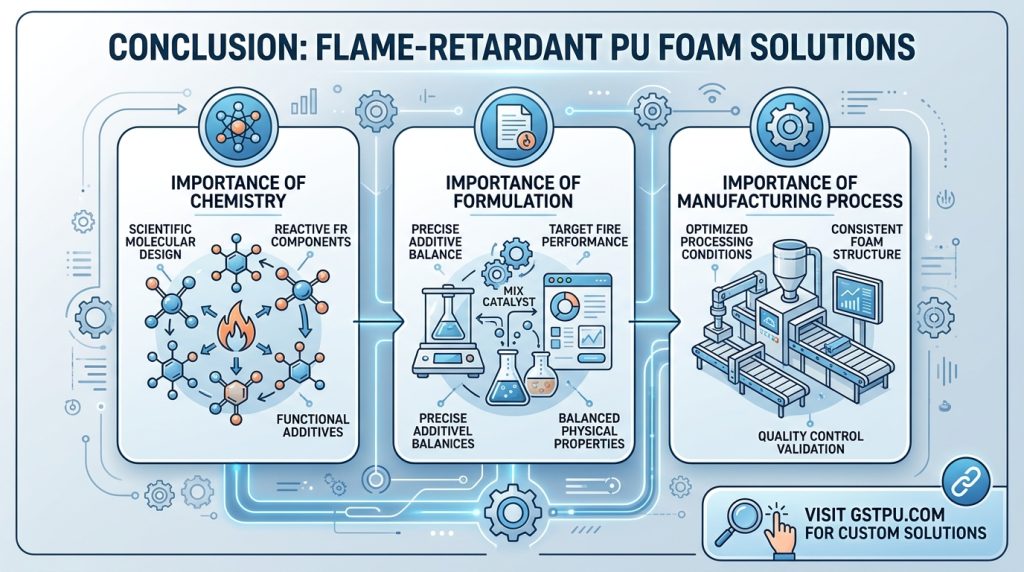
Flame retardants play an important role in developing PU foam for applications with specific fire-safety requirements. Their effectiveness depends on the flame-retardant chemistry, the overall formulation, the manufacturing process, and the applicable testing standard.
GST provides PU combination materials, formulation R&D, and technical support to help foam manufacturers evaluate flame-retardant solutions for their applications.
Looking for a flame-retardant PU foam solution? Contact GST at https://gstpu.com to discuss your product requirements and formulation challenges.
PREVIOUS:What Is a Silicone Surfactant?
CATEGORIES
LATEST NEWS
- What Is a Two-Component PU ...
- What Is Polyol Blend?
- What Is a Polyurethane System?
- How to Select Catalysts for...
- What Are Flame Retardants i...
- What Is a Silicone Surfactant?
- What Are Delayed-Action Cat...
- Balanced Catalysts for Poly...
- Blowing Catalysts in PU Foam
- Gelling Catalysts in PU Foam
CONTACT US
Tel:+86 18688691634
Email:sam@1688pu.com
Add:No. 91 Central East Rd, Luxi Village, Gaobu Town, Dongguan 523283, China.