What Is Polyester Polyol?
Polyester polyol is an important raw material used to produce polyurethane (PU) materials. Compared with polyether polyols, polyester polyols are known for their good mechanical strength, abrasion resistance, chemical resistance, and strong compatibility with certain applications.
They are widely used in rigid foam, spray foam, elastomers, adhesives, coatings, footwear, insulation materials, and other polyurethane products.
But polyester polyol itself is only one part of the PU system. The real challenge is how to select the right polyester polyol and balance it with isocyanate, catalysts, blowing agents, silicone surfactants, and other additives.
1,What Is Polyester Polyol?
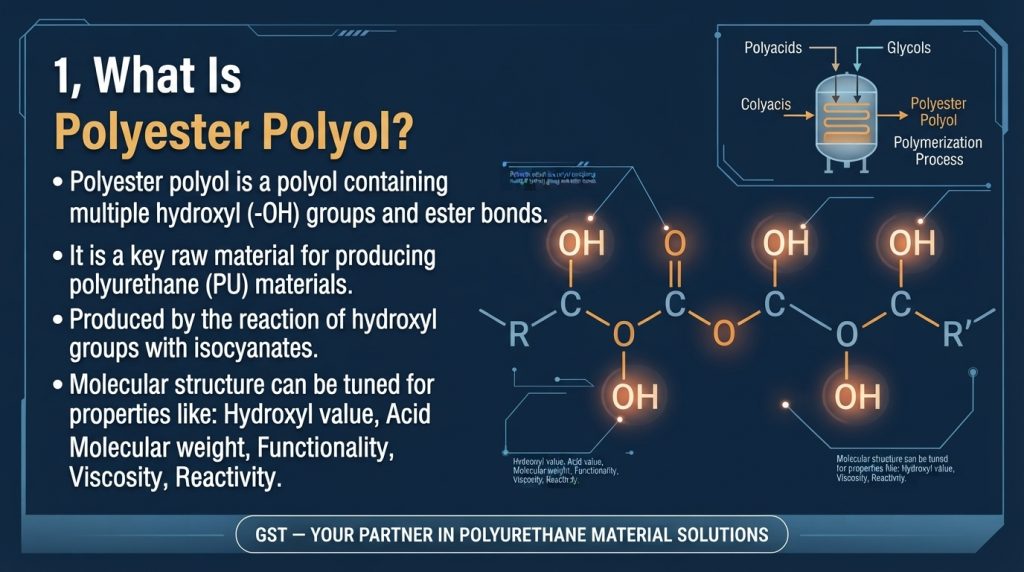
Polyester polyol is a polyol containing multiple hydroxyl (-OH) groups and ester bonds in its molecular structure.
During polyurethane production, the hydroxyl groups react with isocyanates to form polyurethane polymers.
The molecular structure of polyester polyol can be adjusted by selecting different raw materials and controlling parameters such as:
- Hydroxyl value
- Acid value
- Molecular weight
- Functionality
- Viscosity
- Reactivity
These parameters directly influence the final PU foam or polymer performance.
2,Why Is Polyester Polyol Needed?
Different PU applications require different performance characteristics.
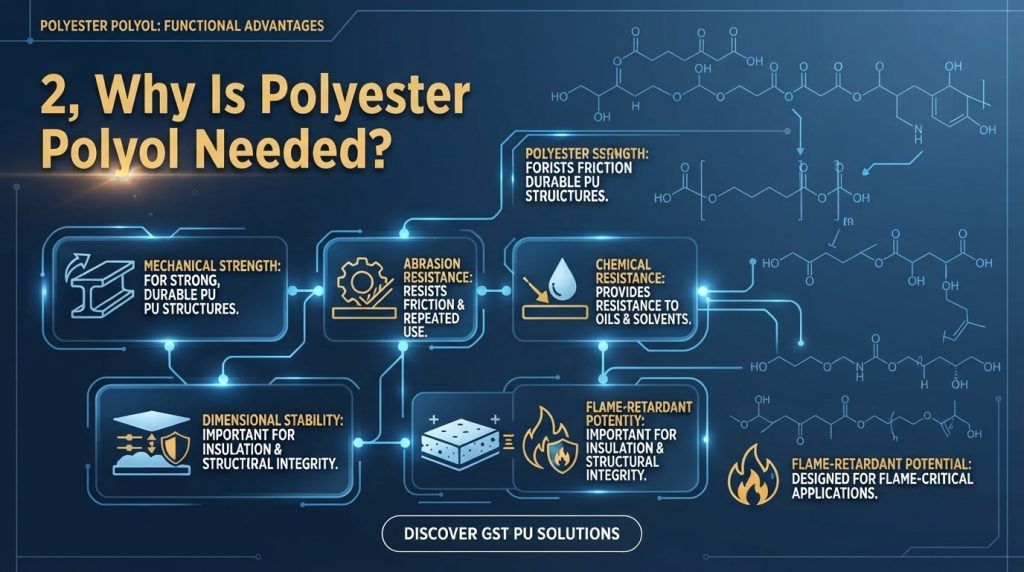
Polyester polyol can help improve properties such as:
Mechanical strength
Suitable for applications requiring strong and durable PU structures.
Abrasion resistance
Useful for products exposed to friction and repeated use.
Chemical resistance
Can provide better resistance to certain oils, solvents, and chemicals.
Dimensional stability
Important for insulation and structural PU applications.
Flame-retardant formulation potential
Certain polyester polyol systems can be designed for applications where flame performance is important.
This is why polyester polyol is frequently considered when developing high-performance PU systems.
3,How Does Polyester Polyol Work in PU Foaming?
In a typical PU system, polyester polyol does not work alone.
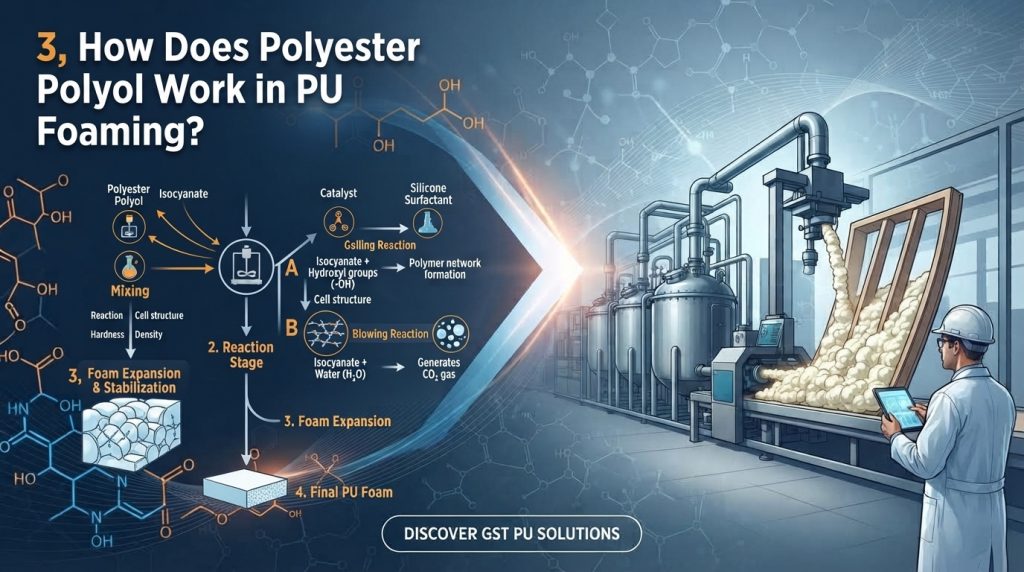
The formulation needs to achieve a balance between the polyol component and isocyanate, while catalysts control the reaction speed and silicone surfactants help stabilize the foam structure.
During foaming, two key reactions occur:
Gelling reaction:
Isocyanate reacts with hydroxyl groups to build the polymer network.
Blowing reaction:
Isocyanate reacts with water and generates CO₂, which helps create the foam cells.
The polyester polyol influences the reaction behavior, cell structure, hardness, density, resilience, and overall mechanical performance.
Therefore, simply replacing one polyol with another does not always produce the expected result.
4,Common Problems When Using Polyester Polyol
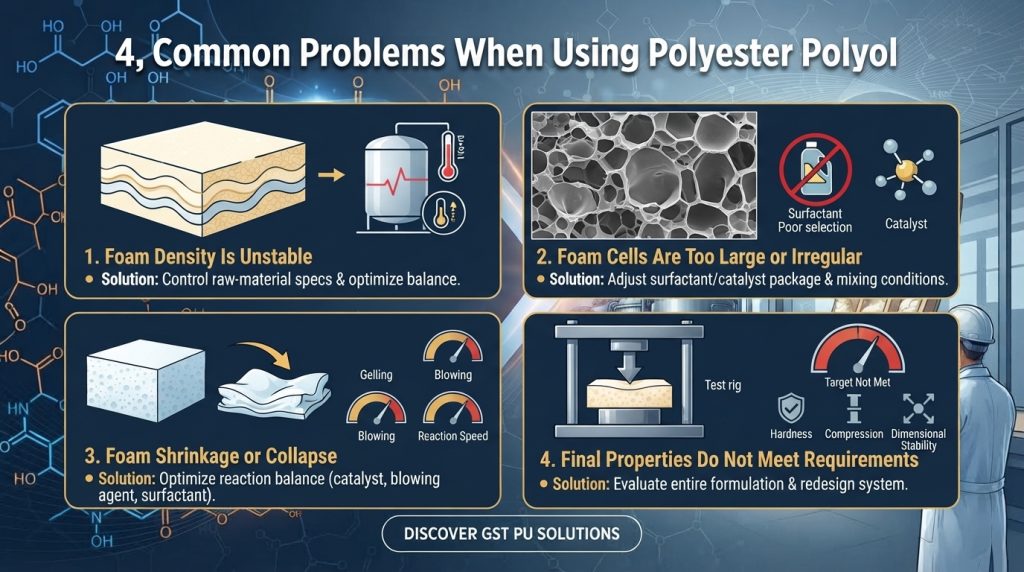
1. Foam Density Is Unstable
Changes in viscosity, hydroxyl value, raw-material temperature, or formulation balance can affect the foaming process.
Solution:
Control raw-material specifications and optimize the polyol/catalyst/blowing-agent balance through laboratory testing.
2. Foam Cells Are Too Large or Irregular
This may result from poor surfactant selection, incorrect catalyst balance, or an unsuitable reaction profile.
Solution:
Adjust the silicone surfactant and catalyst package while optimizing the formulation and mixing conditions.
3. Foam Shrinkage or Collapse
If the blowing reaction is too fast compared with the gelling reaction, the foam structure may not be strong enough to support itself.
Solution:
Optimize the reaction balance and adjust catalyst levels, water/blowing agent, surfactant, and polyol characteristics.
4. Final Properties Do Not Meet Requirements
Hardness, compression strength, dimensional stability, adhesion, or flame performance may not reach the target.
Solution:
Instead of changing one raw material blindly, evaluate the entire formulation and redesign the PU system according to the application.
5,How Can GST Help?
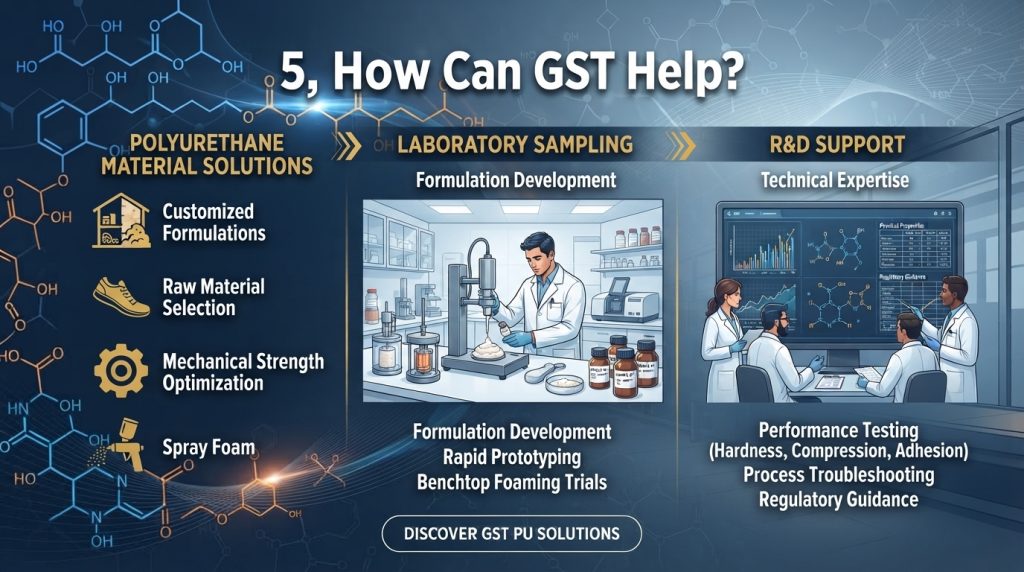
At GST, we understand that a good PU system is more than just a collection of raw materials.
GST provides polyurethane combination materials, formulation development, laboratory sampling, and technical application solutions for different PU applications.
Our R&D team can evaluate factors such as:
- Polyester polyol selection
- Isocyanate index
- Catalyst balance
- Blowing system
- Silicone surfactant
- Foam density
- Reaction profile
- Cell structure
- Mechanical properties
- Application conditions
Based on the customer’s product, equipment, target density, physical properties, and production process, GST can develop and optimize a suitable PU formulation.
From Raw Materials to Production
Whether you are developing PU rigid foam, spray insulation, structural foam, footwear, elastomers, or other polyurethane applications, GST can support the process from:
Application analysis → Raw-material selection → Formula development → Laboratory sampling → Foaming trial → Formula optimization → Production support
The goal is simple: make the formulation work in your actual production—not just in the laboratory.
Need a Polyester Polyol-Based PU Solution?
If you are looking for a polyester polyol PU system, customized formulation, laboratory sample, or technical support, contact GST.
GST — Your Partner in Polyurethane Material Solutions.
PREVIOUS:What Is Polyether Polyol?
CATEGORIES
LATEST NEWS
- Polyether Polyol vs Polyest...
- What Is Polyester Polyol?
- What Is Polyether Polyol?
- What Is Polyol?
- Why Is Reaction Balance Cri...
- Blowing Reaction vs Gelling...
- How Molecular Structure Det...
- Soft Segment vs Hard Segmen...
- What Is Crosslinking in Pol...
- What Is Polyurethane Polyme...
CONTACT US
Tel:+86 18688691634
Email:sam@1688pu.com
Add:No. 91 Central East Rd, Luxi Village, Gaobu Town, Dongguan 523283, China.