What Is Isocyanate?
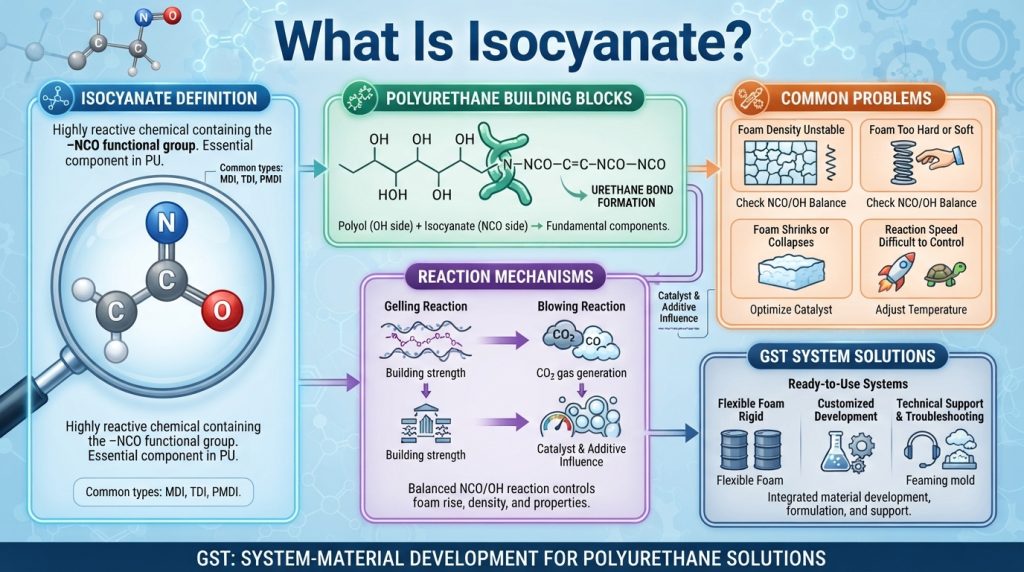
When talking about polyurethane, we often discuss polyols, catalysts, blowing agents, and additives. But there is another key component that makes the whole polyurethane reaction possible: Isocyanate.
So, what exactly is isocyanate? Why is it so important in polyurethane? And why can the same polyol produce completely different foam performance when the isocyanate side changes?
Let’s break it down.
What Is Isocyanate?
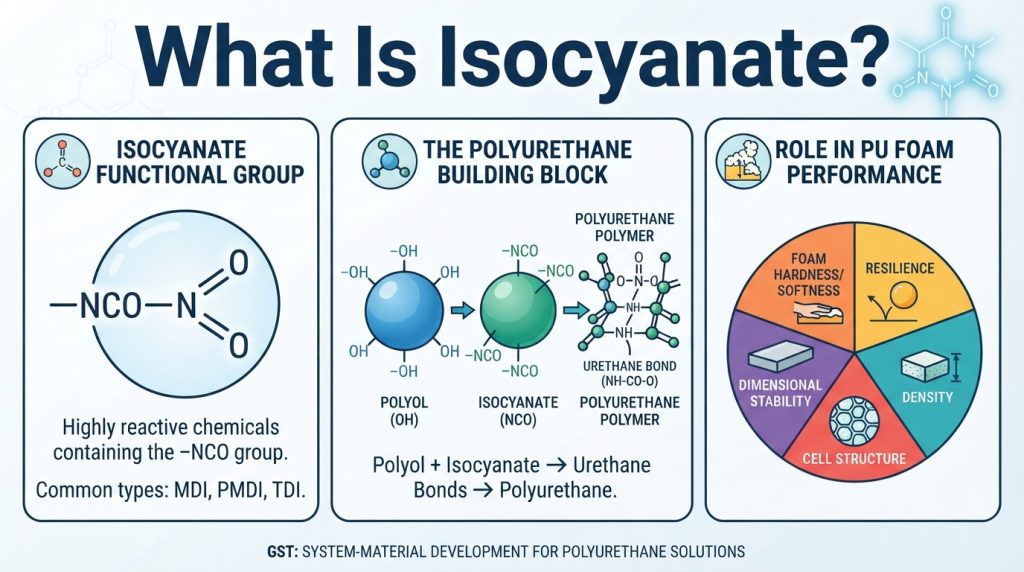
Isocyanates are a family of highly reactive chemicals containing the –NCO functional group.
In polyurethane production, commonly used isocyanates include MDI, polymeric MDI (PMDI), and TDI. They react with polyols containing hydroxyl groups (–OH) to form polyurethane polymers.
Simply put:
Polyol provides the “OH side,” while isocyanate provides the “NCO side.”
When these two components react, they form urethane bonds and build the polyurethane structure.
That is why isocyanate is not simply another raw material—it is one of the fundamental building blocks of polyurethane.
Why Do We Need Isocyanate?
Without isocyanate, there is no conventional polyurethane reaction.
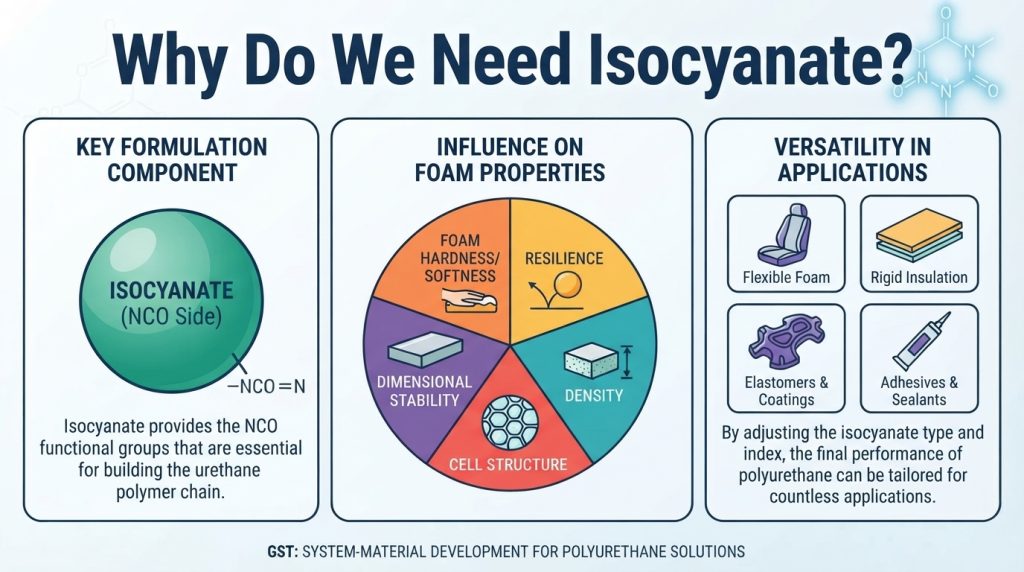
By adjusting the type and amount of isocyanate, formulators can influence important properties such as:
- Foam hardness and softness
- Resilience
- Density
- Cell structure
- Dimensional stability
- Mechanical strength
- Reaction profile
- Final product durability
This is also why polyurethane can be used for such different applications—from flexible foam and automotive seats to rigid insulation, elastomers, adhesives, and coatings.
The goal is not simply to “add more isocyanate.”
The real challenge is finding the right balance between NCO and OH for the target application.
How Does Isocyanate Work?
The basic polyurethane reaction is relatively simple:
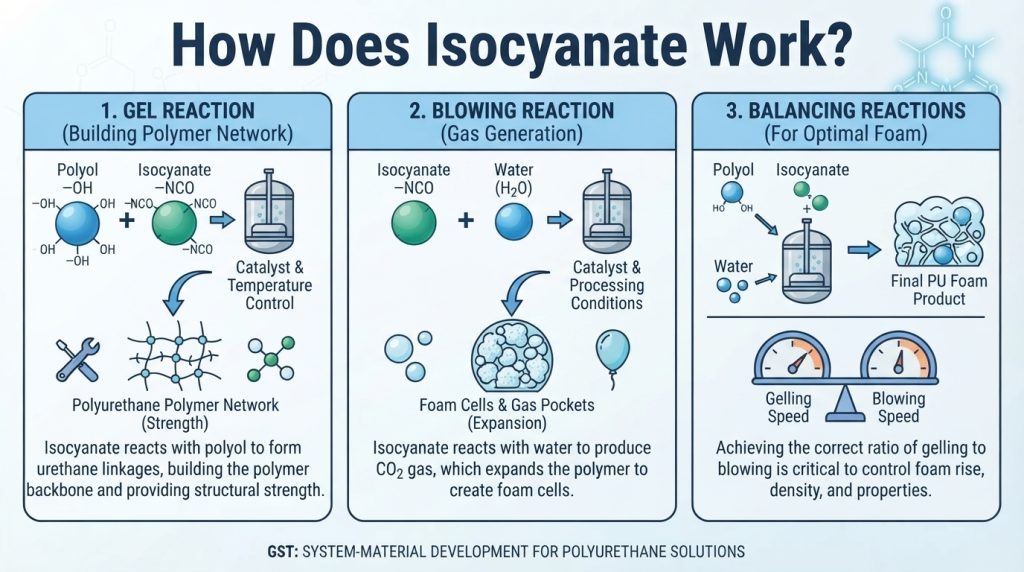
Polyol –OH + Isocyanate –NCO → Polyurethane
But the actual foaming process is much more complicated.
In a typical PU formulation, the isocyanate component interacts with the polyol system while catalysts, silicone surfactants, blowing agents, and other additives control the reaction and foam structure.
Two reactions are particularly important in many foam systems:
Gelling reaction
Helps build the polymer network and strength.
Blowing reaction
Generates gas and contributes to foam expansion and cell formation.
The balance between these reactions strongly affects whether the foam rises properly, develops an appropriate cell structure, and achieves the required physical properties.
So when a customer says:
“The foam density is correct, but the resilience is wrong.”
or
“The foam rises too quickly and collapses.”
The problem may not be the isocyanate alone. It can involve the entire formulation balance.
Common Isocyanate Problems
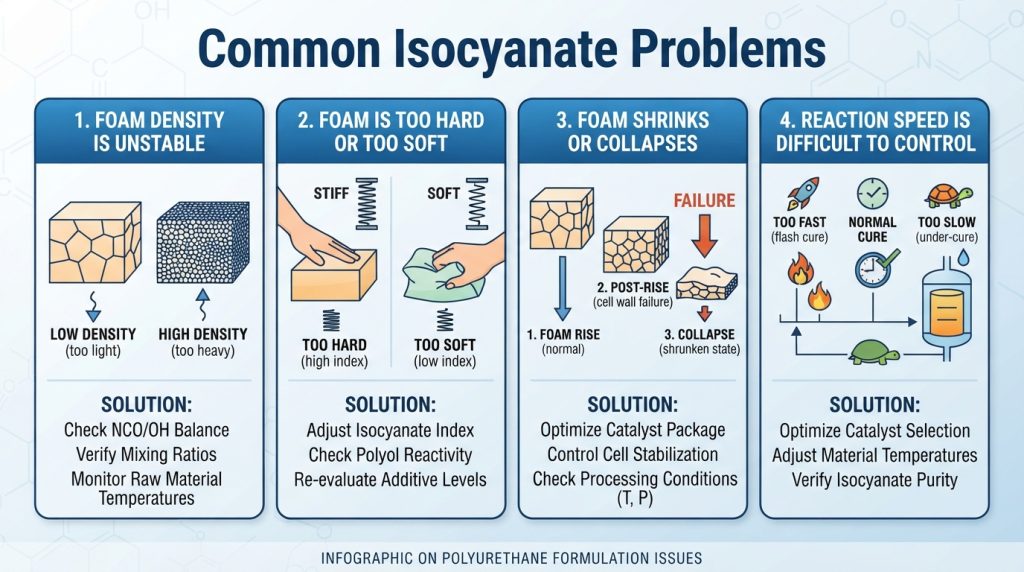
1. Foam Density Is Unstable
Small changes in the isocyanate/polyol balance, raw-material temperature, mixing conditions, or processing parameters can affect density.
Solution:
Check the NCO/OH balance, raw-material temperature, mixing ratio, machine parameters, and formulation consistency together instead of changing only one ingredient.
2. Foam Is Too Hard or Too Soft
Changing the isocyanate index can significantly influence the final polymer structure and physical properties.
Solution:
Adjust the formulation based on the target hardness, resilience, density, compression performance, and application requirements.
3. Foam Shrinks or Collapses
Foam collapse may be related to an imbalance between polymer formation and gas generation, but processing conditions and cell stabilization can also play important roles.
Solution:
Evaluate the complete formulation—including polyol, isocyanate, catalysts, surfactant, blowing system, and processing conditions.
4. Reaction Speed Is Difficult to Control
If the cream time, rise time, or gel time does not match the production process, operators may experience poor filling, incomplete molding, surface defects, or inconsistent products.
Solution:
Instead of simply changing the isocyanate dosage, optimize the catalyst package and overall formulation together.
Is More Isocyanate Always Better?
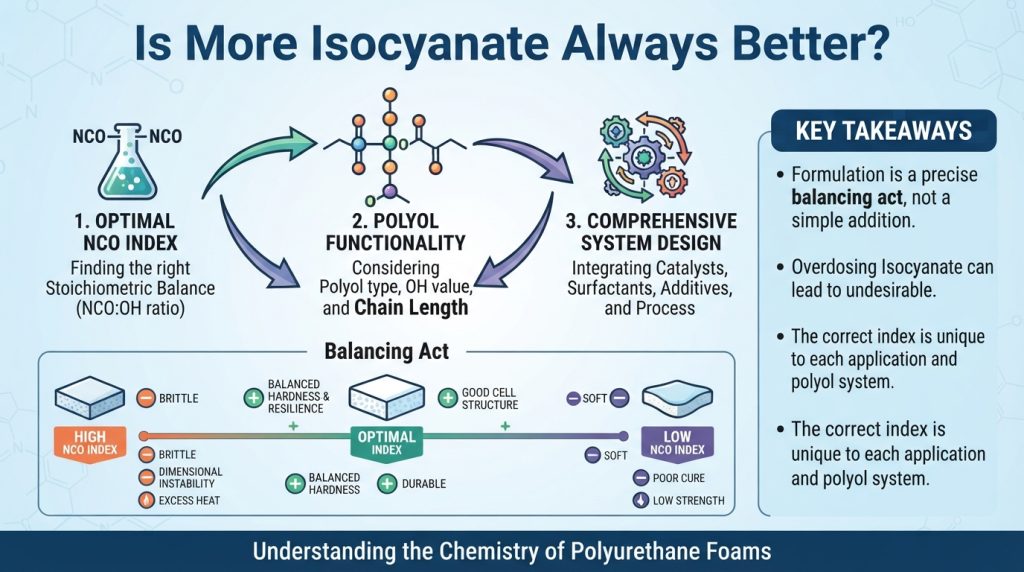
No.
Polyurethane formulation is a balancing process.
Too little or too much isocyanate can change reaction behavior and final properties. The optimum level depends on the polyol functionality, OH value, desired NCO index, additives, processing method, and end-use requirements.
This is why simply purchasing individual raw materials and mixing them according to a fixed ratio does not always produce stable industrial foam.
The formulation has to be designed as a system.
How Can GST Help?
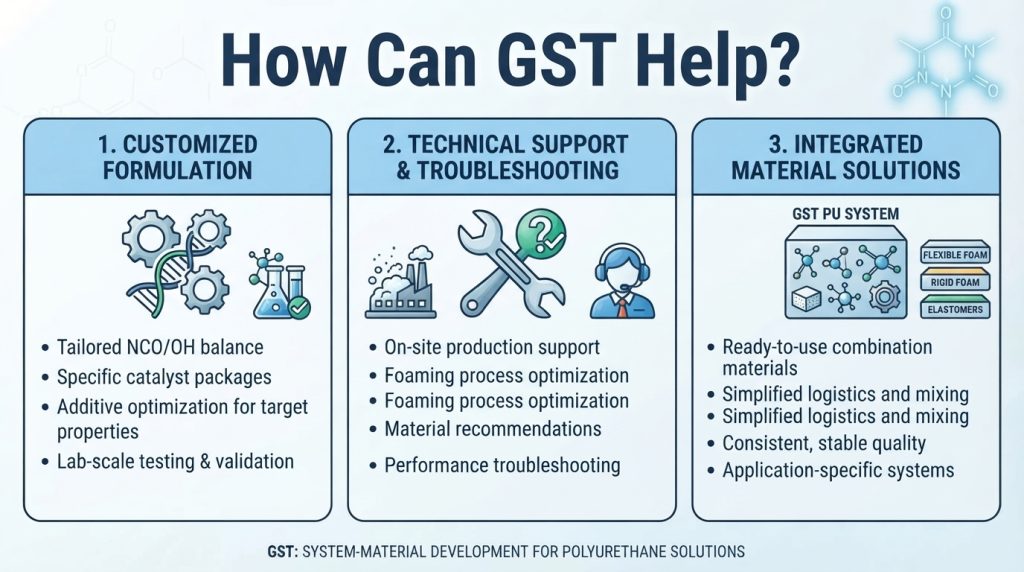
This is where GST’s polyurethane formulation and system-material development capability becomes valuable.
Instead of supplying only individual raw materials, GST can provide a more integrated solution:
1. Ready-to-Use PU Combination Materials
GST develops polyurethane combination materials for different applications, helping customers reduce the complexity of handling and balancing multiple raw materials.
Depending on the application, GST can provide systems for:
- Flexible and high-resilience foam
- Memory foam
- Rigid foam
- Spray insulation
- Self-skinning foam
- Gel systems
- Bio-based polyurethane systems
2. Customized Formulation Development
Different factories have different machines, molds, densities, production temperatures, cycle times, and performance requirements.
GST can adjust the formulation according to the customer’s actual production conditions and target specifications.
The objective is not simply to make the foam rise.
The objective is to make it rise correctly, cure correctly, and perform consistently.
3. Sample Testing & Formula Adjustment
If a customer already has a foam sample, GST can analyze the required performance and help develop or adjust a suitable polyurethane system.
Typical evaluation can include:
Density → Hardness → Resilience → Cell Structure → Compression → Reaction Profile → Processing Stability
This allows formulation development to move from trial-and-error toward a more systematic approach.
4. Technical Support
GST can also provide technical support during production trials, including material recommendations, formulation adjustment, foaming guidance, and troubleshooting.
For customers who want to develop their own PU products, the combination of system materials + formulation development + technical support can shorten the path from laboratory testing to stable production.
Isocyanate Is Only One Part of the Puzzle
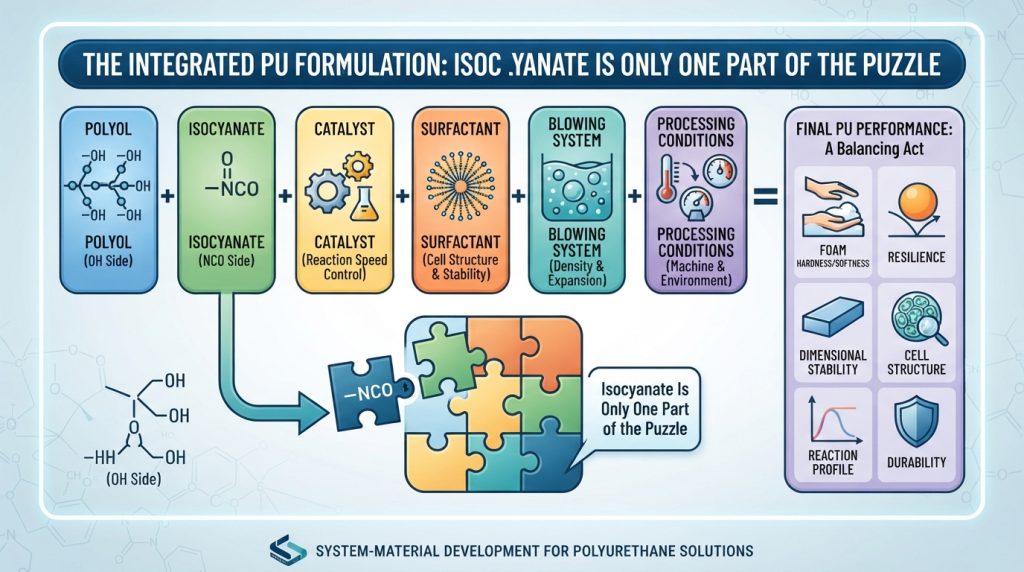
Understanding isocyanate is important.
But successful polyurethane production requires more than understanding one raw material.
Polyol + Isocyanate + Catalyst + Surfactant + Blowing System + Processing Conditions = Final PU Performance
A small change in one component can affect the entire system.
That is why experienced formulation development matters.
At GST, our goal is not simply to supply polyurethane raw materials. We focus on helping customers develop practical, stable, and application-oriented polyurethane system solutions.
Need a PU combination material, customized formulation, or technical support for your application?
Talk to GST and let’s develop the right PU system for your production.
PREVIOUS:How to Select the Right Polyol for PU Formulation?
NEXT:What Is MDI?
CATEGORIES
LATEST NEWS
- What Is TDI?
- What Is Polymeric MDI (pMDI)?
- What Is MDI?
- What Is Isocyanate?
- How to Select the Right Pol...
- How Does Polyol Affect Foam...
- What Is Hydroxyl Value (OH ...
- What Is Polyol Functionality?
- BASF Ludwigshafen Incident:...
- What Is Polyol Molecular We...
CONTACT US
Tel:+86 18688691634
Email:sam@1688pu.com
Add:No. 91 Central East Rd, Luxi Village, Gaobu Town, Dongguan 523283, China.