What Are Delayed-Action Catalysts?
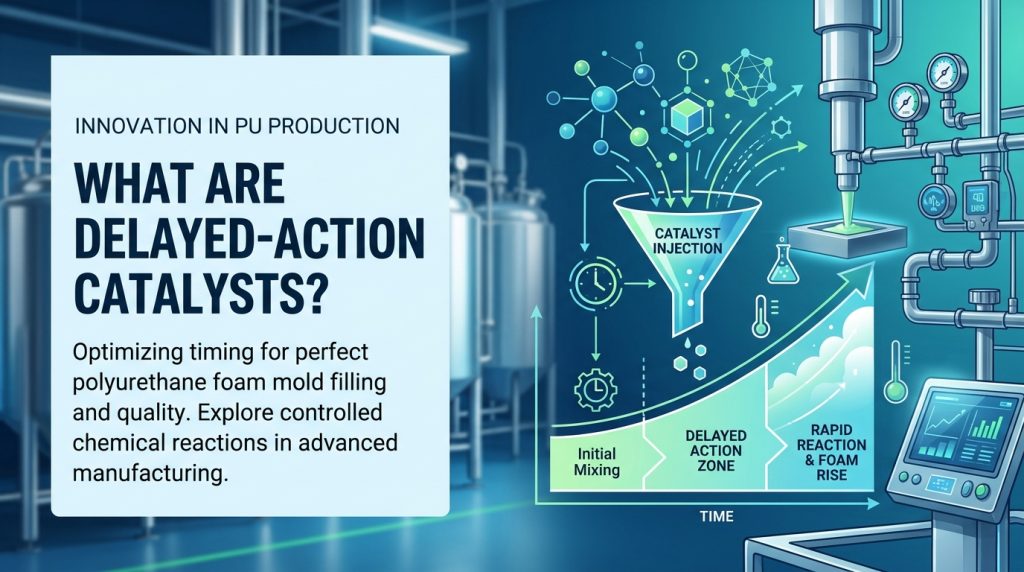
In polyurethane (PU) foam production, timing is just as important as reaction speed. If the reaction starts too quickly, mixing, pouring, or mold filling may become difficult. If it starts too slowly, production efficiency and foam quality may suffer.
This is where delayed-action catalysts can make a difference.
What Are Delayed-Action Catalysts?
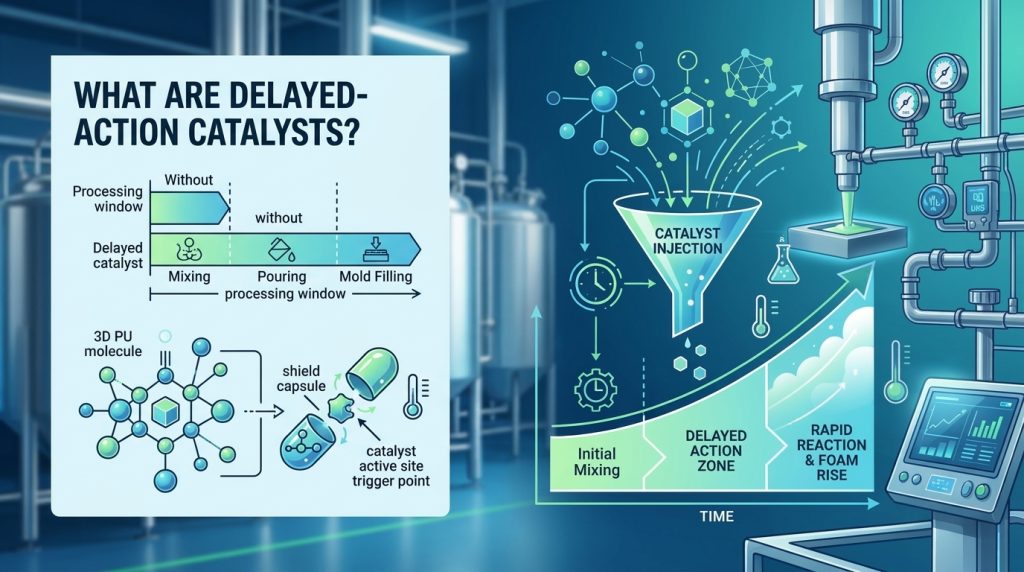
Delayed-action catalysts are catalysts designed to provide reduced catalytic activity during the early stage of processing, followed by stronger catalytic activity as the reaction progresses.
They are used in selected polyurethane formulations to help control reaction timing, improve processing flexibility, and coordinate foam expansion with polymer formation.
Their behavior depends on the catalyst chemistry, formulation, temperature, and processing conditions. Not every catalyst marketed as delayed-action works in the same way.
Why Does PU Foam Need Delayed-Action Catalysts?
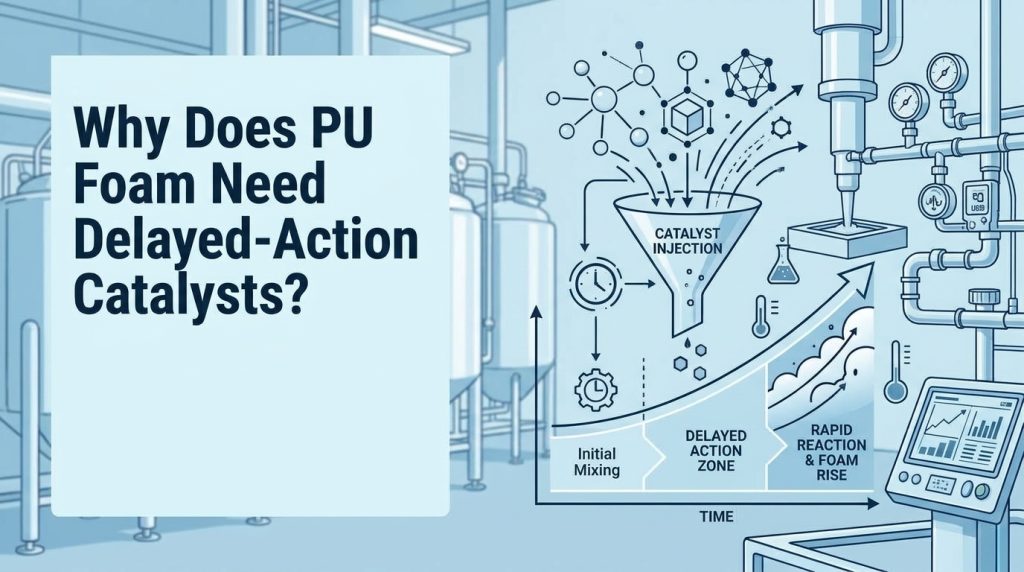
In many PU applications, manufacturers need enough time to mix ingredients, pour the system, or fill a mold before the foam becomes too reactive.
Delayed-action catalysts can help provide:
- Longer processing time: More time for mixing, pouring, or mold filling when required.
- Better mold filling: Helps the reacting mixture reach the intended areas before significant expansion or gelation.
- Improved process control: Helps coordinate the timing of blowing and gelling reactions.
- More consistent production: Supports repeatable processing when the catalyst system is properly matched to the formulation.
They can be particularly useful in selected molded foam and other applications where reaction timing and filling behavior are critical.
How Do Delayed-Action Catalysts Work?
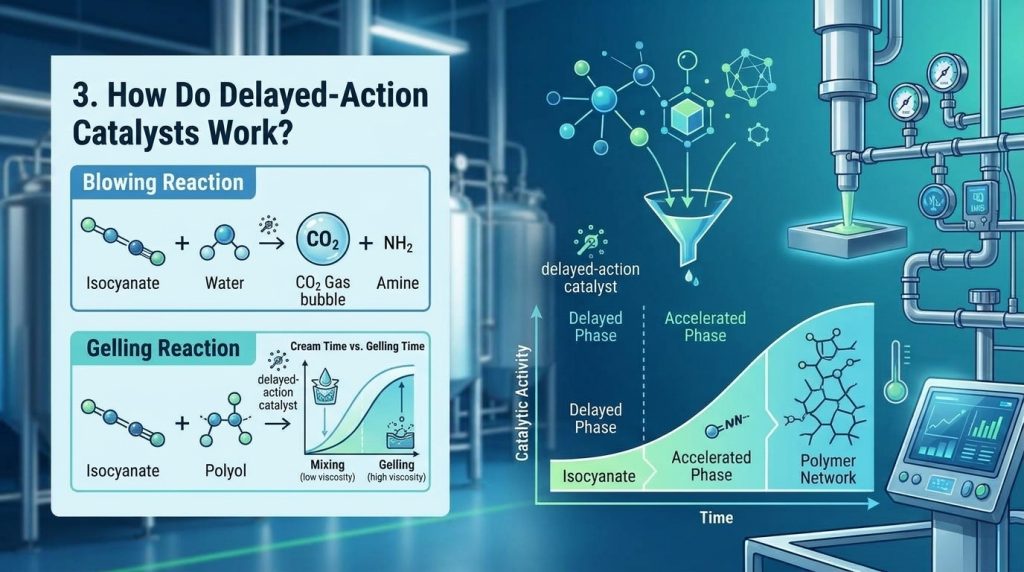
Polyurethane foam formation involves several competing reactions. The blowing reaction generates carbon dioxide when isocyanate reacts with water, while the gelling reaction builds the polymer network through reactions between isocyanate and polyol.
A delayed-action catalyst system is selected to manage when catalytic activity becomes significant. Depending on its chemistry, it may limit early reaction activity and allow the reaction rate to increase later under the intended processing conditions.
The goal is to provide enough time for processing, followed by sufficient reaction activity to support foam rise, structure development, and curing.
The key is not simply slowing the reaction down—it is controlling when the reaction needs to accelerate.
Common Problems and How to Solve Them
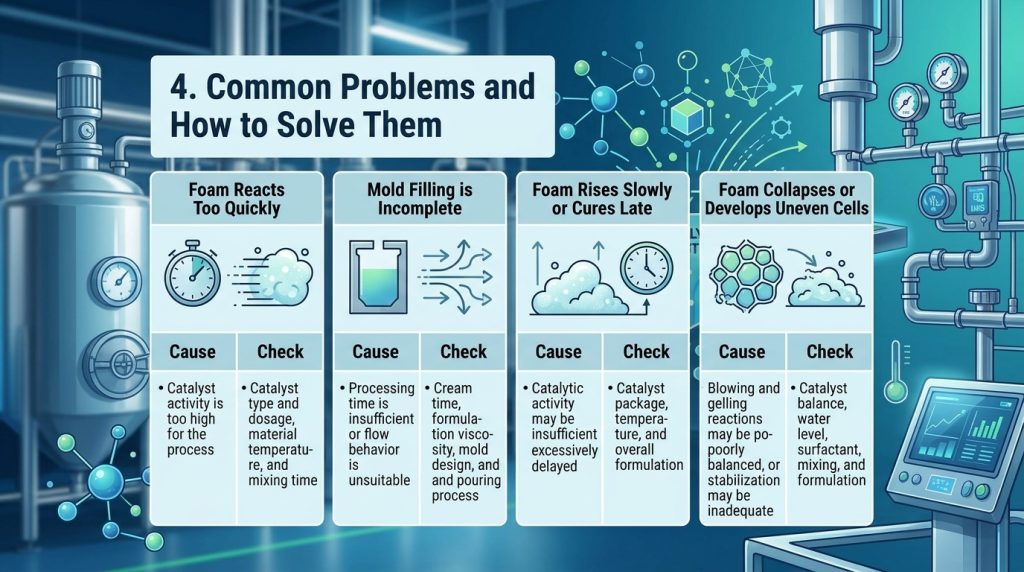
| Common problem | Possible causes | What to check |
| Foam reacts too quickly | Catalyst activity is too high for the process | Catalyst type and dosage, material temperature, and mixing time |
| Mold filling is incomplete | Processing time is insufficient or flow behavior is unsuitable | Cream time, formulation viscosity, mold design, and pouring process |
| Foam rises slowly or cures late | Catalytic activity may be insufficient or excessively delayed | Catalyst package, temperature, and overall formulation |
| Foam collapses or develops uneven cells | Blowing and gelling reactions may be poorly balanced, or cell stabilization may be inadequate | Catalyst balance, water level, surfactant, mixing, and formulation |
These symptoms can have multiple causes. Delayed-action catalysts are not a universal fix; adjustments should be based on the foam system, equipment, and production conditions.
How Can GST Help?
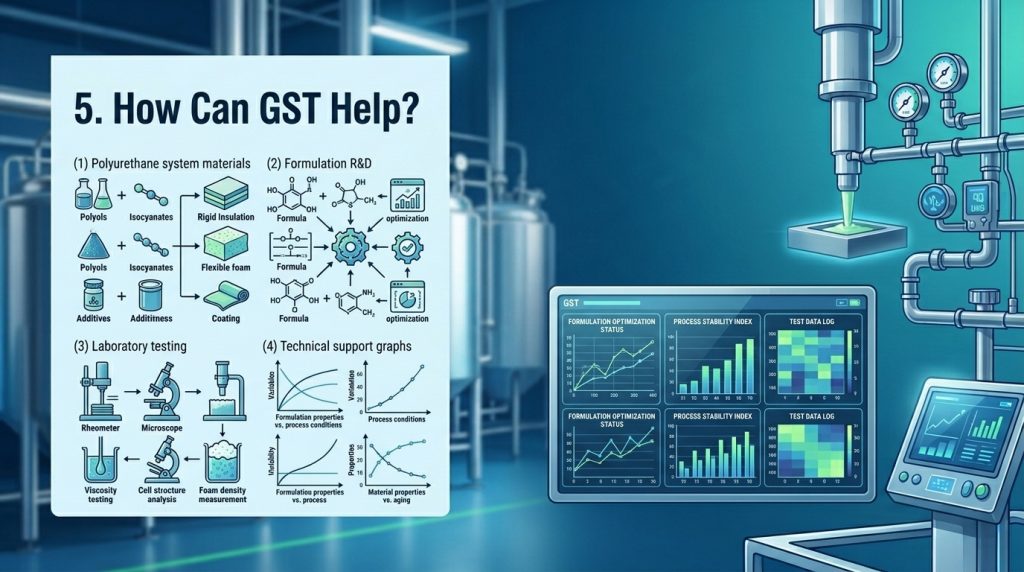
At GST, we focus on more than supplying individual catalysts. We help customers optimize the complete polyurethane system to match their application and processing requirements.
Our support includes:
- PU combination materials: Systems tailored to different foam applications and production processes.
- Customized formulation development: Catalyst selection and dosage optimization based on required processing time, rise profile, and final foam properties.
- Laboratory sampling and testing: Evaluation of reaction behavior and foam performance before production trials.
- Technical troubleshooting: Support for issues such as fast reaction, incomplete mold filling, slow curing, and foam instability.
- Production guidance: Assistance in adjusting processing conditions and improving batch-to-batch consistency.
Conclusion
Delayed-action catalysts can help manufacturers manage reaction timing and improve processing flexibility in suitable PU applications. Their effectiveness depends on the catalyst chemistry and how well it is integrated into the overall formulation.
GST combines PU system materials, formulation R&D, laboratory testing, and technical support to help manufacturers develop more controllable and reliable foaming processes.
Looking to optimize your PU processing time or mold-filling performance? Contact GST to discuss your application and formulation requirements.
PREVIOUS:Balanced Catalysts for Polyurethane: The Key to Stable Foam Performance
CATEGORIES
LATEST NEWS
- What Is a Two-Component PU ...
- What Is Polyol Blend?
- What Is a Polyurethane System?
- How to Select Catalysts for...
- What Are Flame Retardants i...
- What Is a Silicone Surfactant?
- What Are Delayed-Action Cat...
- Balanced Catalysts for Poly...
- Blowing Catalysts in PU Foam
- Gelling Catalysts in PU Foam
CONTACT US
Tel:+86 18688691634
Email:sam@1688pu.com
Add:No. 91 Central East Rd, Luxi Village, Gaobu Town, Dongguan 523283, China.