What Is a Silicone Surfactant?
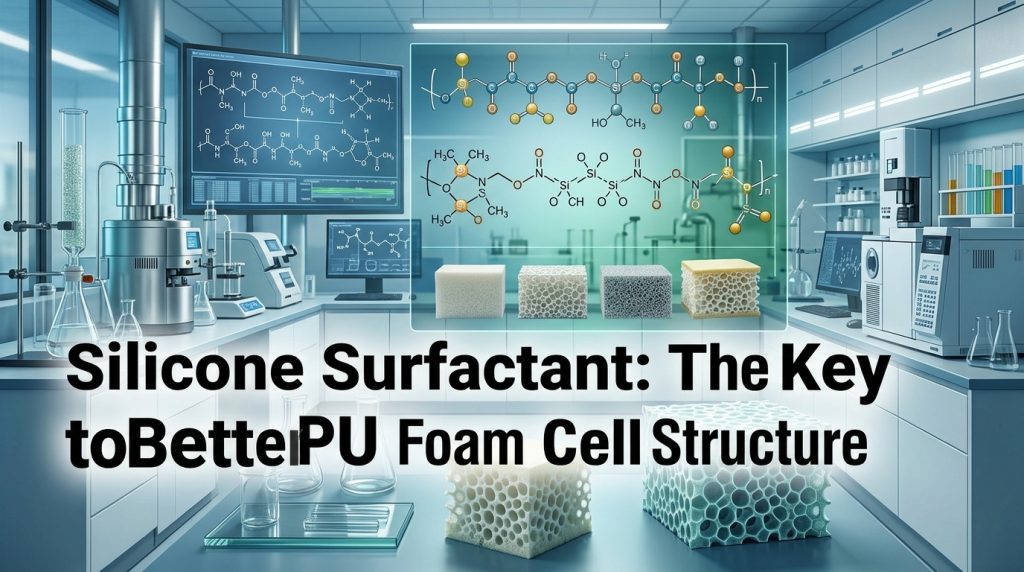
In polyurethane (PU) foam production, small formulation changes can make a big difference. Foam may collapse, develop uneven cells, or show inconsistent quality—even when the main raw materials are correctly selected.
One important factor is the silicone surfactant. It helps stabilize the foam structure as the chemical reactions take place.
What Is a Silicone Surfactant?
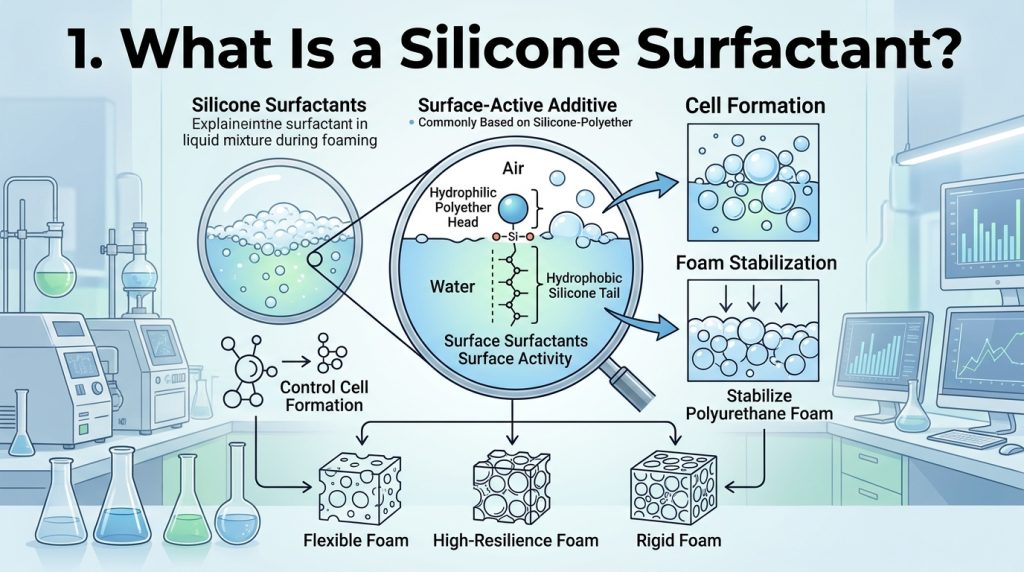
A silicone surfactant is a surface-active additive, commonly based on silicone-polyether chemistry, used to help control cell formation and stabilize polyurethane foam during foaming.
Different surfactants are designed for different PU systems, including flexible foam, high-resilience foam, and rigid foam. Choosing the right type is essential for achieving the required cell structure and processing performance.
Why Does PU Foam Need Silicone Surfactants?
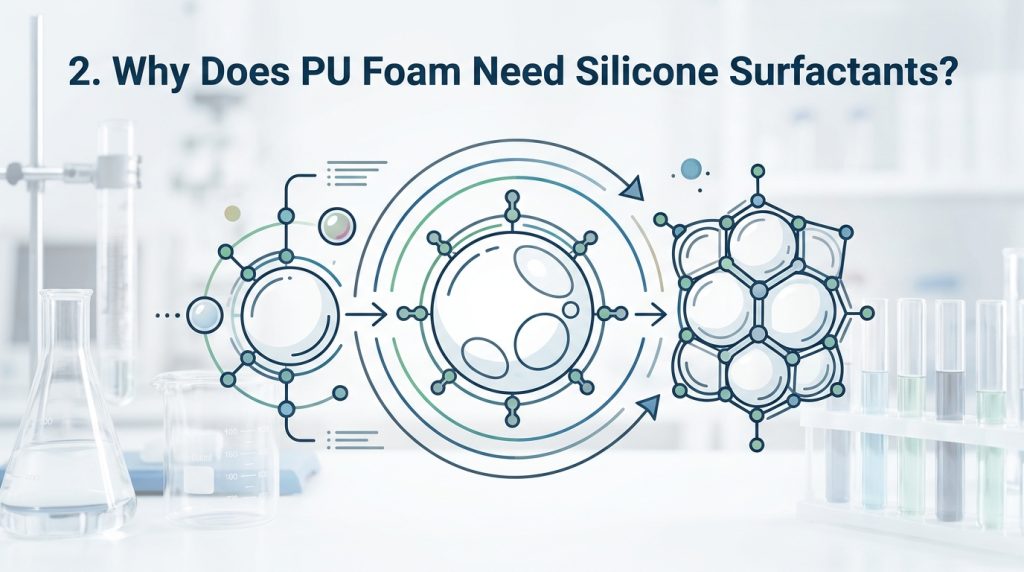
During foaming, gas bubbles form and expand. Without sufficient stabilization, bubbles may merge, rupture, or collapse before the polymer network becomes strong enough.
A suitable silicone surfactant can help:
- Stabilize foam cells and reduce unwanted bubble coalescence.
- Improve cell uniformity for more consistent foam structure.
- Support foam rise and dimensional stability when matched to the formulation.
- Improve process consistency across production batches.
The right surfactant depends on the foam type, target density, formulation, and processing conditions.
How Does a Silicone Surfactant Work?
Silicone surfactants help regulate the interfaces between gas and the reacting liquid mixture. They influence surface and interfacial behavior, helping bubbles form and remain stable while the polyurethane structure develops.
In simple terms, the blowing reaction generates gas, while the surfactant helps stabilize the developing cells. Meanwhile, the gelling reaction builds the polymer network that supports the foam.
The goal is to balance cell stabilization, gas expansion, and polymer strength—not simply to add more surfactant.
Common Problems and How to Solve Them
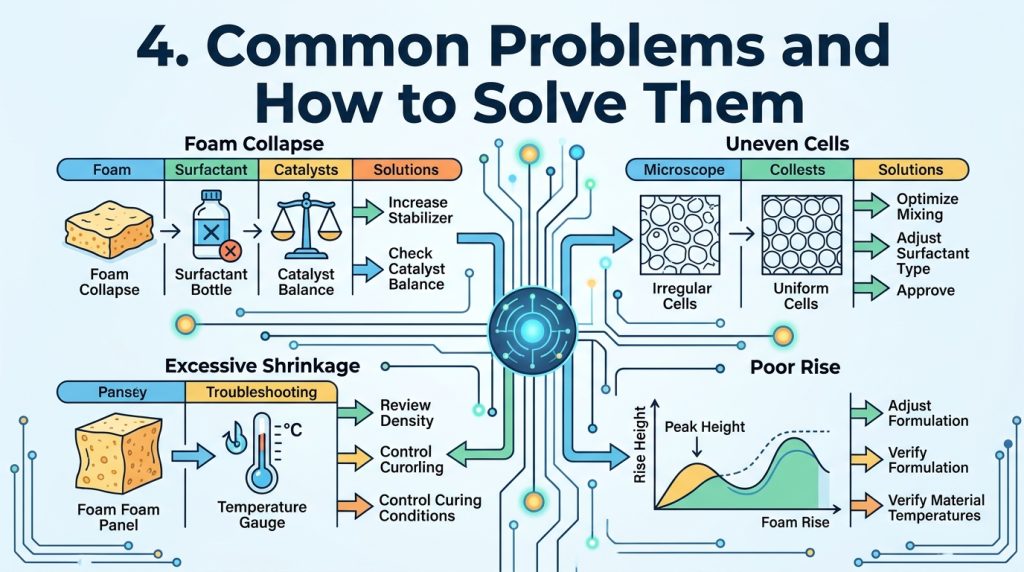
| Common problem | Possible causes | What to check |
| Foam collapse | Insufficient cell stabilization, poor blowing/gelling balance, or unsuitable processing conditions | Surfactant compatibility, catalyst balance, water level, and mixing |
| Uneven or coarse cells | Unsuitable surfactant, poor mixing, or unstable bubble formation | Surfactant type and dosage, mixing quality, and formulation compatibility |
| Excessive shrinkage | Inadequate cell stability or pressure imbalance during cooling | Surfactant selection, foam structure, density, and curing conditions |
| Foam rises poorly or has an inconsistent structure | Formulation imbalance or surfactant incompatibility | Surfactant, catalyst package, raw material temperatures, and processing conditions |
These problems can have multiple causes. Changing the surfactant alone may not solve them; the complete formulation and production process should be evaluated.
How Can GST Help?

At GST, we understand that stable PU foam requires the right combination of raw materials, additives, and reaction control.
We support foam manufacturers with:
- PU combination materials: Systems designed for different foam applications and production requirements.
- Formulation R&D: Surfactant selection and dosage optimization alongside catalysts, polyols, water, and isocyanates.
- Laboratory sampling and testing: Evaluation of cell structure, foam rise, and dimensional stability.
- Technical troubleshooting: Support for collapse, uneven cells, shrinkage, and inconsistent production results.
- Process optimization: Practical guidance to help customers improve foam quality and production repeatability.
Conclusion
Silicone surfactants play an important role in polyurethane foam cell stabilization and structure control. The right choice can help improve foam consistency, but performance depends on the complete formulation and processing conditions.
GST combines PU system materials, formulation R&D, laboratory testing, and technical support to help manufacturers find solutions for their specific foaming challenges.
Looking to improve your PU foam cell structure or solve a recurring foaming problem? Contact GST to discuss your application and formulation requirements.
PREVIOUS:What Are Delayed-Action Catalysts?
CATEGORIES
LATEST NEWS
- What Is a Two-Component PU ...
- What Is Polyol Blend?
- What Is a Polyurethane System?
- How to Select Catalysts for...
- What Are Flame Retardants i...
- What Is a Silicone Surfactant?
- What Are Delayed-Action Cat...
- Balanced Catalysts for Poly...
- Blowing Catalysts in PU Foam
- Gelling Catalysts in PU Foam
CONTACT US
Tel:+86 18688691634
Email:sam@1688pu.com
Add:No. 91 Central East Rd, Luxi Village, Gaobu Town, Dongguan 523283, China.