What Is a Polyurethane System?
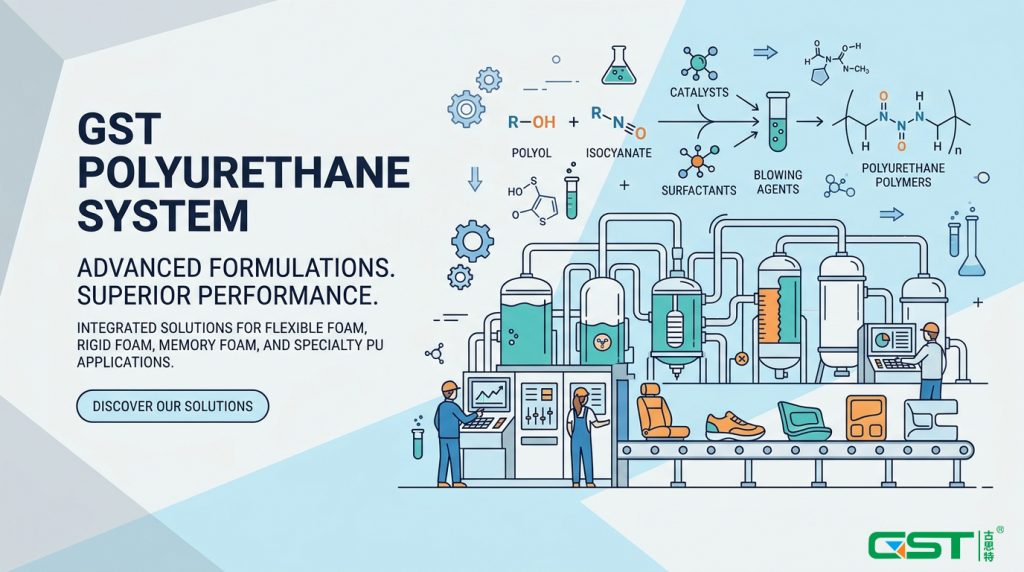
Polyurethane (PU) products are used in countless industries, including automotive, furniture, footwear, construction, electronics, and household products. But behind every successful PU foam product is more than just polyol and isocyanate.
A polyurethane system is a carefully designed combination of raw materials formulated to achieve specific processing characteristics and final product performance.
Choosing the right PU system can make a significant difference in foam quality, production efficiency, and manufacturing consistency.
1. What Is a Polyurethane System?
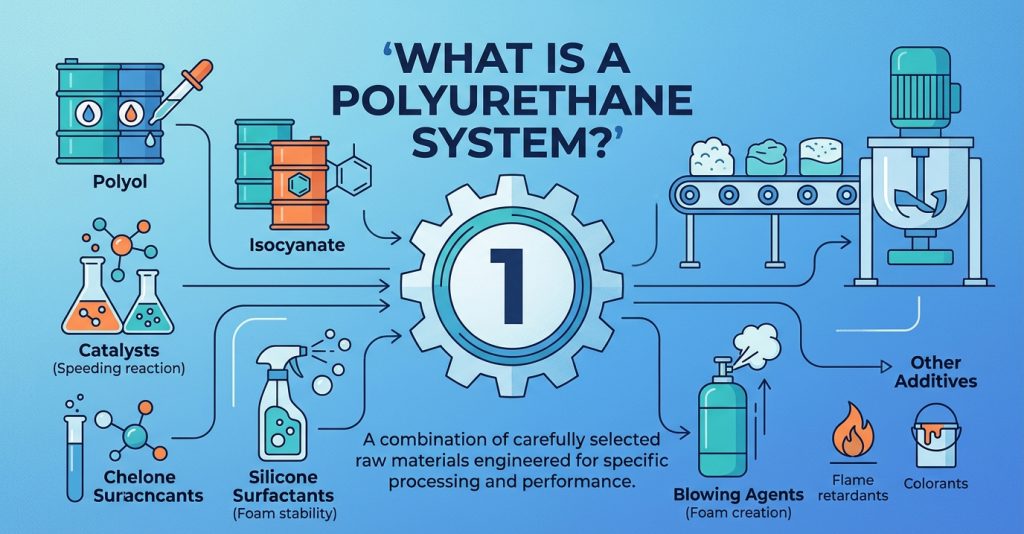
A polyurethane system is a combination of selected raw materials designed to work together during the foaming or molding process.
Depending on the application, a typical PU system may contain:
- Polyol: The main component that reacts with isocyanate to form polyurethane.
- Isocyanate: Usually TDI or MDI, providing the reactive NCO groups needed to build the polymer structure.
- Catalysts: Control the speed and balance of blowing and gelling reactions.
- Silicone surfactants: Help stabilize foam cells and control cell structure.
- Blowing agents: Generate or introduce gas to create the foam structure.
- Other additives: Such as flame retardants, colorants, crosslinkers, and cell regulators, depending on product requirements.
In many commercial applications, the supplier provides a pre-formulated polyol component, commonly called the B-side or PU combination material, which is mixed with the appropriate isocyanate component during production.
A polyurethane system is not simply a mixture of ingredients. It is a formulation engineered to meet specific application and processing requirements.
2. Why Do Manufacturers Need a Polyurethane System?
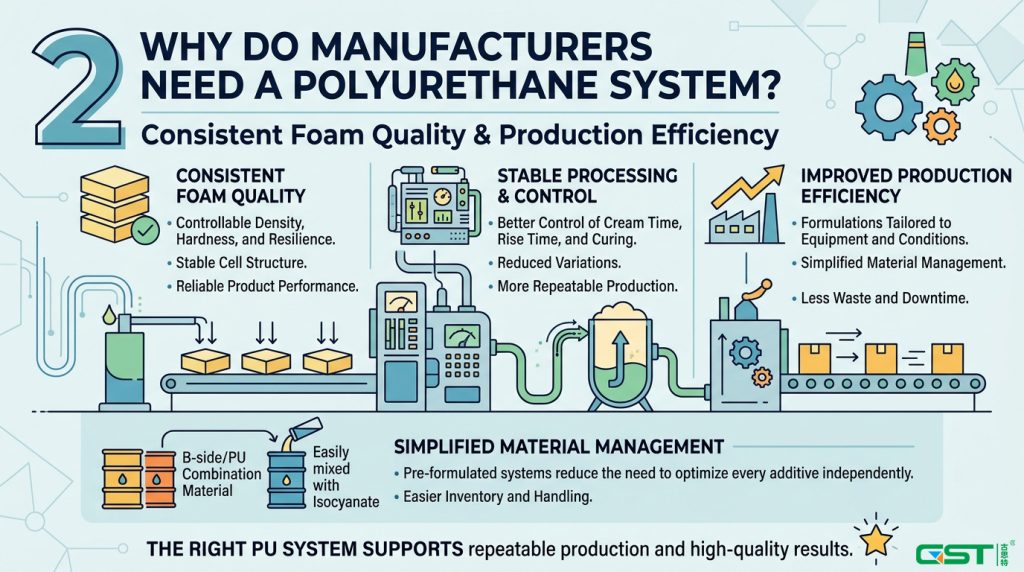
Using individual raw materials without a properly developed formulation can make production difficult to control.
A well-designed PU system helps manufacturers achieve:
- Consistent foam quality: More controllable density, hardness, resilience, and cell structure.
- Stable processing: Better control of cream time, rise time, and curing behavior.
- Improved production efficiency: Formulations designed around equipment and production conditions.
- Application-specific performance: Different systems for flexible foam, rigid foam, memory foam, self-skinning foam, and GEL products.
- Simplified material management: Pre-formulated combination materials can reduce the need for manufacturers to independently optimize every additive.
The right system helps reduce formulation complexity and supports more repeatable production.
3. How Does a Polyurethane System Work?
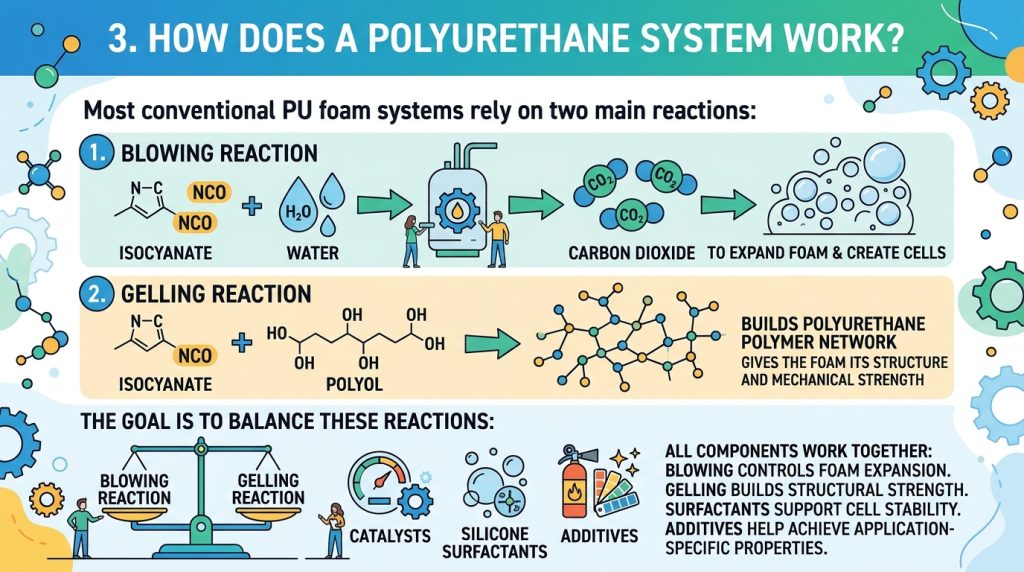
Most conventional PU foam systems rely on two main reactions:
1. Blowing Reaction
Isocyanate reacts with water to generate carbon dioxide (CO₂), which expands the foam and creates cells.
2. Gelling Reaction
Isocyanate reacts with polyol to build the polyurethane polymer network, giving the foam its structure and mechanical strength.
During foaming, catalysts regulate reaction speed, while silicone surfactants help stabilize the developing cells.
All components must work together:
- Blowing controls foam expansion.
- Gelling builds structural strength.
- Surfactants support cell stability.
- Additives help achieve application-specific properties.
The goal is to balance these reactions so that the foam expands properly and develops a stable structure.
4. Common Problems with Polyurethane Systems
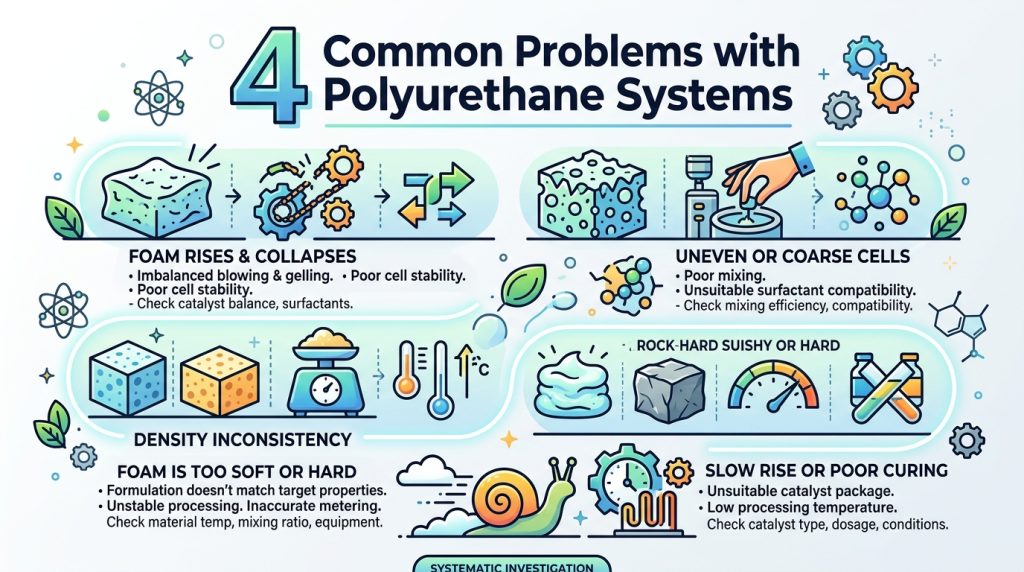
Even when using a PU system, unsuitable material selection or processing conditions can cause production problems.
| Common problem | Possible causes | What to check |
| Foam rises and collapses | Imbalanced blowing and gelling reactions or poor cell stability | Catalyst balance, surfactant, water content, and formulation |
| Uneven or coarse cells | Poor mixing or unsuitable surfactant compatibility | Mixing efficiency, surfactant selection, and material compatibility |
| Density inconsistency | Unstable processing conditions or inaccurate metering | Raw material temperature, mixing ratio, and equipment calibration |
| Foam is too soft or too hard | Formulation not matched to target properties | Polyol selection, isocyanate index, and crosslinking |
| Slow rise or poor curing | Unsuitable catalyst package or low processing temperature | Catalyst type, dosage, and process conditions |
These problems should be investigated systematically. Changing one raw material without evaluating the complete formulation may create additional issues.
5. How Can You Choose and Optimize the Right PU System?
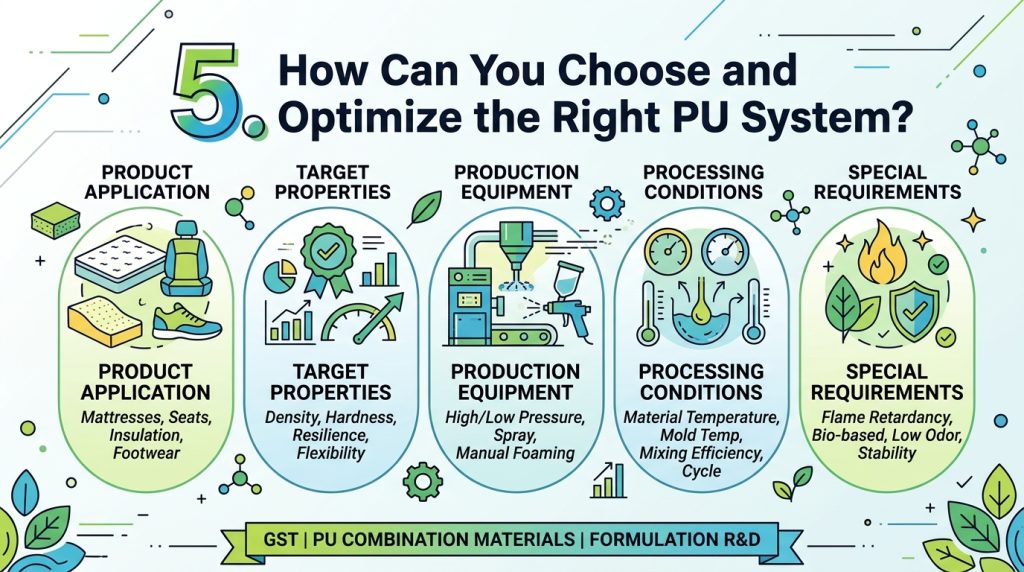
Before selecting a polyurethane system, manufacturers should consider several important factors:
- Product application: What are you manufacturing—mattresses, automotive seats, insulation panels, shoe insoles, or other PU products?
- Target properties: What density, hardness, resilience, flexibility, or thermal performance do you need?
- Production equipment: Are you using high-pressure, low-pressure, spray, or manual foaming equipment?
- Processing conditions: Consider material temperature, mold temperature, mixing efficiency, and production cycle.
- Special requirements: Evaluate flame retardancy, bio-based content, low odor, dimensional stability, or other application-specific targets.
A suitable PU system should be developed around the complete manufacturing process, not just the desired final product.
6. How Can GST Help with Polyurethane System Solutions?
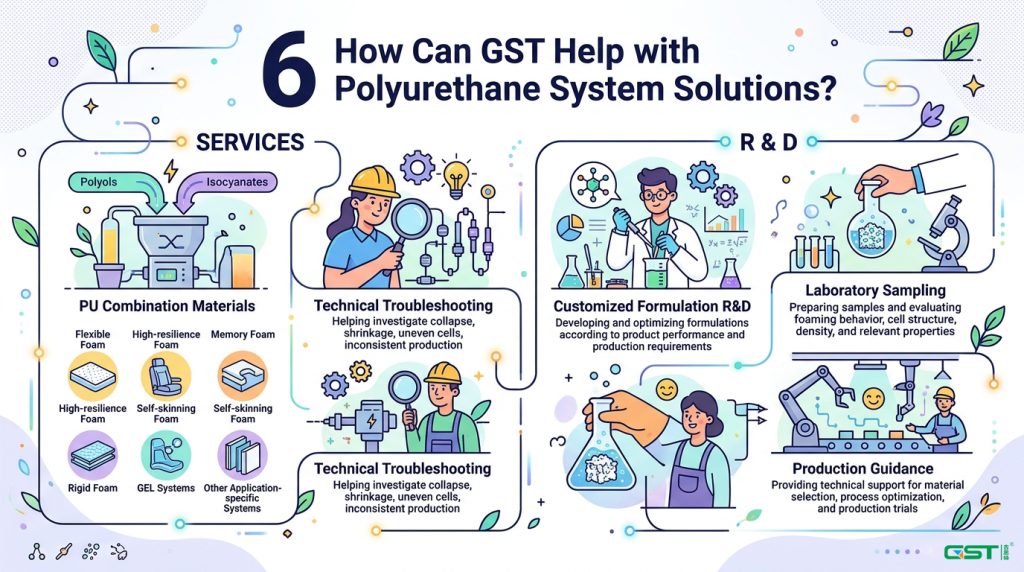
At GST, we understand that different foam manufacturers have different materials, equipment, production conditions, and performance requirements.
As a polyurethane combination-material source supplier, GST combines an independent R&D laboratory, a professional engineering team, and formulation development capabilities to provide application-focused solutions.
Our services include:
- PU Combination Materials: Flexible foam, high-resilience foam, memory foam, self-skinning foam, rigid foam, GEL systems, and other application-specific systems.
- Customized Formulation R&D: Developing and optimizing formulations according to product performance and production requirements.
- Laboratory Sampling: Preparing samples and evaluating foaming behavior, cell structure, density, and other relevant properties.
- Technical Troubleshooting: Helping customers investigate collapse, shrinkage, uneven cells, and inconsistent production.
- Production Guidance: Providing technical support for material selection, process optimization, and production trials.
Whether you are developing a new PU product or looking to improve an existing production process, GST can help evaluate suitable combination materials and formulation solutions.
Conclusion
A polyurethane system is much more than a collection of raw materials. It is an integrated formulation in which polyols, isocyanates, catalysts, surfactants, and additives work together to achieve the required processing behavior and final product performance.
Choosing the right PU system can help manufacturers improve production consistency, control foam quality, and meet specific application requirements.
GST — Your Trusted Partner in Polyurethane Combination Materials, Formulation R&D, and PU Application Solutions.
Looking for a suitable polyurethane system for your production?
Visit https://gstpu.com and contact our team to discuss your application requirements.
Tags: Customized Polyurethane Systems, Isocyanate, MDI, Polyol, Polyurethane, Polyurethane Combination Material, Polyurethane Combination Materials, Polyurethane Foam, Polyurethane Foam System, Polyurethane Formulation, Polyurethane System, Polyurethane System Supplier, Polyurethane Systems, PU Combination Material, PU Combination Materials, PU Foam Raw Materials, TDI
CATEGORIES
LATEST NEWS
- What Is a Two-Component PU ...
- What Is Polyol Blend?
- What Is a Polyurethane System?
- How to Select Catalysts for...
- What Are Flame Retardants i...
- What Is a Silicone Surfactant?
- What Are Delayed-Action Cat...
- Balanced Catalysts for Poly...
- Blowing Catalysts in PU Foam
- Gelling Catalysts in PU Foam
CONTACT US
Tel:+86 18688691634
Email:sam@1688pu.com
Add:No. 91 Central East Rd, Luxi Village, Gaobu Town, Dongguan 523283, China.