What Is Polyol Blend?
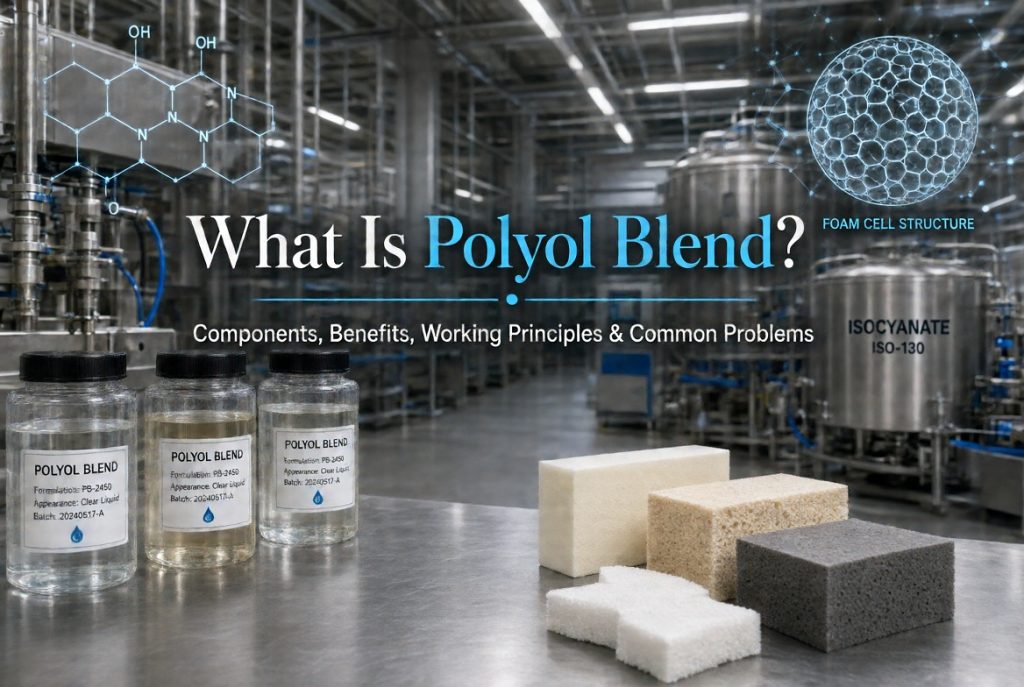
What Is Polyol Blend? Components, Benefits, Working Principles & Common Problems
In polyurethane foam production, polyol is one of the most important raw materials. However, achieving consistent foam quality is not simply a matter of choosing the right polyol.
This is where Polyol Blend comes in.
A properly designed polyol blend helps manufacturers simplify raw material handling, control foaming reactions, and achieve the desired foam properties. But what exactly is it, and why does it matter?
Let’s take a closer look.
1. What Is Polyol Blend?
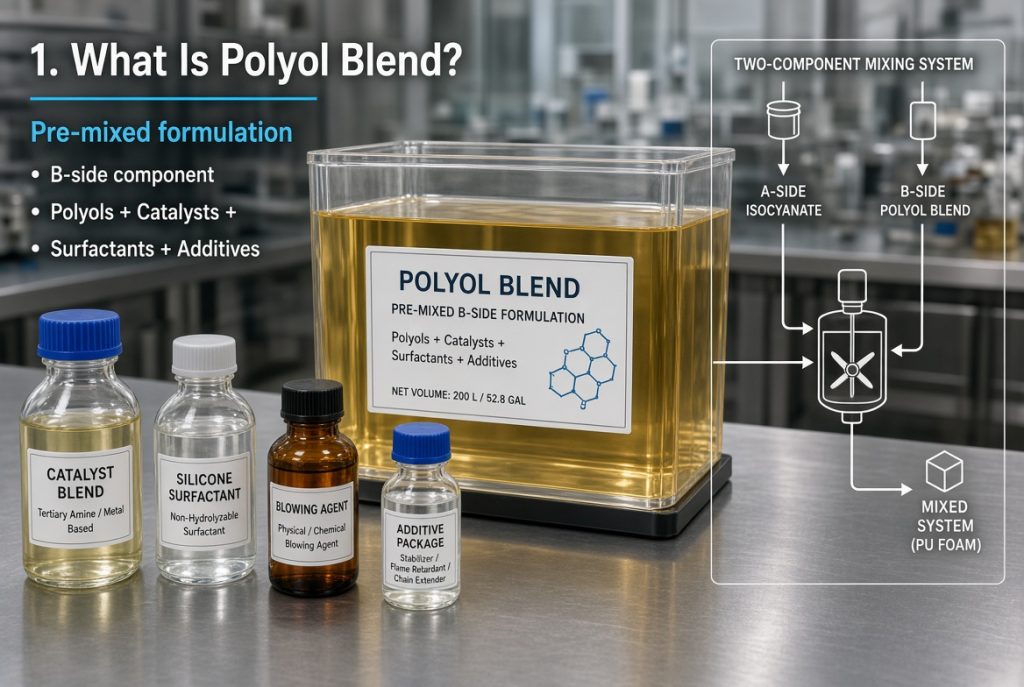
A Polyol Blend is a pre-mixed formulation containing polyol and other necessary ingredients for polyurethane production.
Depending on the foam type and application, it may include:
- Base polyols
- Polymer polyols (POP), when required
- Amine and metal catalysts
- Silicone surfactants
- Blowing agents or water
- Flame retardants
- Crosslinkers and other functional additives
In many two-component polyurethane systems, the polyol blend is supplied as the B-side component. It is mixed with the appropriate isocyanate component (A-side) during production to form polyurethane foam.
Unlike a single polyol, a polyol blend is designed as a complete formulation. Each ingredient has a specific role in controlling processing behavior and final foam performance.
2. Why Do Manufacturers Need Polyol Blend?
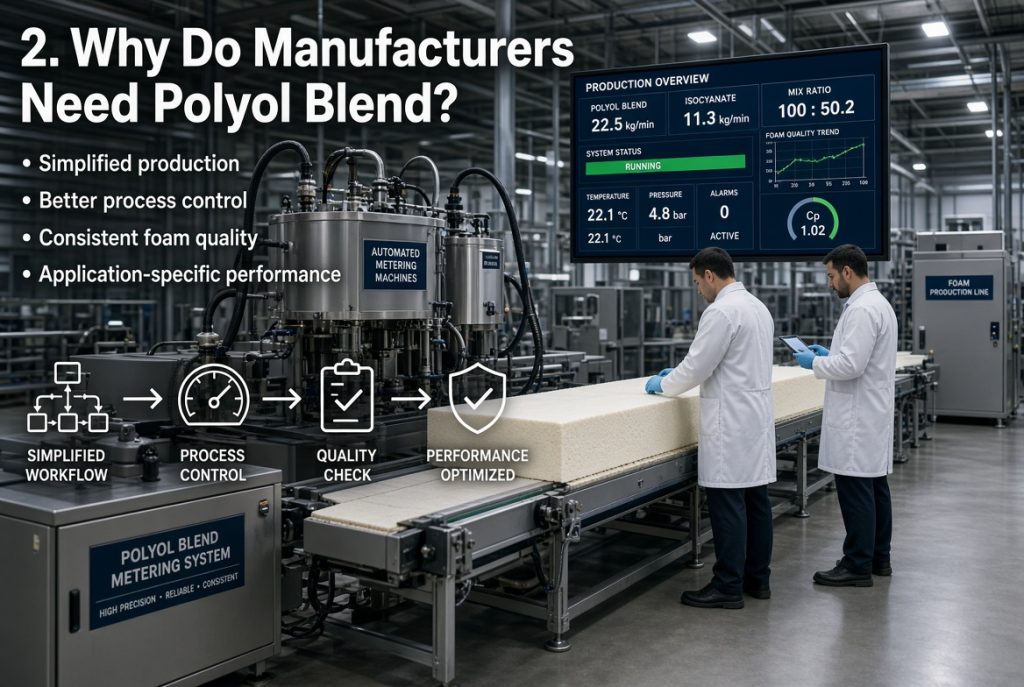
Using individual raw materials means manufacturers must manage multiple ingredients, accurately control their ratios, and understand how they interact.
A professionally developed polyol blend can make this process easier.
Key benefits include:
- Simplified production: Multiple ingredients are pre-mixed into one component, reducing on-site formulation work.
- Better process control: A balanced formulation helps regulate cream time, rise time, and gel time.
- Consistent foam quality: Proper ingredient selection and formulation control help improve batch-to-batch consistency.
- Application-specific performance: Formulations can be adjusted for different requirements, such as softness, resilience, density, and flame retardancy.
- Technical support: Manufacturers can work with a system supplier to optimize formulations for their equipment and production conditions.
The goal is not simply to combine raw materials, but to make the entire foaming process more controllable.
3. How Does Polyol Blend Work?
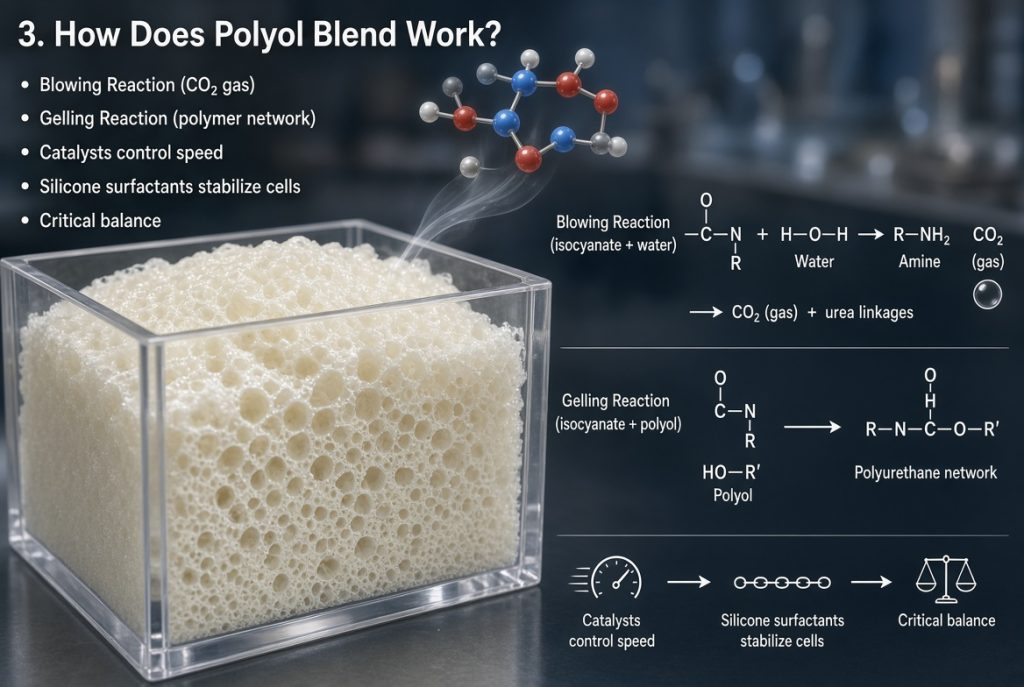
When the polyol blend is mixed with isocyanate, several chemical reactions take place.
Two important reactions determine the foaming process:
1. Blowing Reaction
Isocyanate reacts with water to generate carbon dioxide (CO₂), which creates gas bubbles and helps the foam expand.
2. Gelling Reaction
Isocyanate reacts with polyol to form polyurethane polymer chains and a crosslinked structure. This builds the strength needed to support the expanding foam.
Other ingredients also play important roles:
- Catalysts regulate the speed of blowing and gelling reactions.
- Silicone surfactants help stabilize foam cells and control cell structure.
- Blowing agents contribute to foam expansion, depending on the formulation.
- Crosslinkers help adjust the polymer network and final mechanical properties.
The key is balance. If gas generation is too fast but the polymer structure develops too slowly, the foam may collapse. If gelling happens too quickly, foam expansion may be restricted.
A well-designed polyol blend coordinates these ingredients to achieve the required processing window and foam properties.
4. Common Polyol Blend Problems
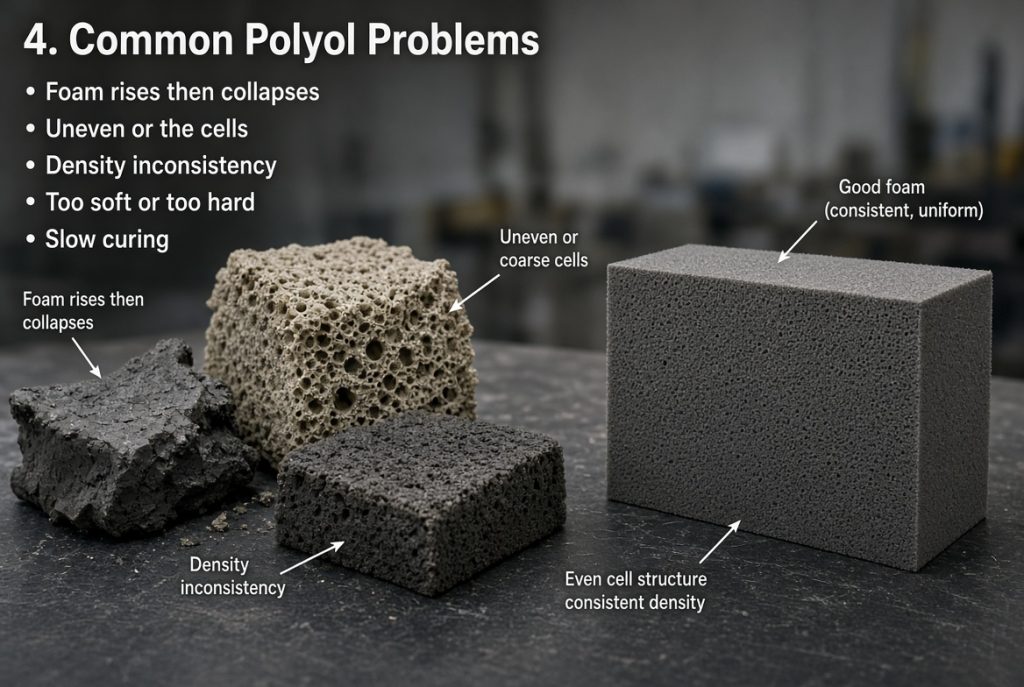
Even when using a pre-mixed polyol blend, production problems can still occur.
Here are some common examples:
Foam rises and then collapses
Possible causes include an imbalance between blowing and gelling reactions, insufficient cell stability, or unsuitable processing conditions.
Uneven or coarse cells
This may be related to poor mixing, surfactant compatibility, formulation balance, or unstable raw material conditions.
Density inconsistency
Incorrect metering, temperature fluctuations, mixing variations, or changes in raw material conditions may affect foam density.
Foam is too soft or too hard
The formulation may not be properly matched to the target application, polymer structure, or isocyanate index.
Slow curing or unstable processing
Catalyst balance, material temperature, dosage accuracy, and production conditions should be checked.
Remember: the same formulation may behave differently under different equipment, temperatures, and production conditions.
5. How Can These Problems Be Solved?
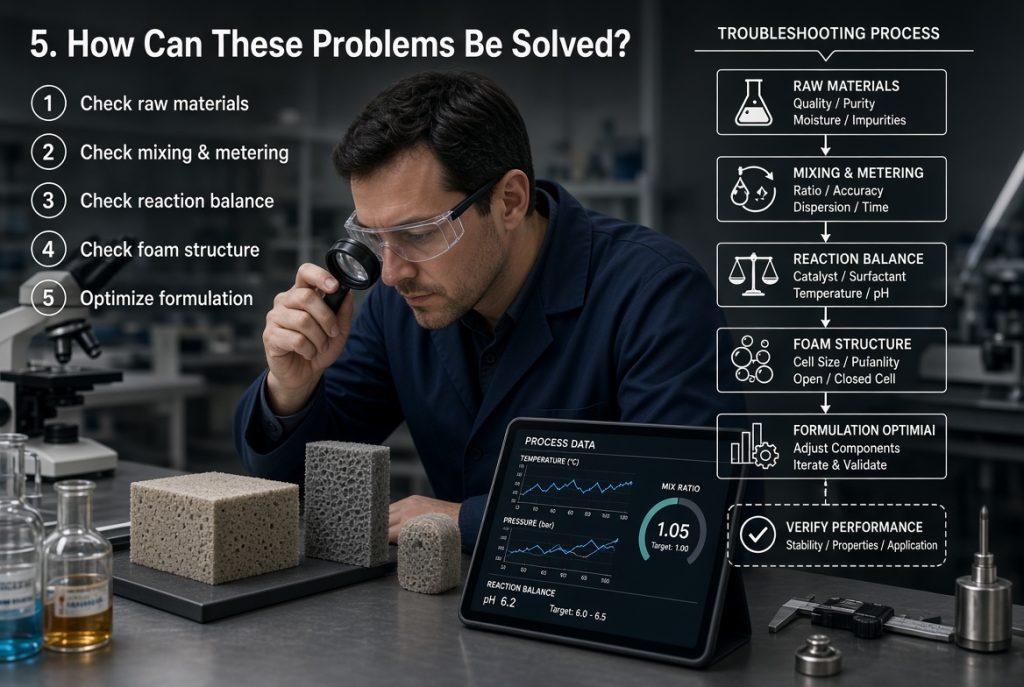
Before changing the formulation, manufacturers should identify the actual cause of the problem.
A practical troubleshooting approach includes:
- Check raw materials: Confirm material condition, storage, temperature, and compatibility.
- Check mixing and metering: Verify mixing efficiency, component ratios, and equipment calibration.
- Check reaction balance: Evaluate catalyst selection, dosage, water content, and blowing/gelling behavior.
- Check foam structure: Observe cell uniformity, skin quality, shrinkage, and curing behavior.
- Optimize the formulation: Adjust the formulation based on actual test results rather than changing ingredients randomly.
A systematic approach can help reduce unnecessary production trials and improve process stability.
6. How GST Supports Your Polyol Blend Development
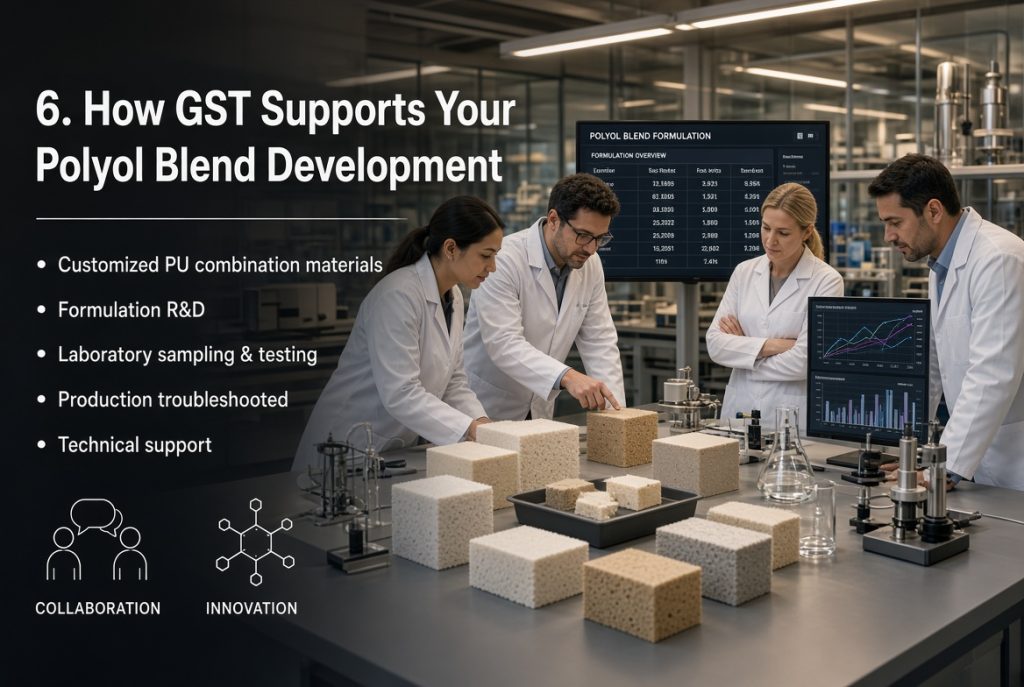
Choosing a polyol blend is not just about purchasing raw materials. It is about finding a formulation that matches your product, equipment, and production requirements.
GST is a polyurethane combination material supplier with an independent laboratory and professional engineering team.
We provide more than standard PU materials. Our services include:
- Customized PU combination materials: Formulations for flexible foam, high-resilience foam, memory foam, rigid foam, self-skinning foam, and other applications.
- Formulation R&D: Adjustment of polyol systems, catalyst packages, surfactants, and other ingredients according to target performance and processing requirements.
- Laboratory sampling and testing: Evaluate foaming behavior and physical properties before production trials.
- Production troubleshooting: Help investigate issues such as foam collapse, uneven cells, density fluctuations, and curing problems.
- Technical support: Provide material recommendations, trial guidance, and remote technical assistance.
Whether you are developing a new foam product or improving an existing production process, GST can work with you to develop a suitable polyurethane combination material solution.
Conclusion
A polyol blend is much more than a mixture of polyols. It is a carefully engineered formulation that coordinates chemical reactions, foam expansion, cell stability, and final product performance.
The right formulation can help manufacturers achieve more stable processing and more consistent foam quality.
Looking for a reliable Polyol Blend or customized PU combination material?
Contact GST to discuss your application, formulation requirements, and polyurethane foaming challenges.
GST – Your Partner in Polyurethane Combination Materials & Formulation Solutions.
PREVIOUS:What Is a Polyurethane System?
CATEGORIES
LATEST NEWS
- What Is a Two-Component PU ...
- What Is Polyol Blend?
- What Is a Polyurethane System?
- How to Select Catalysts for...
- What Are Flame Retardants i...
- What Is a Silicone Surfactant?
- What Are Delayed-Action Cat...
- Balanced Catalysts for Poly...
- Blowing Catalysts in PU Foam
- Gelling Catalysts in PU Foam
CONTACT US
Tel:+86 18688691634
Email:sam@1688pu.com
Add:No. 91 Central East Rd, Luxi Village, Gaobu Town, Dongguan 523283, China.