A Component vs B Component in PU: What’s the Difference?
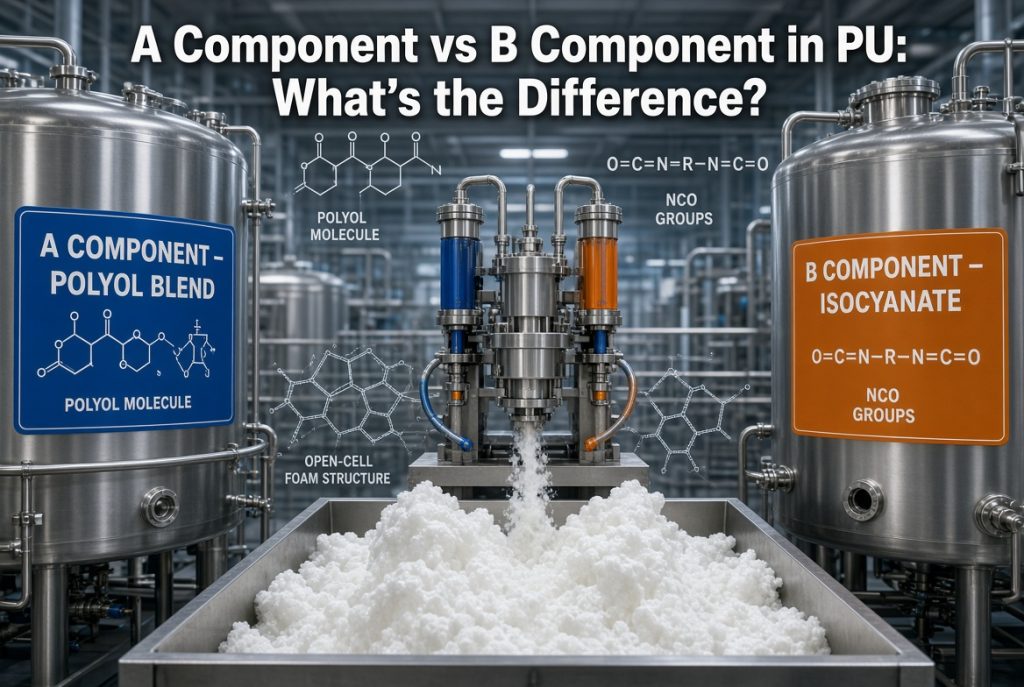
In polyurethane (PU) foam production, A Component and B Component are the two essential parts of a two-component system.
But what exactly is the difference between them? Why are they stored separately? And how do they work together to produce polyurethane foam?
Understanding these two components is important for achieving stable production, consistent foam quality, and the desired product performance.
Let’s take a closer look.
1. What Are A Component and B Component?
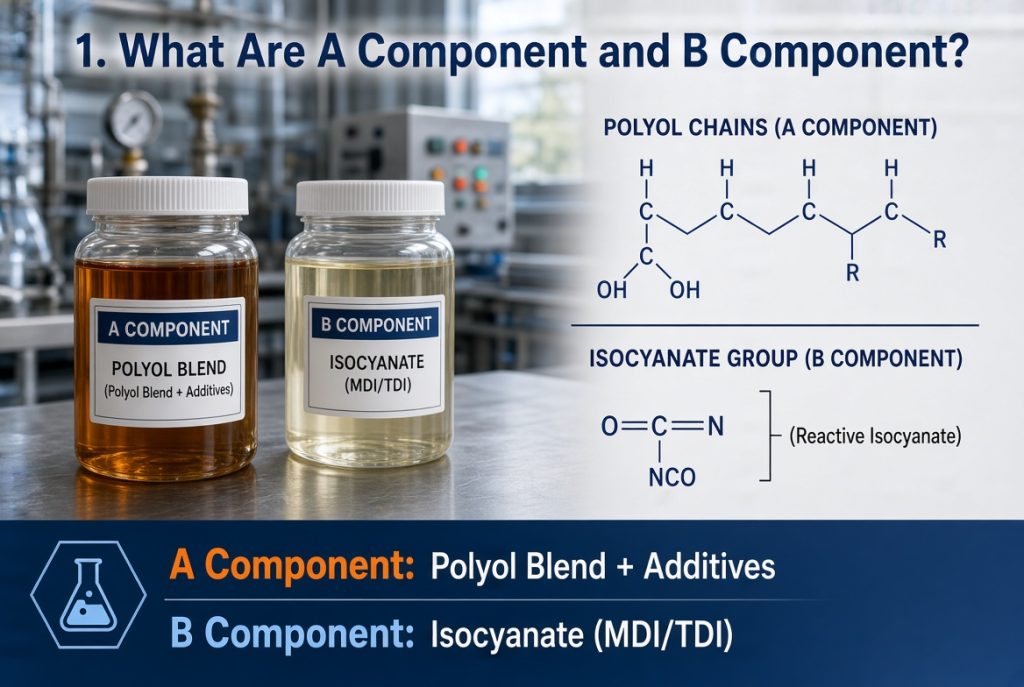
A two-component polyurethane system consists of two main parts:
A Component – Polyol Blend
The A Component is the polyol-side formulation, also known as PU Combination Material.
It typically contains:
- Base polyols
- Polymer polyols (POP), when required
- Amine and metal catalysts
- Silicone surfactants
- Water or other blowing agents
- Crosslinkers
- Flame retardants and other functional additives
Each ingredient plays a specific role in controlling reaction behavior, foam expansion, cell structure, and final product properties.
Unlike a single polyol, the A Component is a carefully designed formulation developed for a particular application and production process.
B Component – Isocyanate
The B Component contains isocyanate, commonly MDI or TDI, depending on the polyurethane system and application.
It provides reactive NCO groups that react with the polyols and other active-hydrogen compounds to form polyurethane.
In simple terms:
- A Component: Polyol blend and supporting additives.
- B Component: Isocyanate.
Together, they form the complete polyurethane system.
2. Why Do We Need Two Components?
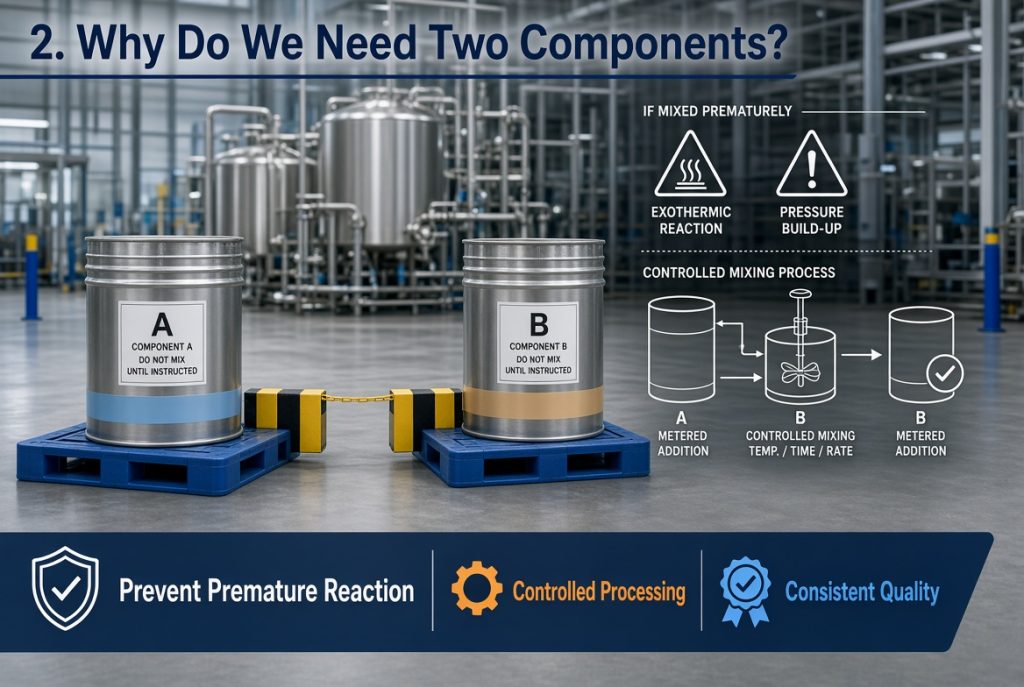
Why not mix all the ingredients together in advance?
The main reason is chemical reactivity.
Isocyanates react with polyols and water. Keeping the two components separate helps prevent premature reactions and allows the chemical reaction to begin during production.
A properly designed A/B system offers several advantages:
- Controlled processing: The reaction starts when A and B are mixed.
- Simplified production: The pre-formulated A Component reduces the need to add multiple ingredients individually.
- Formulation flexibility: Different A-side formulations can be developed for different foam applications.
- Consistent quality: Accurate metering and balanced formulations help improve production stability.
- Application-specific performance: The system can be designed for different requirements, including density, hardness, resilience, and flame retardancy.
The key is not simply having two components, but making sure they are properly formulated and matched.
3. How Do A Component and B Component Work Together?
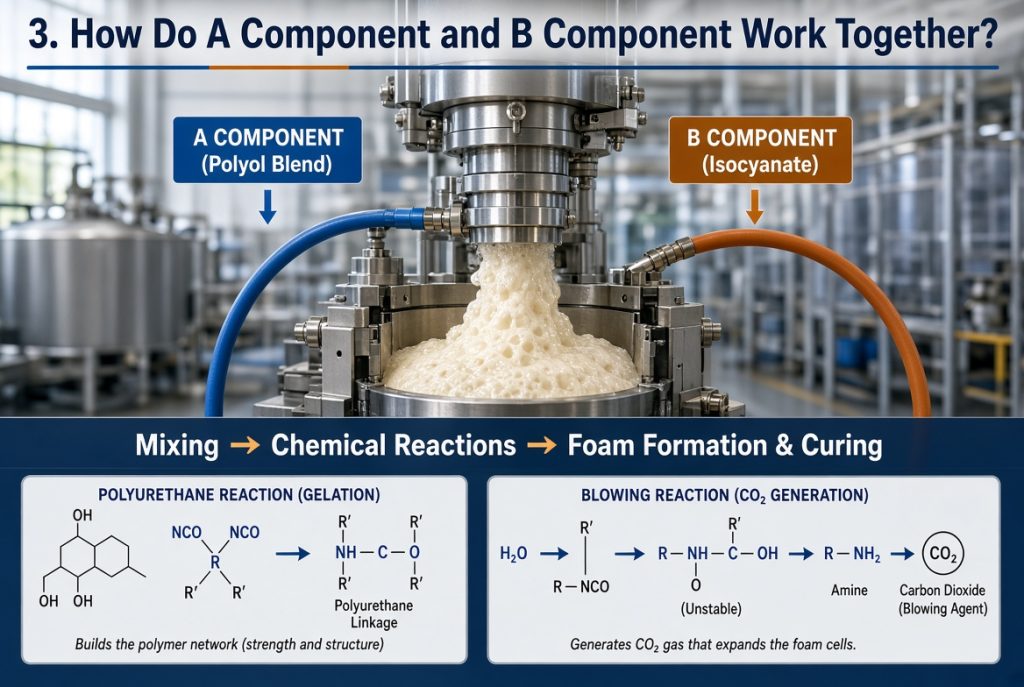
The process begins when the two components are mixed at the specified ratio.
Step 1: Mixing
The A Component (polyol blend) and B Component (isocyanate) are accurately metered and mixed using suitable equipment.
Step 2: Chemical Reactions
Two important reactions take place:
- Polyurethane reaction: Isocyanate reacts with polyol to form polyurethane polymer chains.
- Blowing reaction: When water is included in the A Component, it reacts with isocyanate to generate carbon dioxide (CO₂), helping the foam expand.
Step 3: Foam Formation and Curing
Catalysts in the A Component regulate reaction speed, while silicone surfactants help stabilize the foam cells.
The foam expands, develops its cell structure, and gradually cures into the final product.
The A/B mixing ratio, formulation design, material temperature, mixing efficiency, and processing conditions all influence the final result.
4. Common Problems with A/B Components
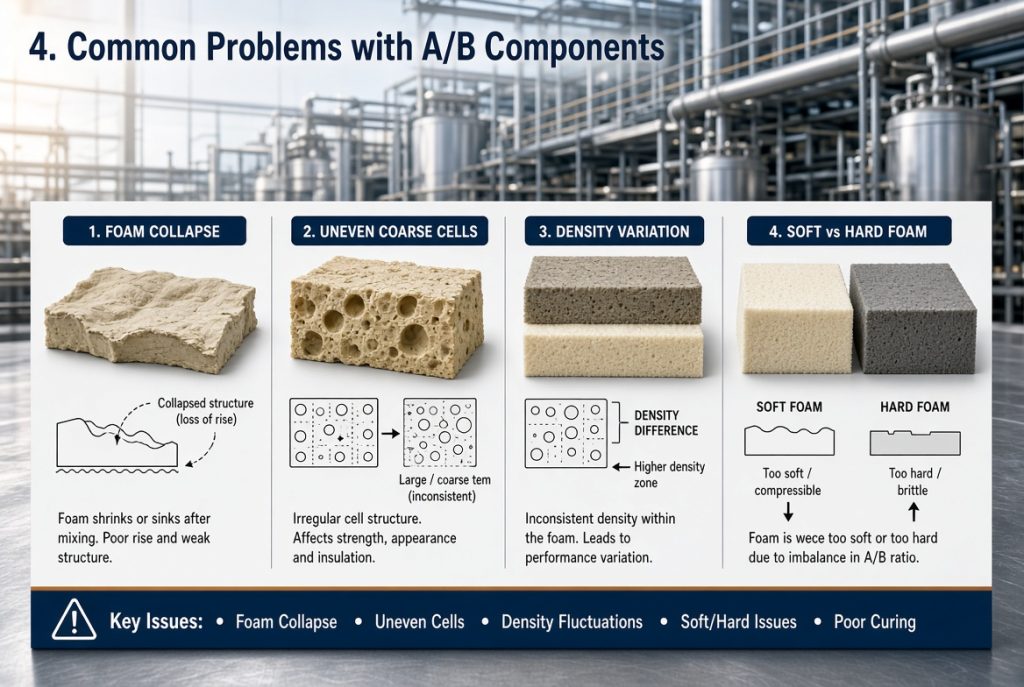
Even when using a two-component system, manufacturers may encounter production problems.
1. Foam Collapse
Possible causes include an imbalance between blowing and gelling reactions, an incorrect A/B ratio, or poor cell stability.
2. Uneven Cell Structure
Poor mixing, unsuitable surfactant selection, contamination, or unstable raw material conditions may lead to coarse or irregular cells.
3. Density Fluctuations
Inaccurate metering, temperature changes, and inconsistent production conditions can affect foam density.
4. Foam Too Soft or Too Hard
The A-side formulation, isocyanate index, and polymer structure may not be properly matched to the target application.
5. Poor Curing or Slow Reaction
Incorrect catalyst balance, low material temperature, moisture exposure, or metering problems may affect reaction behavior.
5. How Can These Problems Be Solved?
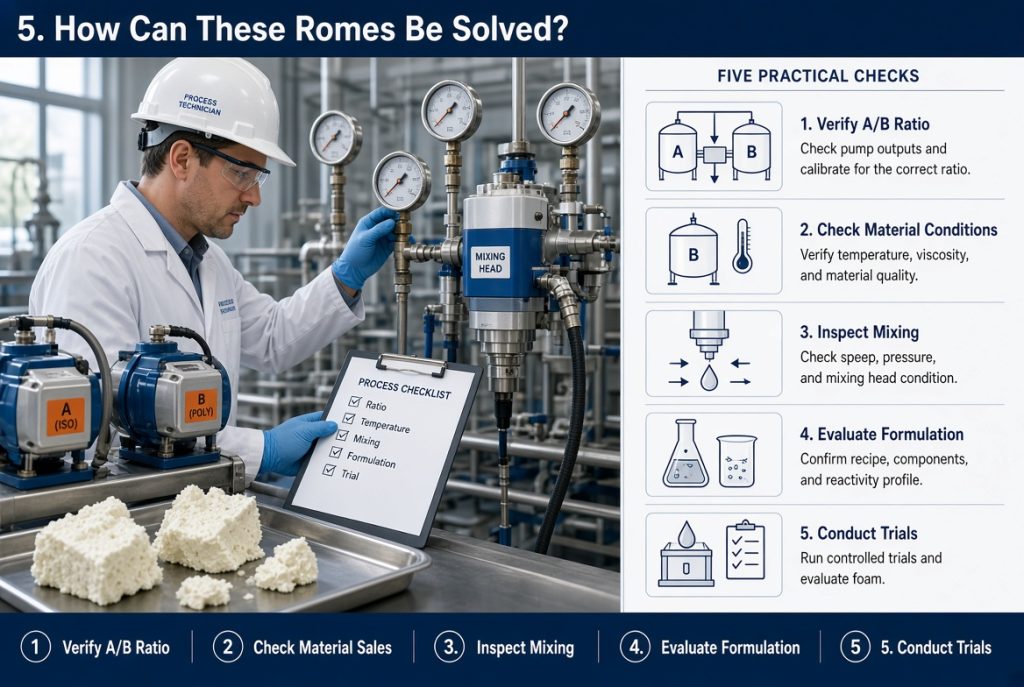
Before changing the formulation, it is important to identify the real source of the problem.
Here are five practical checks:
- Verify the A/B ratio: Check metering accuracy and confirm the mixing ratio specified for the system.
- Check material conditions: Review storage, temperature, moisture exposure, and raw material quality.
- Inspect mixing performance: Ensure the equipment provides sufficient and consistent mixing.
- Evaluate formulation balance: Review catalyst levels, water content, surfactants, and isocyanate index.
- Conduct controlled trials: Adjust key variables systematically and compare actual foaming results.
Remember: the same A/B system may produce different results under different equipment and processing conditions. Troubleshooting should consider the entire production process, not just the raw materials.
6. How GST Supports Your PU A/B System
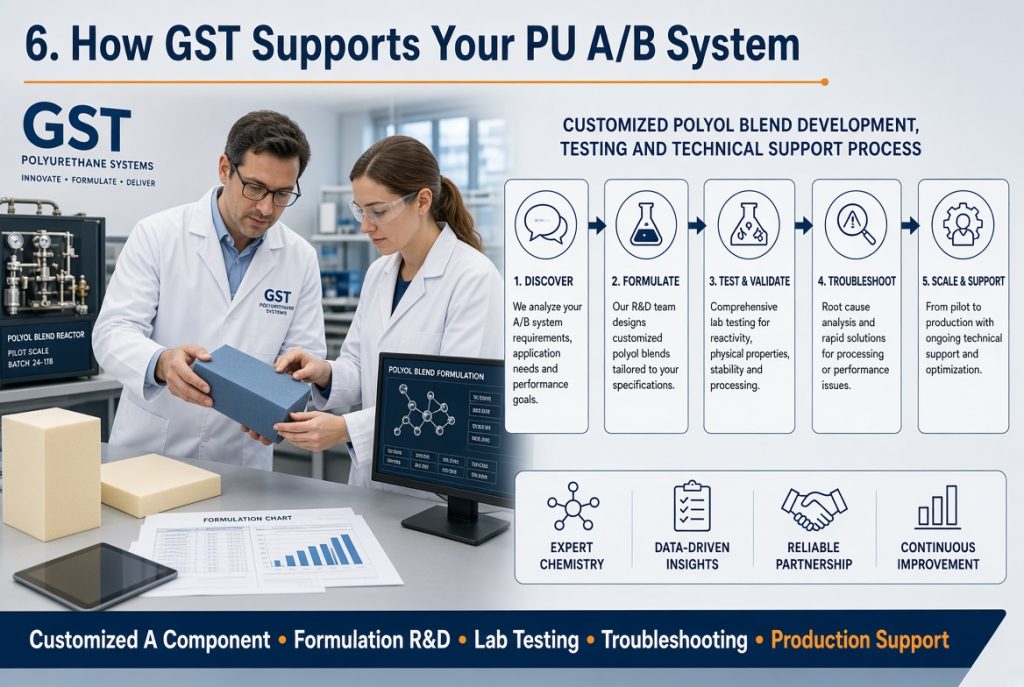
A reliable polyurethane system requires more than two compatible components. It needs a formulation designed around your product and manufacturing process.
GST is a polyurethane combination material supplier with an independent R&D laboratory and professional engineering team.
Our A Component (polyol blend) solutions cover multiple applications, including:
- Flexible foam
- High-resilience foam
- Memory foam
- Rigid foam
- Self-skinning foam
- GEL systems
- Customized polyurethane applications
Our technical services include:
- Customized A Component Combination Materials: Develop polyol blend formulations according to target product properties and production requirements.
- Formulation R&D: Optimize polyol composition, catalyst packages, surfactants, and other ingredients.
- Laboratory Sampling and Testing: Evaluate foaming behavior and physical properties before production trials.
- Technical Troubleshooting: Help investigate foam collapse, uneven cells, density fluctuations, and curing problems.
- Production Support: Provide material recommendations, trial guidance, and remote technical assistance.
Whether you are developing a new PU product or improving an existing production process, GST can help you develop a suitable A Component formulation matched with the appropriate B Component isocyanate.
Conclusion
A Component and B Component have different roles, but they work together to form polyurethane.
The A Component provides the polyol blend and supporting additives, while the B Component supplies the isocyanate. Their compatibility, mixing ratio, and reaction balance are essential for achieving the desired polyurethane properties.
Looking for a reliable PU combination material supplier or customized formulation solution?
Contact GST to discuss your application and production requirements.
GST – Your Partner in Polyurethane Combination Materials & Formulation Solutions.
PREVIOUS:What Is a Two-Component PU System?
CATEGORIES
LATEST NEWS
- A Component vs B Component ...
- What Is a Two-Component PU ...
- What Is Polyol Blend?
- What Is a Polyurethane System?
- How to Select Catalysts for...
- What Are Flame Retardants i...
- What Is a Silicone Surfactant?
- What Are Delayed-Action Cat...
- Balanced Catalysts for Poly...
- Blowing Catalysts in PU Foam
CONTACT US
Tel:+86 18688691634
Email:sam@1688pu.com
Add:No. 91 Central East Rd, Luxi Village, Gaobu Town, Dongguan 523283, China.