Blocked Polyisocyanates
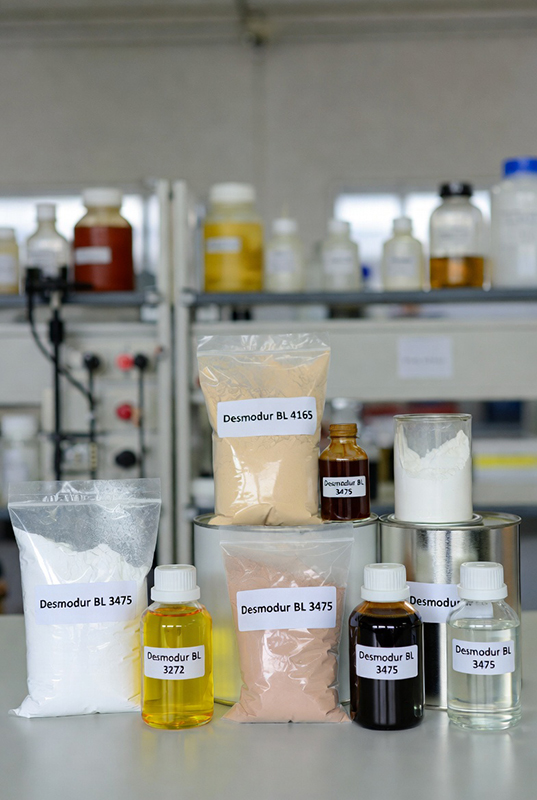
Blocked isocyanates, formed by capping polyisocyanates with blocking agents such as phenol and ε-caprolactam, can be combined with various oligomeric polyols. They are stable at room temperature and can be used to formulate one-component baking coatings for various metals and plastics, such as wire enamel and coil coatings. Adding a catalyst like DBTL can lower the baking temperature or accelerate the curing rate. Even with the addition of a catalyst such as dibutyltin dilaurate (DBTDL) to a mixture of polyols and blocked crosslinkers, the resulting one-component coating can be stored stably at room temperature.
The following examples, using blocked isocyanates from Bayer MaterialScience, illustrate the properties and applications of some blocked isocyanates.
Desmodur BL 1100 is a caprolactam-blocked aromatic polyisocyanate that, when combined with cycloaliphatic diamines (such as BASF’s Laromin C260), forms a highly flexible one-component baking paint. It can be diluted with urethane-grade solvents. It is used in coatings for dip coating or curtain coating, as well as adhesives. BL 1100 and C260 are combined in a 10/1 mass ratio, stable for storage below 40°C, and cured by baking at 150°C/45min, 160°C/30min, or 180°C/10min.
Desmodur BL 1265 is a caprolactam-blocked aromatic polyisocyanate that, when combined with polyol components or polyamines, forms a one-component baking paint. It requires dilution with urethane-grade solvents. It is generally combined with polyester polyols and is also miscible with plasticizers and epoxy resins. When used as a crosslinking agent component for polyols, the resulting coating exhibits high hardness, excellent deformation resistance, impact resistance, and chemical resistance. Applications include pipe coatings, can coatings, and anti-gravel coatings. It can be cured at 150°C/30min. It can be combined with BL 1100 to improve the hardness of coil coatings, etc. Desmodur BL 3165 is a butanone oxime-blocked HDI-type polyisocyanate crosslinker used in baking paints, with a mixed solvent of 100# naphtha/dibasic ester (25/10). BL 3165 is used as a curing agent, formulated with polyester polyols to produce non-yellowing, weather-resistant one-component polyurethane baking paints. Its main applications include coil coatings, automotive paints, appliance coatings, and can coatings. Typical curing conditions (in combination with branched polyesters) are 160°C/60min, 180°C/15min, or 200°C/7min without a catalyst. The addition of DBTL can significantly reduce the baking temperature without reducing storage stability; catalytic curing conditions are 130°C/60min, 150°C/15min, or 175°C/7min.
Desmodur BL 3175 is an HDI-based crosslinking baking paint resin, with 100# naphtha as the solvent. Its uses are similar to BL 3165. It has a higher solids content than BL 3165.
Desmodur BL 3272 is an aliphatic blocked isocyanate resin with MPA as the solvent. BL 3272 is formulated with polyester polyols to produce non-yellowing one-component polyurethane baking paints. It can be diluted to 35% with ester, ketone, and aromatic solvents. Combined with hydroxyl polyesters such as Desmophen T 1665, it can be used to formulate high-quality coil coatings, and can also be used in primer and topcoat coatings with a coating thickness of less than 40 μm. The weather resistance is better than BL 3175 and BL 4265. When formulated with Desmophen T 1665, the typical curing conditions without a catalyst are 165℃/40min, 170℃/30min, 180℃/20min, or 200℃/10min; with 0.3% DBTL catalyst (based on solid content), the curing conditions are 160℃/30min, 180℃/10min, or 200℃/5min.
Desmodur BL 3370 is an HDI-based baking paint resin, with MPA as the solvent. It can be diluted to 40% with ester, ketone, and aromatic solvents. BL 3370 is used to formulate non-yellowing one-component baking paints with polyester polyols. Its main applications are high-grade industrial refinishing coatings, such as can coatings, coil coatings, and automotive surface coatings. Typical curing conditions are 100℃/50min, 120℃/20min, or 160℃/7min. No catalyst is required.
Desmodur BL 3475 is an aliphatic crosslinking baking paint resin, with naphtha/butyl acetate (1/1) as the solvent. It can be diluted to 40%; storage at lower concentrations may result in turbidity and precipitation. It has high reactivity and is used to formulate low-temperature baking, non-yellowing one-component baking paints with saturated polyester polyols. It is mainly used in the formulation of high-quality industrial coatings, especially can coatings and pipe coatings. Depending on the type of polyol used, the baking curing temperature can be as low as 100℃. Typical curing conditions are 120℃/20min or 160℃/7min. No catalyst is required. The peak metal temperature is 216℃.
BL 3165, BL 3175, BL 3272, BL 3370, and BL 3475 can be used as additives in conventional baking paints to improve flexibility, adhesion, and weather resistance. Desmodur BL 3575 (Desmodur VP LS 2253) is an HDI-based blocked polyisocyanate used in the formulation of one-component lightfast baking paints. The solvent is 100# naphtha/propylene glycol monomethyl ether acetate. It is combined with the polyester polyol component at an NCO/OH molar ratio of 1/1. Typical curing conditions are 160℃/20min, 170℃/10min, or 190℃/5min. Compared to Desmodur BL 3175 or BL 3165, the baking temperature is reduced by 10℃.
Desmodur BL 4265 is a butanone oxime-blocked aliphatic polyisocyanate crosslinker, with naphtha as the solvent. It can be combined with flexible polyesters to formulate one-component, non-yellowing, weather-resistant, and chemical-resistant baking coatings for high-grade industrial refinishing coatings and coil coatings. When combined with polyester polyols, curing requires 180℃/20min without a catalyst, and with a catalyst (1% DBTDL of solids content), the baking conditions are 150℃/15min or 125℃/60min. It is added to conventional baking coatings to improve hardness, weather resistance, and chemical resistance.
BL 5375 is an HMDI-based blocked cycloaliphatic polyisocyanate, with SN/MPA (1/1) as the solvent. It is typically used with hydroxyl polyesters to formulate high-quality one-component non-yellowing baking paints for coil coatings and can coatings.
Desmodur VP LS 2078/2 is a caprolactam-blocked aliphatic polyisocyanate, with 100# solvent naphtha as the solvent. It is used in non-yellowing one-component polyurethane baking paints.
Desmodur VP LS 2257 is a butanone oxime-blocked aliphatic polyisocyanate, with MPA/SN as the solvent. Its uses and baking curing conditions are the same as Desmodur BL 3165. Desmodur VP LS 2352 is an aliphatic blocked polyisocyanate used as a crosslinking agent for one-component, non-yellowing industrial baking paints. Baking conditions without (or with 0.3% DBTDL) catalyst are: 120℃/60 (or 40) min, or 130℃/40 min, or 170℃/6(3) min.
Compared to butanone oxime-blocked polyisocyanates, Desmodur PL 340 and PL 350 have approximately 10℃ lower baking temperatures. At the same time, their solvent and chemical resistance are not reduced.
In addition, Desmodur AP stable is a phenol-blocked polyisocyanate. This solid resin has a softening point of approximately 100℃ and a blocked NCO content of 12.1%. It is soluble in urethane-grade solvents. Combined with phthalic anhydride polyester polyols, it can be used to formulate wire enamel coatings, resulting in directly solderable enameled wire. It deblocks above 140℃. Desmodur CT is a phenol-blocked TDI-based polyisocyanate. This solid resin has a softening point of 150℃ and a blocked NCO content of 14.0%. Their relative density is approximately 1.3.
Grelan is a brand of curing agents for electrostatic powder coatings from Bayer. This series of blocked cycloaliphatic polyisocyanate curing agents are caprolactam-blocked IPDI or HMDI prepolymers. When combined with hydroxyl-containing polyesters, they provide good outdoor gloss retention and resistance to chalking and corrosion.
Bayer also offers several water-based blocked aliphatic polyisocyanate products. Most are water-based, containing a small amount of organic solvent and diethanolamine, and are weakly alkaline (with the exception of Bayhydur BL 5335). They are mixed with water-based hydroxyl-containing components to formulate one-component baking-type waterborne polyurethane coatings. Compared to the previously developed Bayhydur BL 5140 and Bayhydur VP LS 2310, Bayhydur BL XP 2706 reduces organic solvents, improves thermal yellowing resistance, and increases reactivity. Bayhydur 2781 XP is an improved product of VP LS 2310, with reduced organic solvents.
The solvent in Takenate B-830 is ethyl acetate/methyl isobutyl ketone, used for general products and primers; the solvents in B-815N and B820NSU are Supersol 1500/butyl acetate, providing weather resistance; the solvents in B-842N, B-846N, and B-870N are 100# solvent naphtha/butyl acetate, 100# solvent oil, and propylene glycol monomethyl ether acetate, respectively, offering weather resistance and high flexibility; the solvents in B-874N and B-882N are ethyl acetate/100# solvent oil and 100# solvent oil/butyl acetate, respectively, providing weather resistance and good compatibility with acrylic resins and fluoropolymers.
Takenate PW-2400, a blocked MDI prepolymer product for powder coatings from Mitsui Chemicals, Japan, is a white powder with a melting point of 170–190°C, a blocked NCO content of 17.2%, and a baking temperature of 180°C. It can be used as a modifier for many polymers.
Vestanat B 1358/100, B 1358 A, and B 1370 are blocked cycloaliphatic polyisocyanates, with Vestanat B 1358/100 and B 1358A being IPDI-based blocked isocyanates. The solvent in B 1358A is 100# aromatic naphtha (C9/C10 aromatics, boiling point 154–178°C). The solvent in B 1370 is butyl acetate/xylene (3/5). Vestanat B 1358/100 is a flake-form, solvent-free product with a melting range of 115–130°C, used in solvent-free, solvent-based, and water-based heat-curing systems. These are light- and weather-resistant resins used as crosslinkers for hydroxyl-containing polyesters, acrylic resins, and alkyd resins, offering a balance of reactivity and storage stability. Typical applications include: exterior can coatings (overprint varnishes, printing inks, basecoats) with polyester resins, exterior coil coatings, acid-resistant automotive coatings, and stone-chip resistant automotive primers and topcoats. They can be used to formulate polyurethane baking enamels with curing temperatures below 130°C, with 0.1%–0.5% DBTDL catalyst recommended. The performance of the coating also depends on the polyol used. These crosslinkers provide hard segment components, allowing the use of soft polyol resins.
Vestagon BF 1320, EP BF 1350, and BF 1540 are internally blocked polyisocyanates that do not release blocking agents upon deblocking. BF 1320 is an internally blocked cycloaliphatic polyisocyanate. EP BF 1350 is a flake-form product with high reactivity and an NCO content of 12.5%–14.0%.
There are also a small number of blocked polyisocyanate emulsion products. These can be used alone as coatings or fabric treatment agents, or as crosslinkers for water-based polyurethanes, forming one-component water-based resins.
For example, Easaqua WT 1000 from Perstorp (Sweden) is a blocked isocyanate emulsion for one-component high-temperature curing formulations. It is an off-white emulsion with water as the medium, containing approximately 2% butyl acetate, and deblocks at around 140°C. Its physical properties are as follows: solid content (63.0±2.0)%, viscosity at 25℃ (3200±1800) mPa.s, density (25℃) 1.00 g/cm³, blocked NCO content approximately 9.4%, free HDI <0.02%, and flash point >100℃.
PREVIOUS:Other Diisocyanate Derivatives
CATEGORIES
LATEST NEWS
- Polyether Polyol vs Polyest...
- What Is Polyester Polyol?
- What Is Polyether Polyol?
- What Is Polyol?
- Why Is Reaction Balance Cri...
- Blowing Reaction vs Gelling...
- How Molecular Structure Det...
- Soft Segment vs Hard Segmen...
- What Is Crosslinking in Pol...
- What Is Polyurethane Polyme...
CONTACT US
Tel:+86 18688691634
Email:sam@1688pu.com
Add:No. 91 Central East Rd, Luxi Village, Gaobu Town, Dongguan 523283, China.