Soft Segment vs Hard Segment in Polyurethane
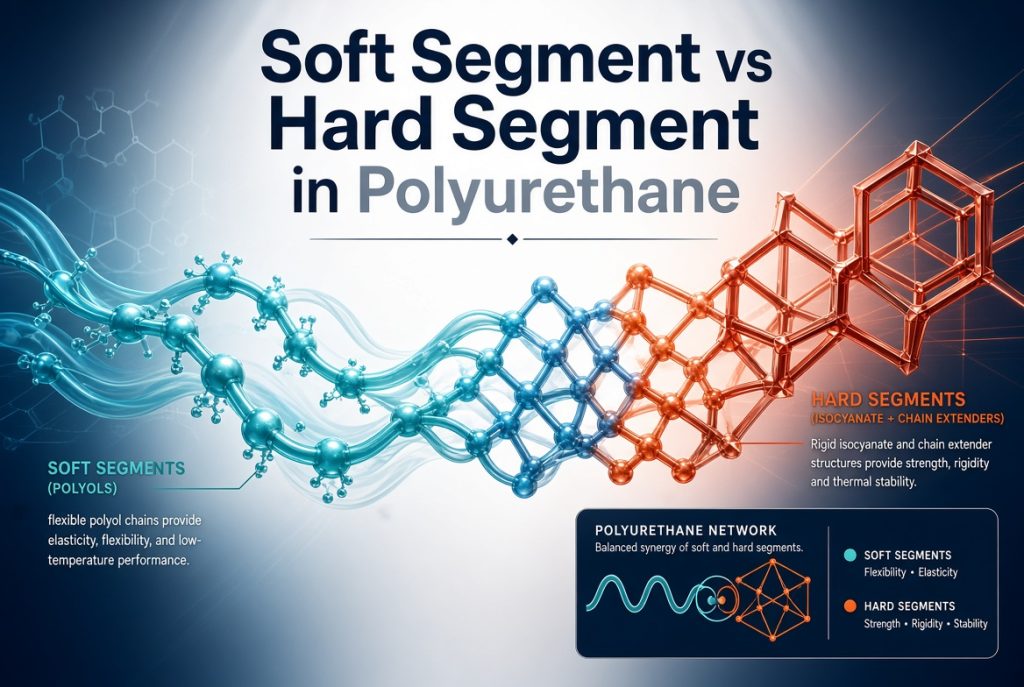
Polyurethane is one of the most versatile polymer materials in the world. It can be soft like a memory pillow, elastic like a car seat cushion, tough like a wheel, or rigid enough for thermal insulation.
But how can one material have such different properties?
The answer lies largely in the unique structure of polyurethane: soft segments and hard segments.
Understanding the relationship between these two components is essential for designing polyurethane systems with the right balance of flexibility, strength, elasticity, durability, and processing performance.
1. What Are Soft Segments and Hard Segments in Polyurethane?
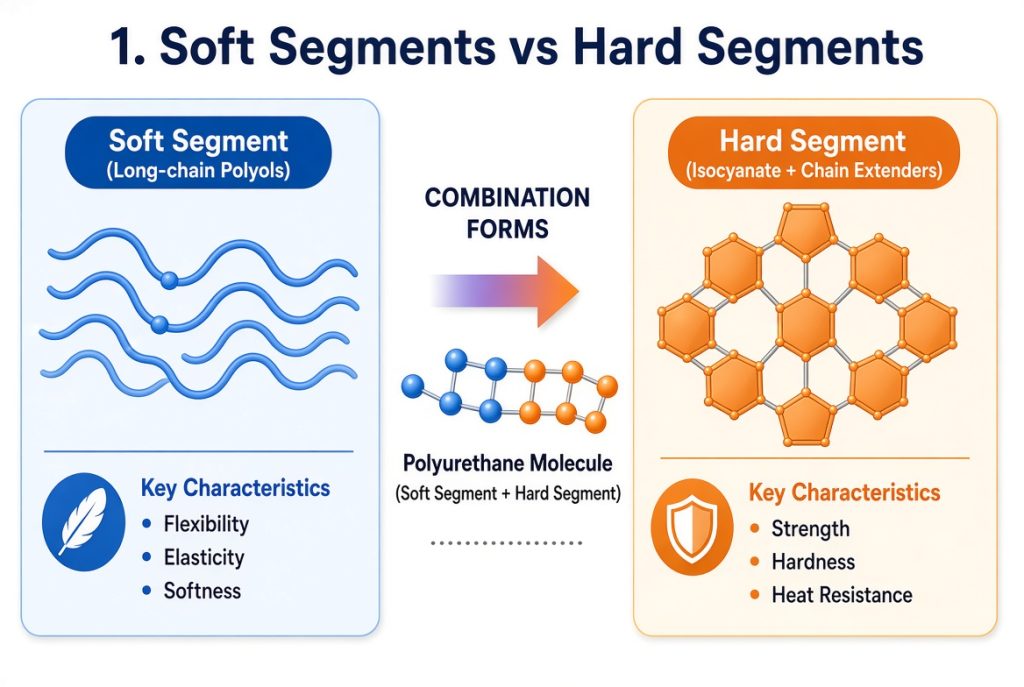
Polyurethane is not simply a uniform material. Its molecular structure usually contains two main parts:
Soft Segment
The soft segment is generally formed from long-chain polyols, such as polyether polyols or polyester polyols.
It provides properties such as:
- Flexibility
- Elasticity
- Low-temperature performance
- Softness
- Resilience
Soft segments are especially important in applications such as:
- Flexible polyurethane foam
- Memory foam
- High-resilience foam
- Cushions and mattresses
- Automotive seating
In simple terms, the soft segment gives polyurethane its flexible and comfortable side.
Hard Segment
The hard segment is mainly formed through the reaction of isocyanates with short-chain polyols or chain extenders.
It provides:
- Mechanical strength
- Hardness
- Structural stability
- Heat resistance
- Tear resistance
The hard segment acts like the structural framework of polyurethane.
Together, soft and hard segments create the unique combination of flexibility and strength that makes polyurethane such a highly customizable material.
2. Why Is the Balance Between Soft and Hard Segments Important?
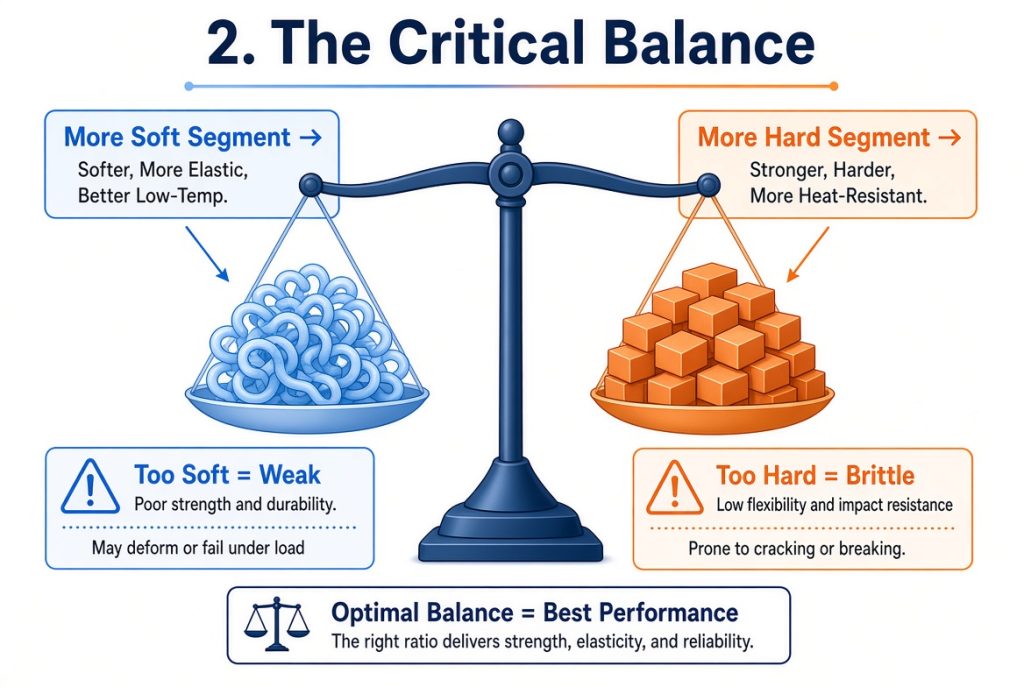
Polyurethane performance depends heavily on the balance between these two segments.
More soft segment may produce a material that is:
- Softer
- More flexible
- More elastic
- Better at low temperatures
More hard segment may produce a material that is:
- Stronger
- Harder
- More durable
- More heat-resistant
However, polyurethane formulation is not simply about adding more of one component.
For example:
Too much soft segment may cause insufficient strength or poor dimensional stability.
Too much hard segment may make the material excessively hard, brittle, or difficult to process.
The real challenge is finding the right balance for the final application.
That is why polyurethane formulation requires both chemical knowledge and practical production experience.
3. How Do Soft and Hard Segments Work Together?
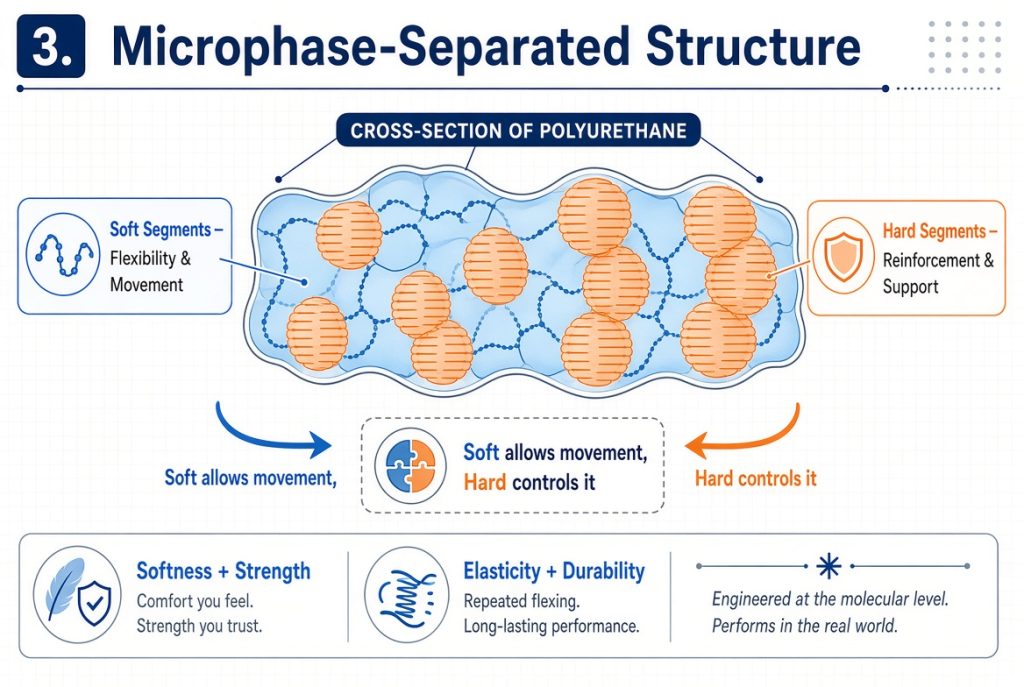
One of the most interesting characteristics of polyurethane is its microphase-separated structure.
Because soft and hard segments have different chemical properties, they may organize themselves into different microscopic regions.
The soft segments provide flexibility and movement.
The hard segments provide physical reinforcement and structural support.
You can think of polyurethane as a carefully designed material system:
Soft segments allow movement. Hard segments control that movement.
This interaction helps polyurethane achieve properties that many traditional materials struggle to combine, such as:
Softness + Strength
Elasticity + Durability
Flexibility + Structural Stability
By adjusting the chemistry and proportion of these segments, manufacturers can design polyurethane materials for completely different applications.
4. Common Problems in Soft and Hard Segment Design
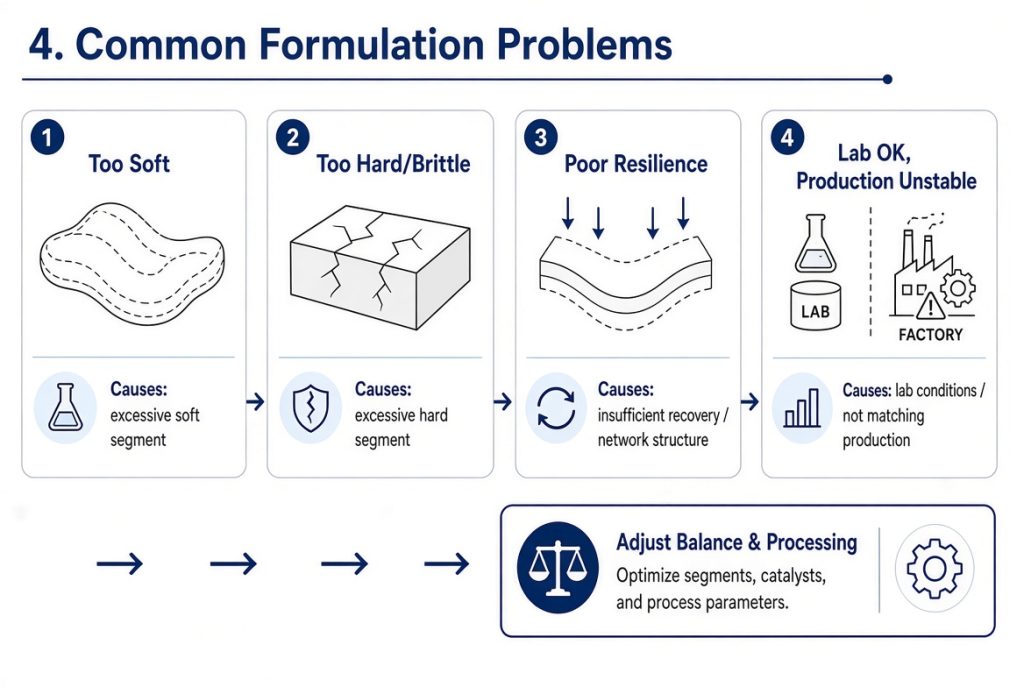
Problem 1: The Material Is Too Soft
A polyurethane product may deform easily or lack sufficient mechanical strength.
Possible causes include:
- Excessive soft segment content
- Insufficient crosslinking
- Inadequate hard segment structure
Solution:
The formulation may need adjustment to improve structural strength and mechanical performance.
Problem 2: The Material Is Too Hard or Brittle
The product may have good strength but poor flexibility or impact resistance.
Possible causes include:
- Excessive hard segment content
- High crosslink density
- Improper raw material selection
Solution:
The formulation can be optimized to improve flexibility while maintaining the required strength.
Problem 3: Poor Resilience
This is particularly important for cushions, mattresses, seating, and high-resilience foam.
The problem may result from an unsuitable balance between molecular flexibility, hard segment structure, and foam formulation.
Solution:
A customized polyurethane system can be designed according to the required density, resilience, hardness, and application environment.
Problem 4: Performance Is Good in the Laboratory but Unstable in Production
This is a common challenge in polyurethane manufacturing.
Even a good chemical formula may produce inconsistent results because of:
- Temperature changes
- Raw material variation
- Processing equipment
- Mixing conditions
- Mold design
- Reaction speed
A successful polyurethane solution must consider both formulation chemistry and actual production conditions.
5. How GST Can Help Optimize Polyurethane Formulations
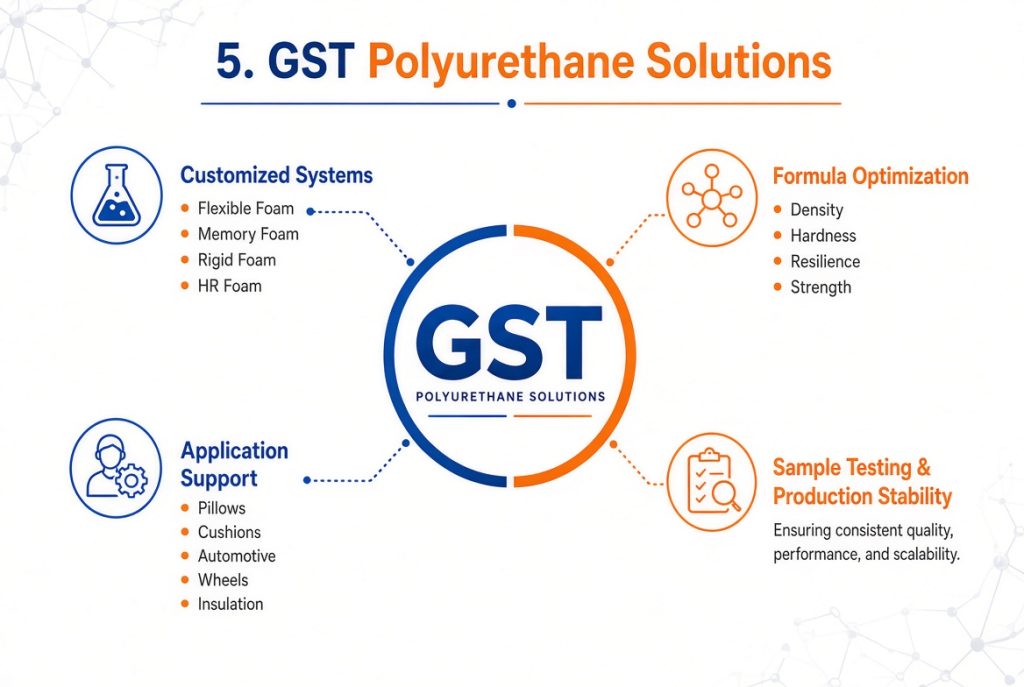
At GST, we understand that every polyurethane application requires a different balance between softness, strength, resilience, processing performance, and cost.
Rather than simply supplying materials, we focus on providing polyurethane application solutions.
Our technical support can include:
Customized Polyurethane Combination Materials
GST can develop polyurethane systems according to different product requirements, including:
- Flexible foam
- Rigid foam
- Memory foam
- High-resilience foam
- Self-skinning polyurethane
- Gel and specialty polyurethane systems
Formula Development and Optimization
Our technical team can help optimize important performance requirements such as:
- Density
- Hardness
- Resilience
- Reaction time
- Foam structure
- Mechanical strength
- Dimensional stability
Application-Based Technical Solutions
Different products require different soft and hard segment designs.
Whether you are producing:
- Memory pillows
- Furniture cushions
- Automotive components
- Solid wheels
- Insulation products
- Self-skinning products
- Customized polyurethane foam products
GST can provide technical support based on the actual application and production process.
Sample Testing and Production Support
From laboratory formulation development to production testing, our team can help customers evaluate and optimize polyurethane performance.
The goal is not simply to create a material that works once.
The goal is to develop a polyurethane system that performs consistently in real production.
Conclusion
The difference between soft segments and hard segments is one of the key reasons polyurethane can be transformed into so many different materials.
Soft segments provide flexibility and elasticity.
Hard segments provide strength and structural support.
The right balance between them determines how the final polyurethane product performs.
For polyurethane manufacturers, the key is not simply choosing raw materials—it is understanding how molecular structure, formulation design, processing conditions, and final application work together.
GST provides customized polyurethane combination materials, formulation development, and technical application solutions to help customers create polyurethane products with the performance they need.
Whether your goal is a softer foam, higher resilience, greater strength, better durability, or improved production stability, the right polyurethane formulation can make the difference.
CATEGORIES
LATEST NEWS
- Polyether Polyol vs Polyest...
- What Is Polyester Polyol?
- What Is Polyether Polyol?
- What Is Polyol?
- Why Is Reaction Balance Cri...
- Blowing Reaction vs Gelling...
- How Molecular Structure Det...
- Soft Segment vs Hard Segmen...
- What Is Crosslinking in Pol...
- What Is Polyurethane Polyme...
CONTACT US
Tel:+86 18688691634
Email:sam@1688pu.com
Add:No. 91 Central East Rd, Luxi Village, Gaobu Town, Dongguan 523283, China.