Why Is Reaction Balance Critical in PU Foaming?
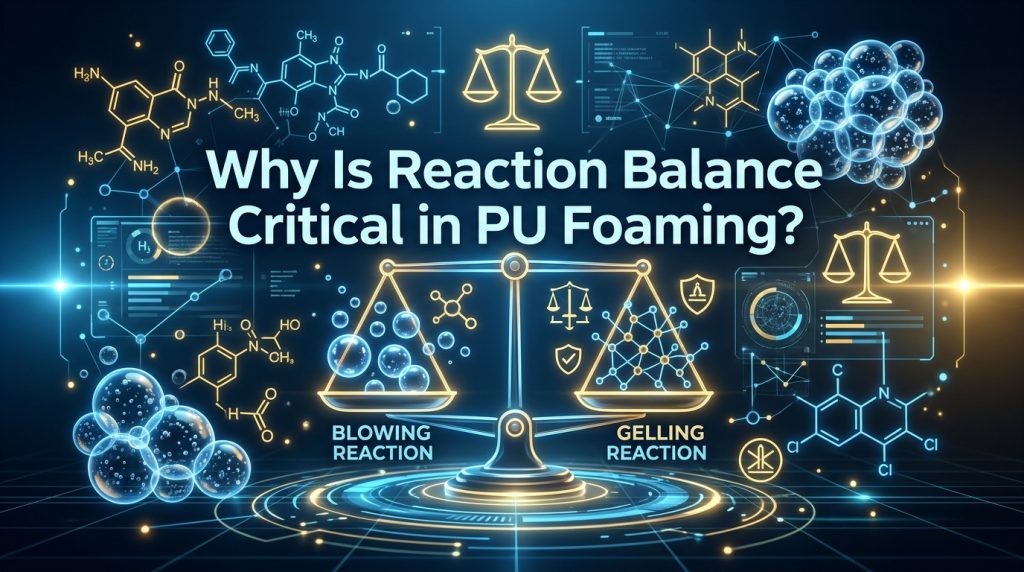
Polyurethane (PU) foam may look simple from the outside, but inside the mold or production equipment, multiple chemical reactions are happening at the same time.
One of the most important factors determining whether the final foam is successful is reaction balance.
If the reactions are not properly balanced, the foam may collapse, shrink, crack, develop poor cell structures, or fail to achieve the required physical properties. For PU manufacturers, understanding reaction balance is therefore essential for achieving stable production and consistent product quality.
1.What Is Reaction Balance in PU Foaming?
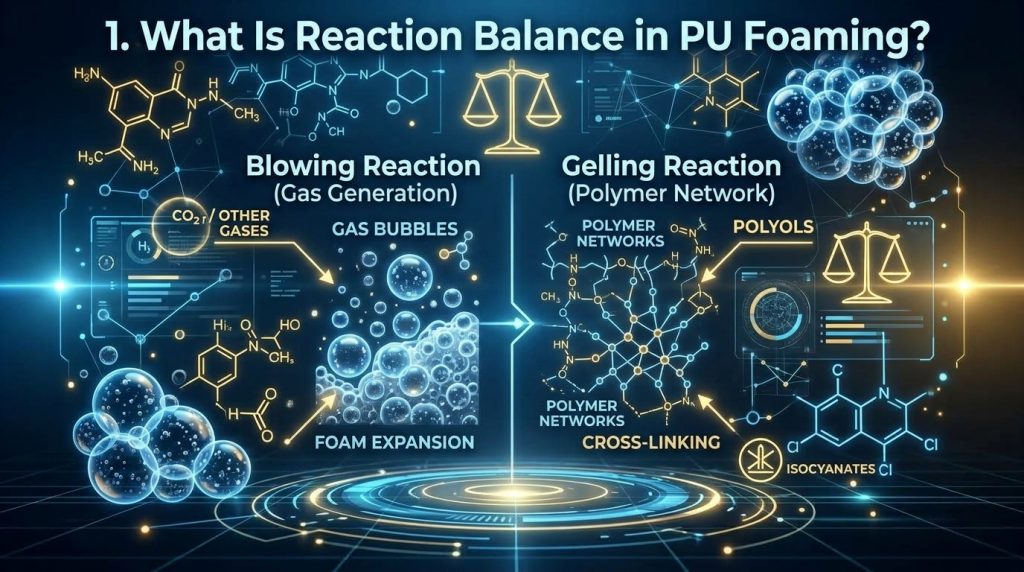
In polyurethane foaming, two major reactions must work together:
The blowing reaction generates gas that expands the foam and creates the cellular structure.
The gelling reaction builds the polymer network that gives the foam strength and stability.
Simply put:
Blowing creates the foam structure. Gelling stabilizes it.
A successful PU foam system requires these two processes to happen at the right speed and at the right time.
If gas is generated too quickly before the polymer structure becomes strong enough, the foam may become unstable. If the polymer structure develops too quickly, the foam may not expand properly.
That is why reaction balance is critical.
2.Why Does PU Foaming Need the Right Balance?
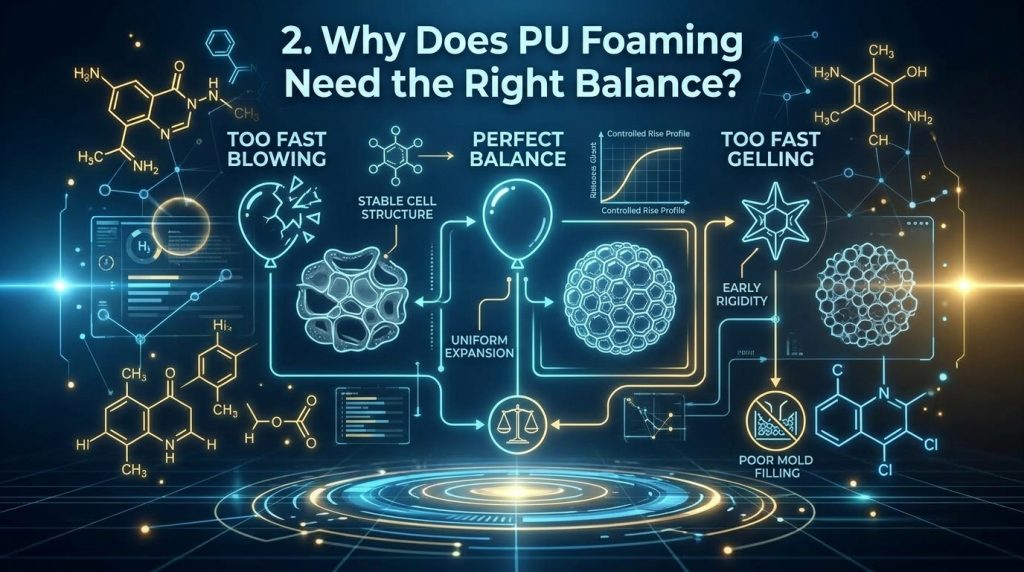
Imagine inflating a balloon while simultaneously strengthening its walls.
If you inflate it too quickly before the walls are strong enough, it may burst or collapse.
If the walls become too rigid too early, the balloon cannot expand properly.
PU foaming works in a similar way.
A properly balanced reaction helps manufacturers achieve:
- Uniform foam expansion
- Stable cell structures
- Good mold filling
- Controlled rise profiles
- Consistent density
- Improved mechanical properties
- Reduced production defects
The goal is not simply to make the reaction faster.
The goal is to make every stage of the reaction happen at the right time.
3.How Does Reaction Balance Work?
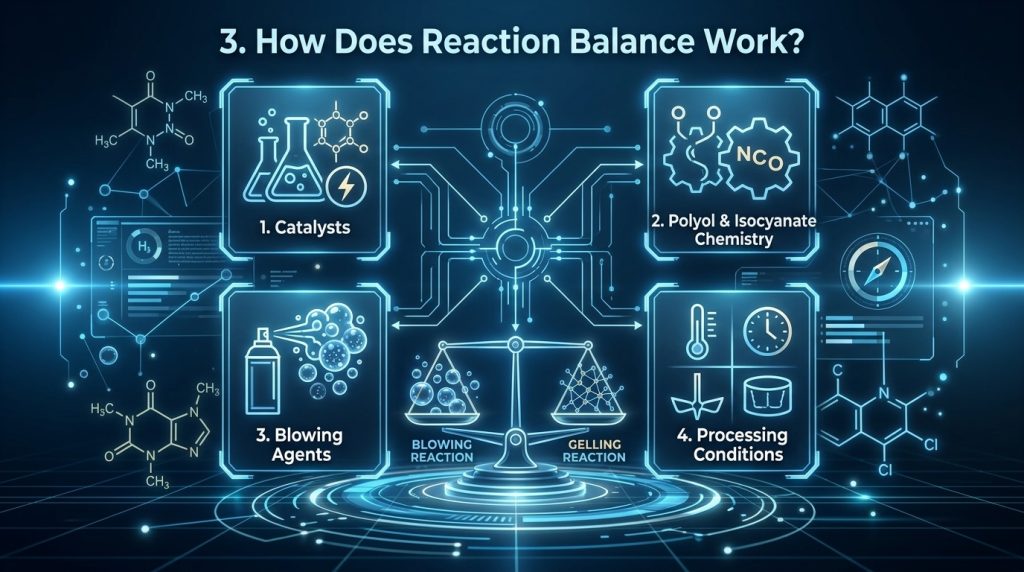
The reaction balance in PU foam is influenced by several factors.
1. Catalysts Control Reaction Speed
Catalysts play a major role in controlling both blowing and gelling reactions.
Different catalysts can promote different parts of the PU reaction. By selecting and combining catalysts properly, formulators can adjust:
- Cream time
- Rise time
- Gel time
- Tack-free time
- Demold time
A well-designed catalyst package helps synchronize foam expansion with polymer network formation.
2. Polyol and Isocyanate Chemistry Matters
The type of polyol, isocyanate index, functionality, and molecular structure all influence reaction behavior.
Even small formulation changes can affect foam processing and final performance.
For example, increasing crosslinking may improve structural strength, but excessive crosslinking can make the foam too rigid or difficult to process.
3. Blowing Agents Affect Foam Expansion
The blowing system determines how quickly gas is generated and how the cells develop.
If expansion is too aggressive, the foam structure may become weak.
If expansion is insufficient, the foam may have high density or poor filling performance.
4. Processing Conditions Also Matter
Reaction balance is not determined by formulation alone.
Temperature, mixing quality, machine pressure, mold temperature, and ambient conditions can all influence the final result.
This is why a formula that works well in the laboratory may still require adjustment during actual production.
4.Common Problems Caused by Poor Reaction Balance
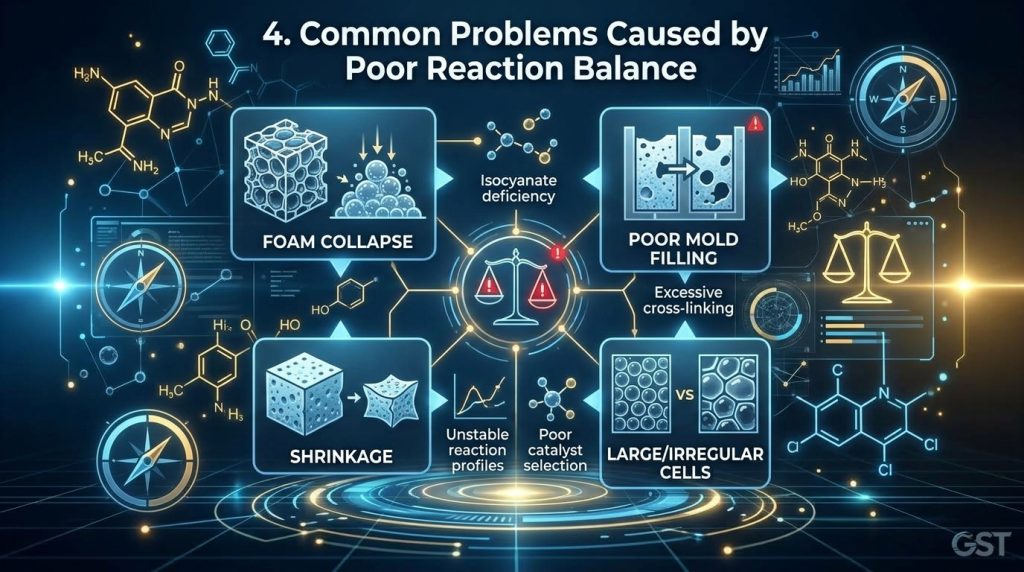
When blowing and gelling reactions are not synchronized, manufacturers may experience several common problems.
Foam Collapse
The foam expands, but the polymer structure is not strong enough to support it.
Possible cause: Blowing reaction is too fast compared with gelling.
Poor Mold Filling
The material begins to gel before it completely fills the mold.
Possible cause: Gelling reaction is too fast.
Shrinkage
The foam loses volume after production.
Possible cause: Insufficient structural strength or an unstable reaction profile.
Large or Irregular Cells
The foam develops uneven cell structures.
Possible cause: Poor control of blowing speed, mixing, or formulation balance.
Inconsistent Production Results
One batch performs well, while another shows defects.
Possible cause: Raw material variation, temperature changes, or insufficient processing control.
5.How Can These Problems Be Solved?
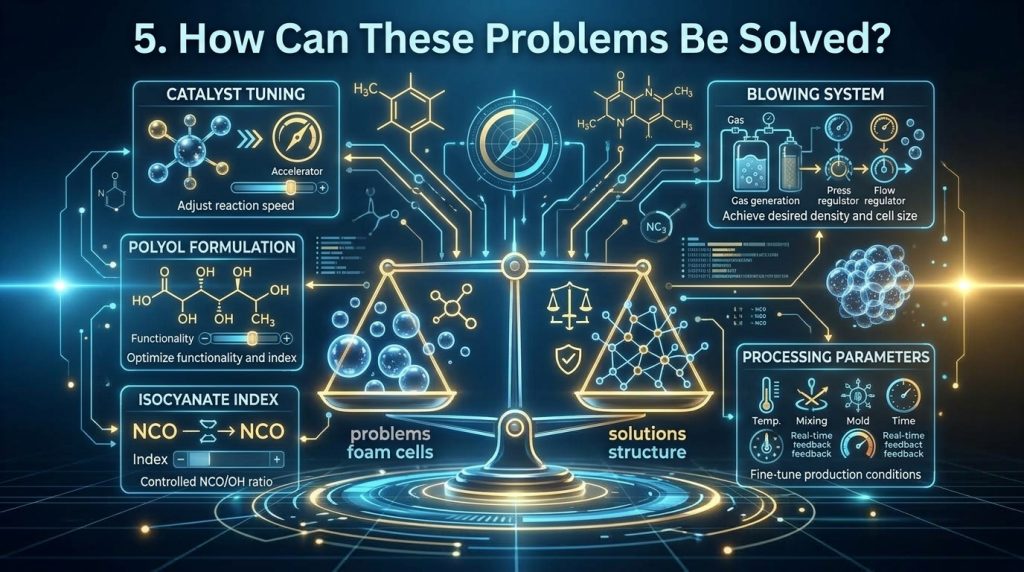
The most effective solution is usually not to adjust only one ingredient.
PU foaming is a system, and successful troubleshooting requires understanding how different components interact.
A proper solution may involve adjusting:
- Catalyst type and dosage
- Polyol formulation
- Isocyanate index
- Blowing system
- Surfactants and additives
- Processing temperature
- Mixing conditions
- Machine parameters
The key is to identify which reaction is happening too early or too late.
Once the reaction profile is understood, the formulation can be optimized more accurately.
6.How GST Supports PU Foaming Solutions

At GST, we understand that different PU products require different reaction profiles.
A memory foam pillow, automotive headrest, rigid insulation panel, self-skinning product, or high-resilience foam cannot rely on exactly the same formulation strategy.
GST can provide customized support based on the customer’s production requirements, including:
Customized PU System Materials
GST can develop polyurethane combination materials according to specific applications and performance requirements.
Formula Optimization
Our technical team can help optimize reaction balance based on factors such as:
- Product density
- Hardness
- Resilience
- Foam structure
- Processing time
- Mold requirements
- Production equipment
Catalyst and Reaction Control Solutions
By adjusting catalyst systems and formulation components, GST can help customers achieve more controlled and stable foaming reactions.
Sample Development and Testing
Before large-scale production, formulas can be evaluated through laboratory testing and sample development to reduce production risks.
Technical Support for Production
From laboratory formulation development to actual production conditions, GST aims to provide practical polyurethane application solutions.
Final Thoughts
Reaction balance is one of the foundations of successful PU foaming.
The blowing reaction creates the cells. The gelling reaction builds the structure. When both are properly synchronized, manufacturers can achieve stable processing, better foam quality, and more consistent product performance.
In polyurethane production, the best formula is not simply the one that reacts fastest.
It is the one where every reaction happens at the right time.
With customized polyurethane combination materials, formulation development, catalyst solutions, and technical support, GST helps customers build more stable, efficient, and application-focused PU foaming systems.
Looking for a customized PU formulation or technical solution? Contact GST to discuss your polyurethane application requirements.
PREVIOUS:Blowing Reaction vs Gelling Reaction: The Two Reactions That Define PU Foam Performance
NEXT:What Is Polyol?
CATEGORIES
LATEST NEWS
- Polyether Polyol vs Polyest...
- What Is Polyester Polyol?
- What Is Polyether Polyol?
- What Is Polyol?
- Why Is Reaction Balance Cri...
- Blowing Reaction vs Gelling...
- How Molecular Structure Det...
- Soft Segment vs Hard Segmen...
- What Is Crosslinking in Pol...
- What Is Polyurethane Polyme...
CONTACT US
Tel:+86 18688691634
Email:sam@1688pu.com
Add:No. 91 Central East Rd, Luxi Village, Gaobu Town, Dongguan 523283, China.