Trimethylolethane
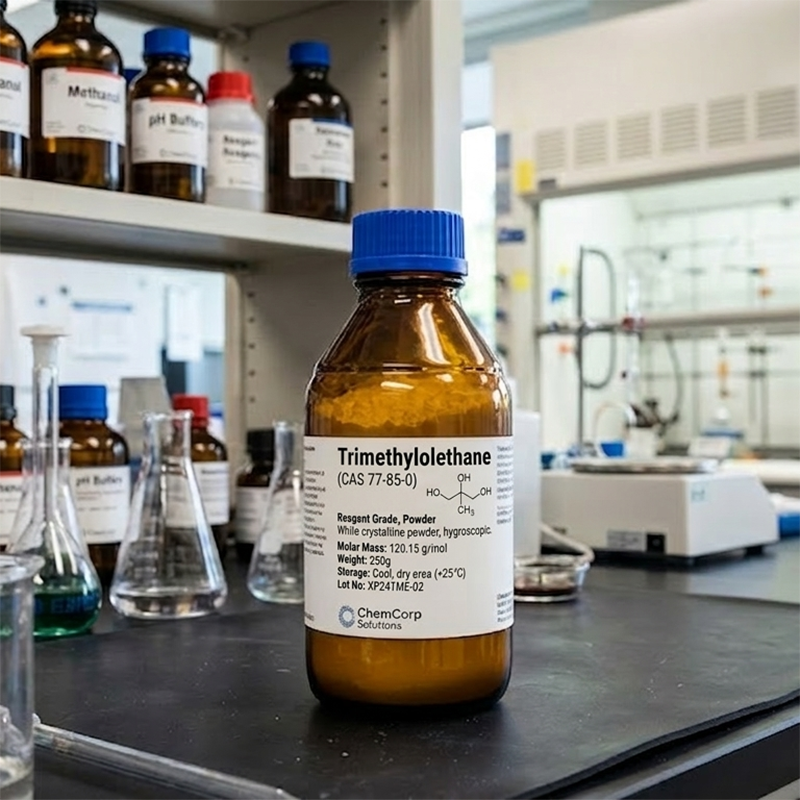
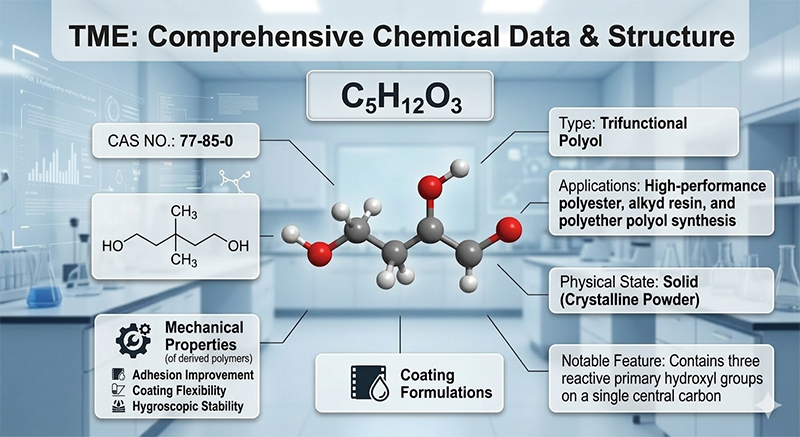
Chemical Name and Synonyms: 1,1,1-Tris(hydroxymethyl)ethane; 2-Methyl-2-hydroxymethyl-1,3-propanediol.
Abbreviation: TME.
Molecular Formula: C₅H₁₂O₃
Molecular Weight: 120.15
CAS No.: 77-85-0
EINECS No.: 201-063-9
Structural Formula:
Physicochemical Properties:
At room temperature, it exists as a white crystalline granular or lumpy solid. It is odorless, with a melting point of 200–203°C. It is soluble in water; its solubility in water and alcohols (at 25°C) is: 140 g/100 g water, 75.2 g/100 g methanol, and 27.9 g/100 g ethanol.
TME is essentially non-toxic; acute oral toxicity data for mice indicates an LD50 > 5 g/kg.
Characteristics and Applications:
The molecular structure of Trimethylolethane is similar to that of Trimethylolpropane (TMP), as it contains three primary hydroxyl groups. However, it possesses a high melting point; its compact neopentyl structure and high hydroxyl content impart excellent heat resistance, light resistance, hydrolysis resistance, and oxidation resistance to polymers. It is utilized in the production of high-quality alkyd resins and polyester resins for use in coatings and powder coatings. Its polyol ester derivatives serve as lubricants, as well as plasticizers and stabilizers for plastics and titanium dioxide pigment coatings. Its nitrate esters are employed in explosives and propellants. Furthermore, the substance itself can be utilized as a solid-phase thermal energy storage medium.
In the field of polyurethanes, TME—much like TMP—can be used to synthesize branched polyurethane polyols, serving as a polyurethane crosslinker, a starter for polyether polyols, and similar applications. It finds use in various products such as polyurethane coatings, elastomers, and foams.
PREVIOUS:Glycerin
CATEGORIES
LATEST NEWS
- Polyether Polyol vs Polyest...
- What Is Polyester Polyol?
- What Is Polyether Polyol?
- What Is Polyol?
- Why Is Reaction Balance Cri...
- Blowing Reaction vs Gelling...
- How Molecular Structure Det...
- Soft Segment vs Hard Segmen...
- What Is Crosslinking in Pol...
- What Is Polyurethane Polyme...
CONTACT US
Tel:+86 18688691634
Email:sam@1688pu.com
Add:No. 91 Central East Rd, Luxi Village, Gaobu Town, Dongguan 523283, China.