What Is Polyurethane Polymerization?
Polyurethane is everywhere—from comfortable mattresses and automotive seats to refrigerator insulation, spray foam, coatings, adhesives, and industrial components.
But how does polyurethane actually become a useful material?
The answer lies in one of the most important processes in polyurethane chemistry: polyurethane polymerization.
Understanding this process helps manufacturers control foam quality, processing speed, density, hardness, strength, and many other critical product properties.
1. What Is Polyurethane Polymerization?
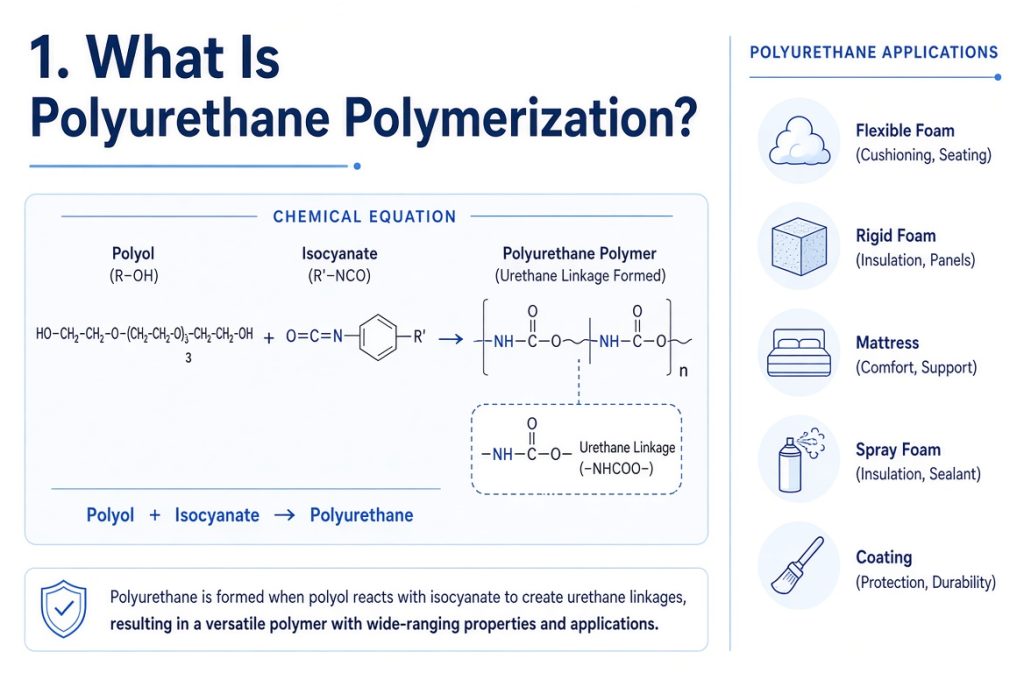
Polyurethane polymerization is the chemical process in which reactive raw materials—primarily polyols and isocyanates—react to form long-chain polyurethane polymers.
The key chemical reaction creates a urethane linkage, which becomes part of the polymer structure.
In simple terms:
Polyol + Isocyanate → Polyurethane Polymer
Unlike some polymers that are produced from a single monomer, polyurethane is highly customizable because manufacturers can select different raw materials, catalysts, additives, and formulations.
This flexibility allows polyurethane systems to produce many different materials, including:
- Flexible polyurethane foam
- Rigid polyurethane foam
- Memory foam
- High-resilience foam
- Integral skin foam
- Polyurethane elastomers
- Coatings and adhesives
- Spray polyurethane insulation
The polymerization process is therefore the foundation of polyurethane performance.
2. Why Is Polyurethane Polymerization Important?
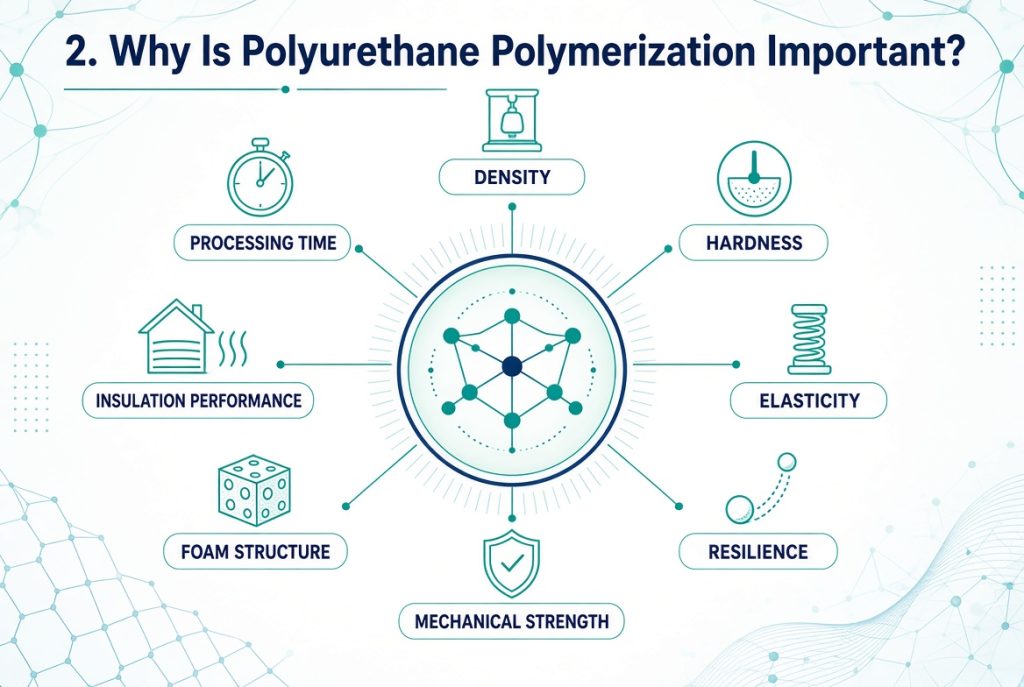
Polyurethane polymerization determines much more than whether a material simply reacts or cures.
It directly influences important product properties such as:
- Density
- Hardness
- Elasticity
- Resilience
- Mechanical strength
- Foam structure
- Insulation performance
- Processing time
- Surface quality
For example, a polyurethane foam used for a memory pillow requires controlled polymerization to achieve slow recovery and comfortable softness.
A rigid polyurethane insulation foam, however, requires a different formulation to achieve high strength, dimensional stability, and excellent thermal insulation.
Even small changes in the reaction system can significantly affect the final product.
That is why polyurethane polymerization is not simply a chemical reaction—it is a carefully controlled engineering process.
3. How Does Polyurethane Polymerization Work?
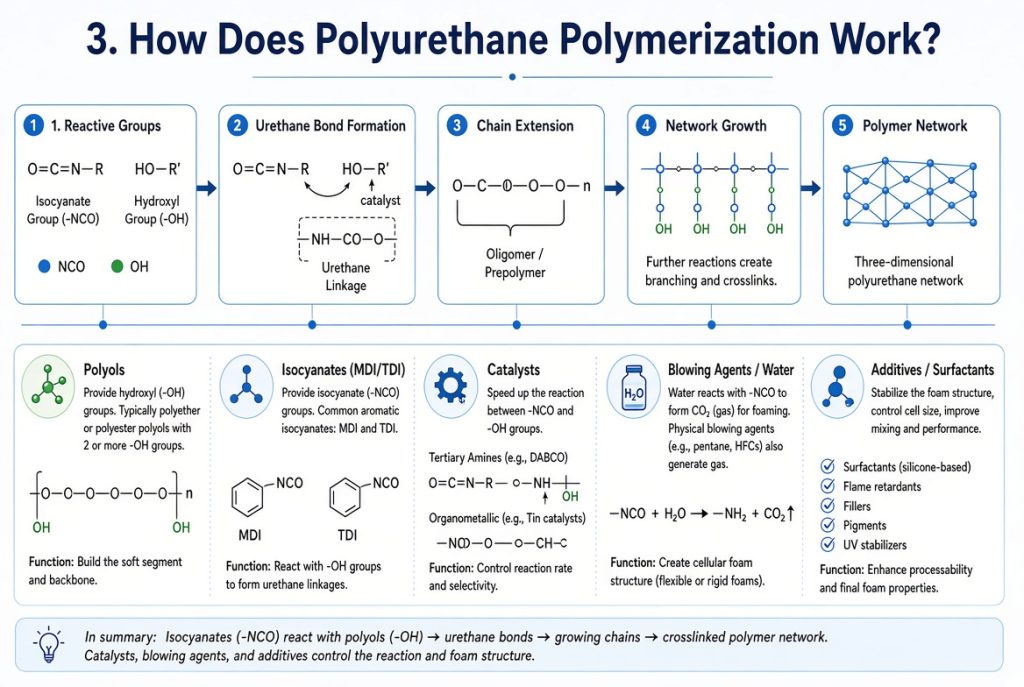
The basic polyurethane reaction begins when isocyanate groups (-NCO) react with hydroxyl groups (-OH) from polyols.
This reaction forms urethane bonds and gradually creates a larger polymer network.
However, real polyurethane production is usually more complex.
A typical polyurethane formulation may include:
Polyols
Polyols are one of the main building blocks of polyurethane.
Different types of polyols can influence flexibility, hardness, resilience, and other physical properties.
Isocyanates
Isocyanates react with polyols to form the polyurethane structure.
Common polyurethane raw materials include MDI and TDI-based systems.
Catalysts
Catalysts help control the reaction speed and balance different reactions during polyurethane production.
Proper catalyst selection can improve processing stability and product quality.
Blowing Agents or Water
For polyurethane foam production, gas generation is needed to create the cellular foam structure.
Water can react with isocyanate to generate carbon dioxide, which helps expand the foam.
Additives
Surfactants, flame retardants, pigments, chain extenders, and other additives can be used to improve processing and product performance.
All these components must work together in the right proportions.
That is why formulation design is critical to successful polyurethane polymerization.
4. What Problems Can Occur During Polyurethane Polymerization?
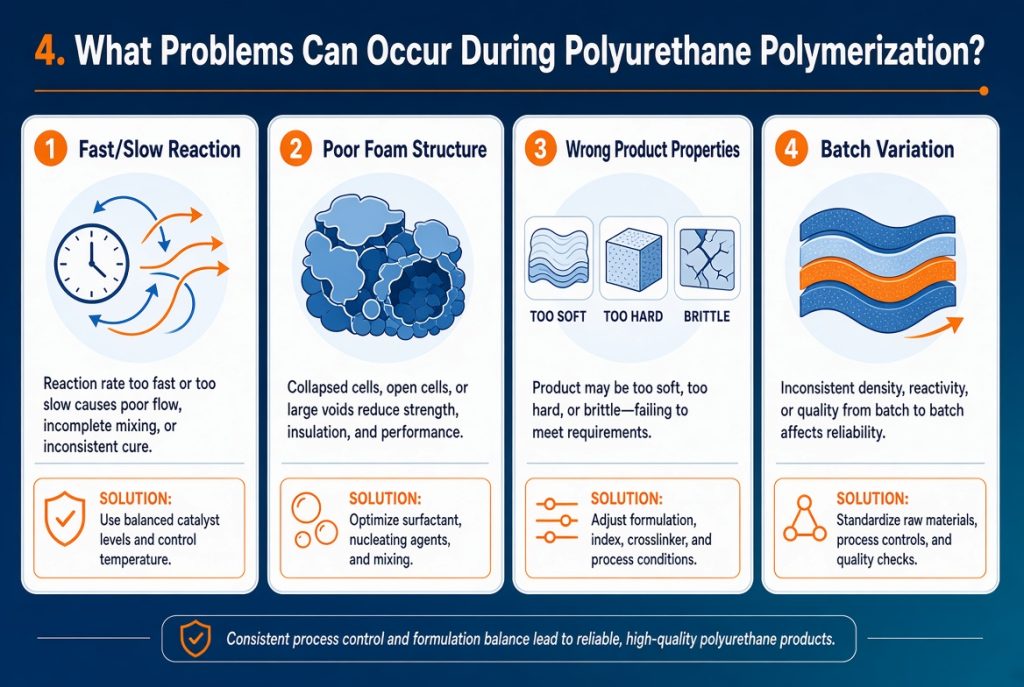
Although the chemistry may sound straightforward, polyurethane production can face many practical challenges.
Problem 1: Reaction Is Too Fast or Too Slow
If polymerization happens too quickly, manufacturers may experience:
- Poor flow
- Difficult processing
- Uneven filling
- Surface defects
If the reaction is too slow, production efficiency may decrease and the material may not cure properly.
Solution:
Optimize the catalyst system, raw material ratio, and processing temperature.
Problem 2: Poor Foam Structure
Problems such as uneven cells, collapse, shrinkage, or large bubbles may occur during foam production.
Solution:
Adjust the blowing system, surfactants, catalyst balance, and formulation design.
Problem 3: Product Properties Do Not Meet Requirements
A polyurethane product may become:
- Too soft
- Too hard
- Too brittle
- Not resilient enough
- Too slow or too fast in recovery
Solution:
Modify the polyol system, isocyanate index, additives, and overall formulation.
Problem 4: Batch-to-Batch Quality Variation
In industrial production, even a good formulation can produce inconsistent results if processing conditions are not properly controlled.
Temperature, humidity, mixing quality, and equipment parameters can all affect polymerization.
Solution:
Combine a stable polyurethane formulation with optimized processing parameters and technical support.
5. How Can GST Help Optimize Polyurethane Polymerization?
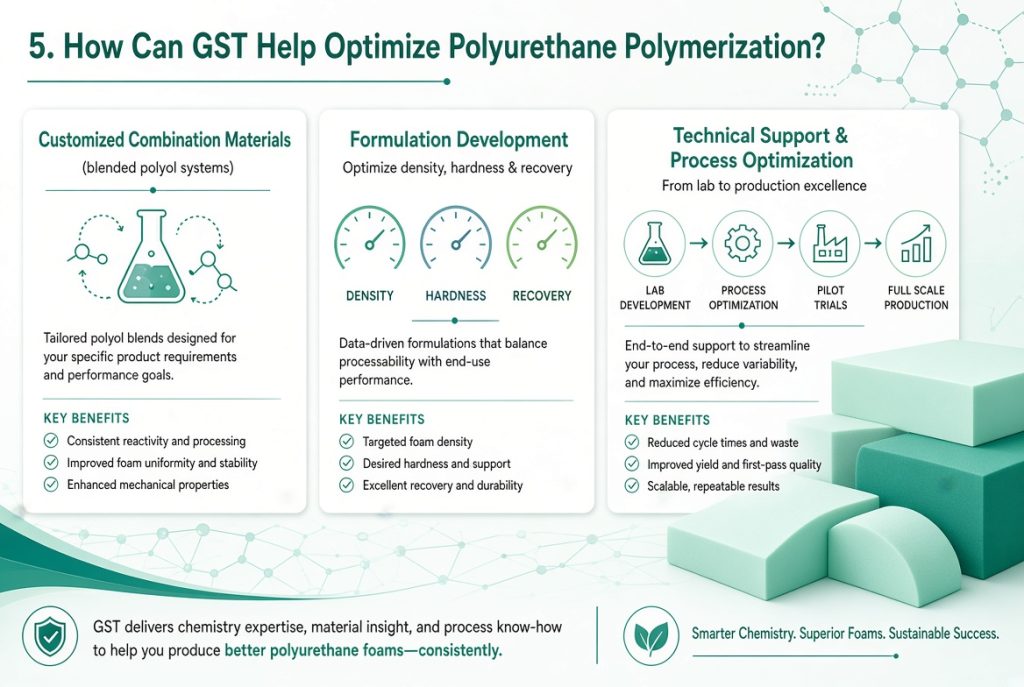
Successful polyurethane production requires more than purchasing raw materials.
Manufacturers need a system that matches their product, equipment, process, and performance requirements.
GST can provide customized polyurethane solutions based on different applications.
Customized Polyurethane Combination Materials
GST can develop and supply polyurethane combination materials and blended polyol systems for different applications.
These systems can help simplify production and improve formulation consistency.
Applications can include:
- Flexible foam
- Rigid foam
- Memory foam
- High-resilience foam
- Integral skin foam
- Spray polyurethane foam
- Packaging materials
- Automotive components
- Furniture and bedding products
Customized Formulation Development
Different customers have different performance requirements.
GST can support formulation development based on requirements such as:
- Density
- Hardness
- Recovery speed
- Resilience
- Strength
- Thermal insulation
- Processing time
- Surface appearance
The goal is not simply to create polyurethane—but to create the right polyurethane system for the application.
Technical Support and Process Optimization
A good formula must also work successfully in real production.
GST can provide technical support related to:
- Raw material selection
- Formula adjustment
- Reaction control
- Foaming parameters
- Equipment compatibility
- Production troubleshooting
From laboratory development to production testing, technical optimization can help customers improve product quality and manufacturing efficiency.
Conclusion
Polyurethane polymerization is the process that transforms reactive chemical components into highly versatile polyurethane materials.
By controlling the interaction between polyols, isocyanates, catalysts, blowing agents, and additives, manufacturers can create polyurethane products with very different properties.
However, achieving stable and high-quality production requires the right balance of materials, formulation, chemistry, and processing technology.
Whether you are developing flexible foam, rigid insulation foam, memory foam, high-resilience foam, integral skin products, or other polyurethane applications, GST can provide customized polyurethane combination materials, formulation development, and technical solutions.
GST helps turn polyurethane chemistry into practical manufacturing solutions.
PREVIOUS:How Is Urea Formed in Polyurethane?
CATEGORIES
LATEST NEWS
- Aromatic vs Aliphatic Isocy...
- What Is Modified MDI?
- MDI vs TDI: What’s th...
- TDI 80/20 vs TDI 65/35
- What Is TDI?
- What Is Polymeric MDI (pMDI)?
- What Is MDI?
- What Is Isocyanate?
- How to Select the Right Pol...
- How Does Polyol Affect Foam...
CONTACT US
Tel:+86 18688691634
Email:sam@1688pu.com
Add:No. 91 Central East Rd, Luxi Village, Gaobu Town, Dongguan 523283, China.