How Molecular Structure Determines PU Foam Properties?
Polyurethane (PU) foam may look simple—a lightweight material filled with tiny cells—but its performance is actually determined at the molecular level.
Why can one PU foam be soft and elastic, while another is rigid and strong? Why do some foams recover quickly, while others provide slow rebound and pressure relief?
The answer starts with molecular structure.
Understanding how molecular structure affects PU foam properties helps manufacturers develop better formulations, improve production stability, and achieve specific performance targets.
1. What Is Molecular Structure in PU Foam?
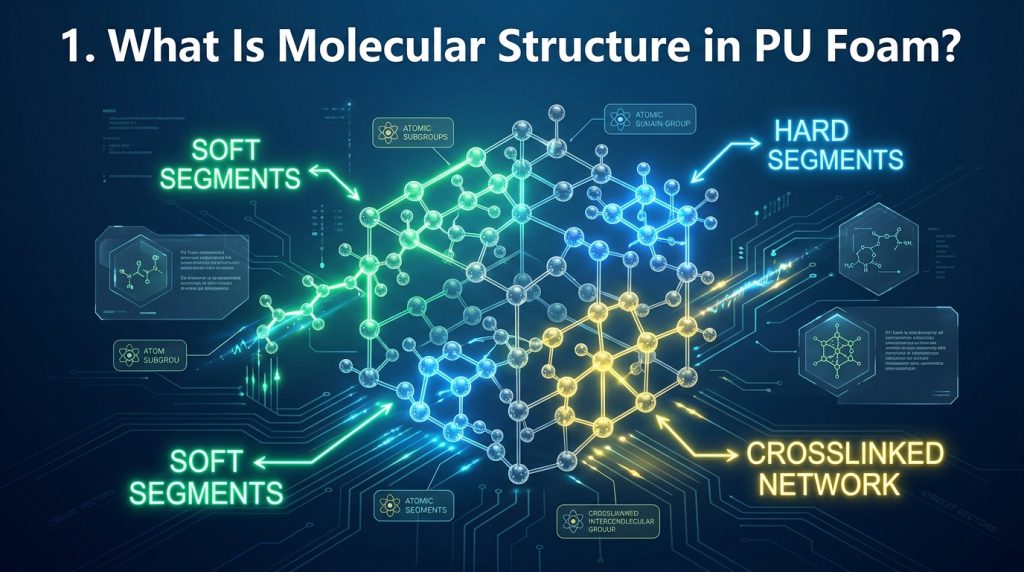
Polyurethane foam is mainly formed through the reaction between polyols and isocyanates, together with catalysts, blowing agents, surfactants, and other additives.
At the molecular level, polyurethane contains different structural segments, including:
- Soft segments – mainly contribute to flexibility, elasticity, and low-temperature performance.
- Hard segments – contribute to strength, hardness, dimensional stability, and heat resistance.
- Crosslinked structures – help build a three-dimensional network and influence resilience and rigidity.
- Hydrogen bonding – affects intermolecular interactions and can influence mechanical strength and recovery behavior.
In simple terms:
Molecular structure → Polymer network → Cell structure → Final foam properties
This is why changing a raw material, catalyst, or formulation ratio can produce a noticeable difference in the final foam.
2. Why Does Molecular Structure Matter?
For PU foam manufacturers, the target is rarely just “making foam.”
Different applications require completely different performance.
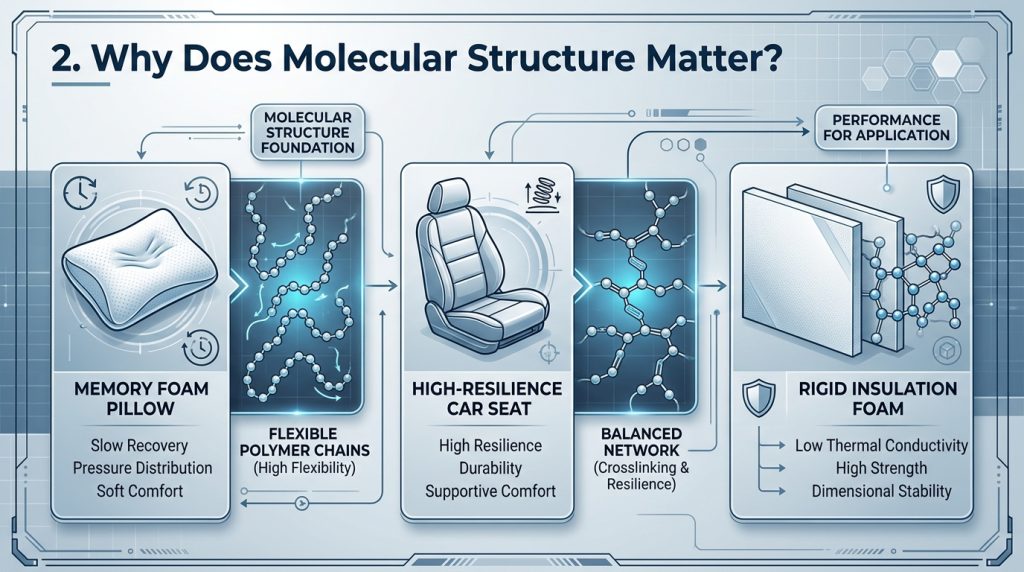
A memory pillow may need slow recovery and pressure distribution, while a car seat requires high resilience, durability, and comfort. Rigid insulation foam focuses more on low thermal conductivity, dimensional stability, and strength.
The molecular structure provides the foundation for these differences.
For example:
More flexible molecular structures can contribute to softer and more elastic foam.
Higher hard-segment content can increase hardness and mechanical strength.
Greater crosslinking can improve structural stability but may also reduce flexibility.
Therefore, formulation design is essentially the process of building the molecular structure needed for the final application.
3. How Does Molecular Structure Work?
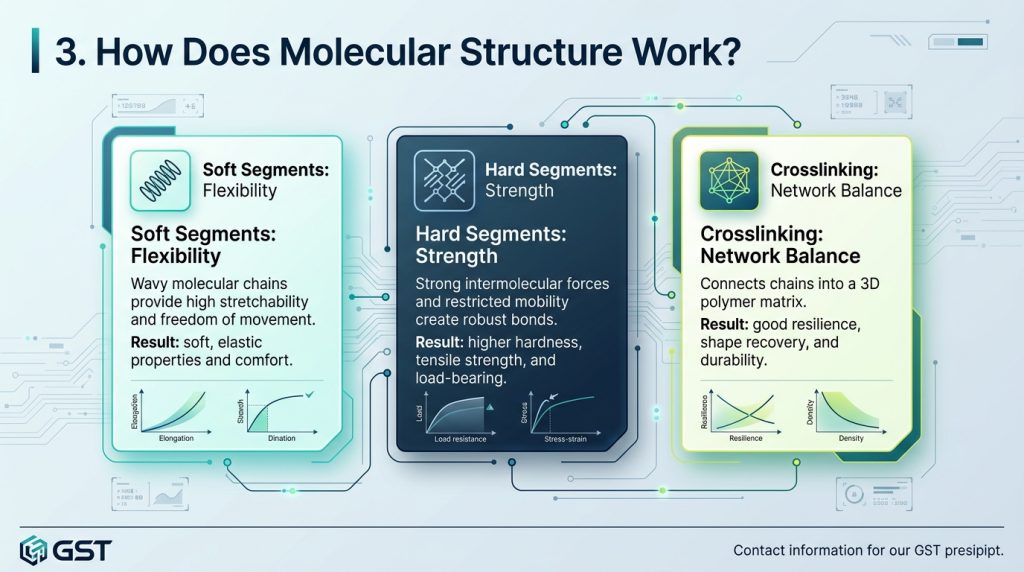
The relationship can be understood through three important levels.
Soft Segments: Flexibility & Elasticity
Longer and more flexible polymer chains allow molecular segments to move more easily.
This can contribute to:
- Softer foam
- Better flexibility
- Improved elongation
- Comfortable touch and feel
This is particularly important in flexible PU foam, memory foam, cushions, and other comfort-oriented products.
Hard Segments: Strength & Support
Hard segments restrict molecular movement and create stronger interactions within the polymer structure.
They can contribute to:
- Higher hardness
- Better tensile and tear strength
- Improved load-bearing capability
- Better dimensional stability
The challenge is finding the right balance. Too much rigidity can make foam hard and brittle, while insufficient structural support can lead to poor mechanical performance.
Crosslinking: Building the Network
Crosslinking connects polymer chains into a three-dimensional network.
Appropriate crosslinking can improve:
- Resilience
- Compression performance
- Dimensional stability
- Heat resistance
- Long-term durability
But excessive crosslinking may make the foam too rigid or reduce its flexibility.
The best PU formulation is therefore not about maximizing one parameter—it is about finding the right molecular balance.
4. Common Problems Caused by Molecular Structure
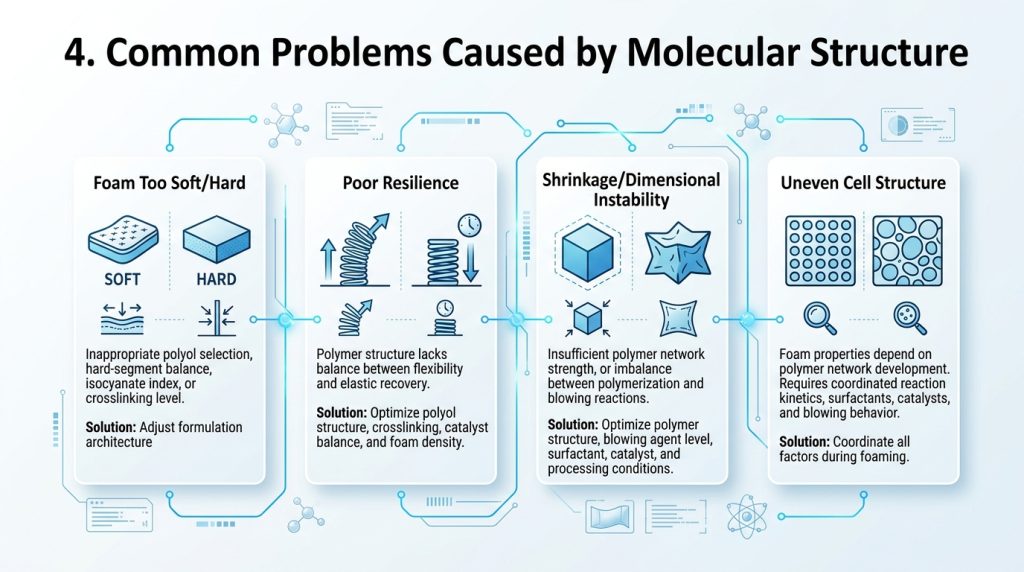
When the molecular structure and formulation are not properly matched, manufacturers may encounter problems such as:
Foam Is Too Soft or Too Hard
Possible causes include inappropriate polyol selection, hard-segment balance, isocyanate index, or crosslinking level.
Solution: Adjust the formulation architecture rather than simply adding more additives.
Poor Resilience or Slow Recovery
The polymer structure may not provide the required balance between flexibility and elastic recovery.
Solution: Optimize polyol structure, crosslinking, catalyst balance, and foam density according to the application.
Shrinkage or Dimensional Instability
Insufficient polymer network strength or an imbalance between polymerization and blowing reactions can cause dimensional problems.
Solution: Optimize the polymer structure together with blowing-agent level, surfactant system, catalyst package, and processing conditions.
Uneven Cell Structure
Foam properties depend not only on molecular structure but also on how the polymer network develops during foaming.
Solution: Coordinate reaction kinetics, surfactants, catalysts, blowing behavior, and processing parameters.
5. Molecular Structure Is Only One Piece of the Puzzle

One important point is often overlooked:
PU foam performance is not determined by molecular structure alone.
The final result is influenced by the interaction between:
Raw Materials + Formulation + Reaction Kinetics + Cell Structure + Processing Conditions
For example, even a well-designed polymer structure may fail to deliver the expected performance if the cream time, rise time, gel time, density, or cell structure is not properly controlled.
That is why professional PU formulation development requires both chemical understanding and practical processing experience.
6. How GST Provides PU Formulation & Technical Solutions
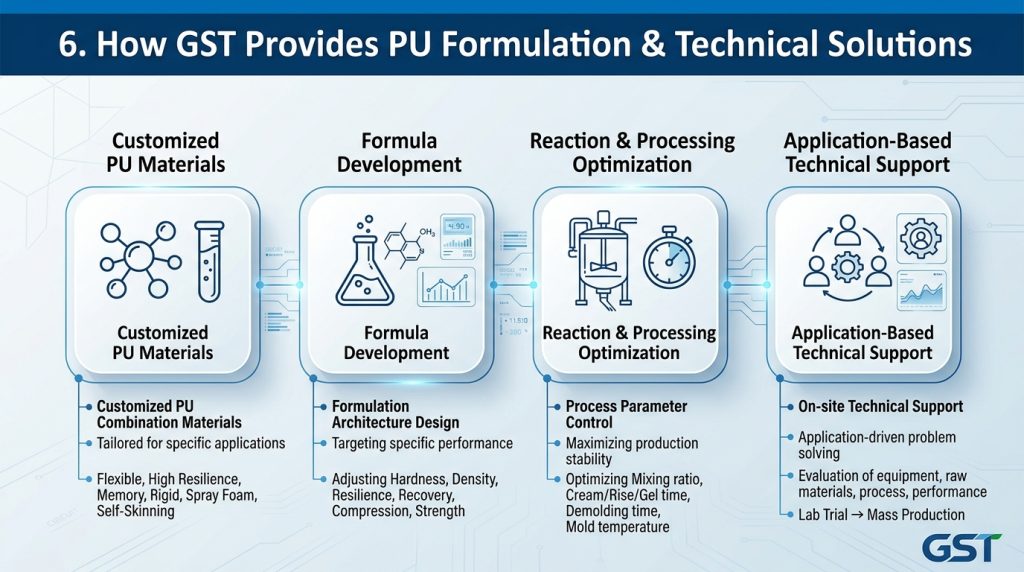
At GST, we focus on more than supplying polyurethane raw materials.
Our goal is to help customers turn formulation concepts into stable, manufacturable PU foam systems.
GST can provide:
Customized PU Combination Materials
We develop customized combination materials for different applications, including:
- Flexible PU foam
- High resilience foam
- Memory foam
- Rigid PU foam
- Spray foam
- Self-skinning PU
- Gel systems
- Other customized polyurethane applications
Formula Development
Different products require different molecular structures and reaction characteristics.
GST can adjust the formulation according to requirements such as:
Hardness • Density • Resilience • Recovery • Compression • Strength • Cell Structure • Processing Speed
Reaction & Processing Optimization
A good formulation must also run well on the customer’s equipment.
Our technical support can help optimize:
- Mixing ratio
- Cream time
- Rise time
- Gel time
- Demolding time
- Mold temperature
- Foaming parameters
- Density control
Application-Based Technical Support
Instead of providing a “one-formula-fits-all” solution, GST evaluates the product, equipment, raw materials, production process, and performance requirements together.
This makes it easier to move from:
Laboratory Trial → Sample Validation → Production Trial → Mass Production
7. From Molecules to Products
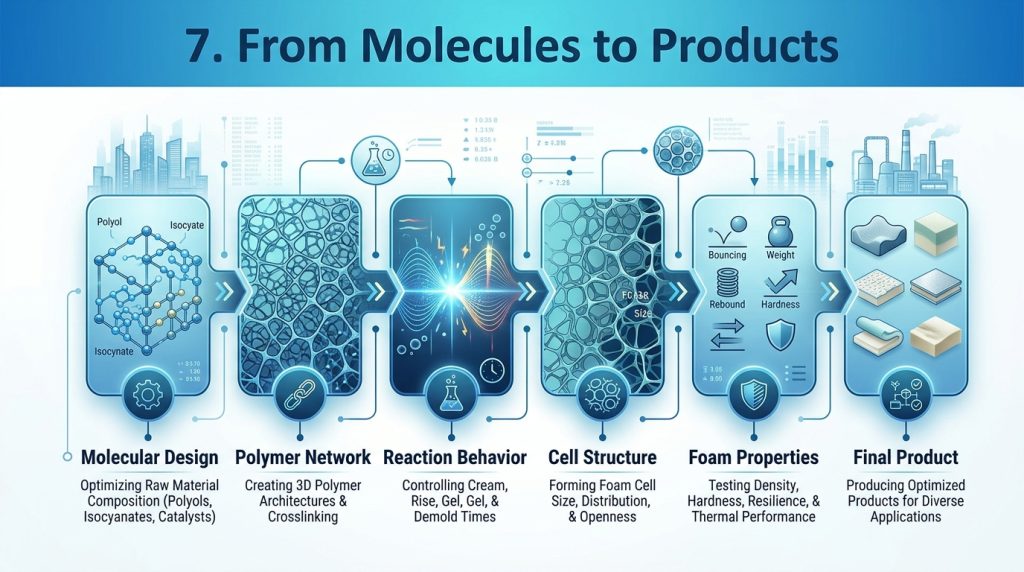
The performance of PU foam begins long before the foam comes out of the mold.
It starts with molecular design.
Molecular Structure
↓
Polymer Network
↓
Reaction Behavior
↓
Cell Structure
↓
Foam Properties
↓
Final Product Performance
Whether you are developing a memory pillow, automotive component, insulation material, cushion, or self-skinning PU product, understanding this relationship can make formulation development much more predictable.
Need a PU formulation for your application?
GST provides polyurethane combination materials, customized formulations, sample testing, and technical application support for PU manufacturers worldwide.
If you have a target density, hardness, resilience, recovery time, production process, or existing formulation that needs optimization, contact GST to discuss your application and formulation requirements.
PREVIOUS:Soft Segment vs Hard Segment in Polyurethane
NEXT:Blowing Reaction vs Gelling Reaction: The Two Reactions That Define PU Foam Performance
CATEGORIES
LATEST NEWS
- Polyether Polyol vs Polyest...
- What Is Polyester Polyol?
- What Is Polyether Polyol?
- What Is Polyol?
- Why Is Reaction Balance Cri...
- Blowing Reaction vs Gelling...
- How Molecular Structure Det...
- Soft Segment vs Hard Segmen...
- What Is Crosslinking in Pol...
- What Is Polyurethane Polyme...
CONTACT US
Tel:+86 18688691634
Email:sam@1688pu.com
Add:No. 91 Central East Rd, Luxi Village, Gaobu Town, Dongguan 523283, China.