What Is Polyol?
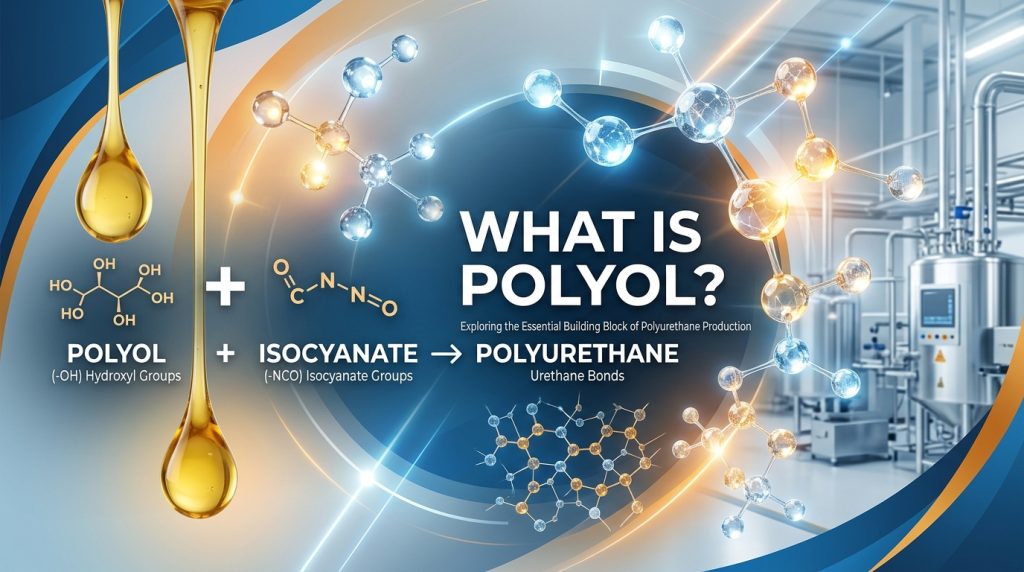
Polyol is one of the most important raw materials in polyurethane production. Whether you are producing flexible foam, rigid insulation foam, memory foam, high-resilience foam, self-skinning products, or other polyurethane materials, polyol plays a critical role in determining the final performance.
But what exactly is polyol, why is it needed, and how does it affect polyurethane products?
Let’s take a closer look.
1,What Is Polyol?
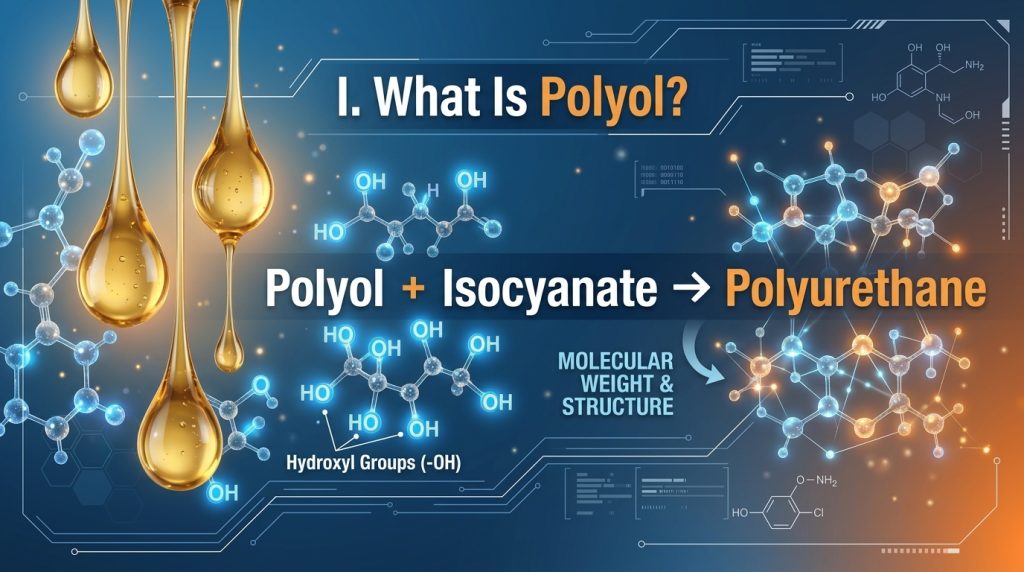
A polyol is a chemical compound containing multiple hydroxyl groups (-OH). In polyurethane production, polyols react with isocyanates to form polyurethane polymers.
Simply put:
Polyol + Isocyanate → Polyurethane
However, polyol is much more than just one half of the reaction.
The type, molecular weight, functionality, and chemical structure of the polyol can significantly influence the properties of the final polyurethane product.
Different polyols can produce materials that are:
- Soft or rigid
- Flexible or highly crosslinked
- Elastic or slow-recovery
- Lightweight or dense
- Highly resilient or highly supportive
That is why selecting the right polyol is one of the foundations of successful polyurethane formulation.
2,Why Is Polyol So Important in Polyurethane?
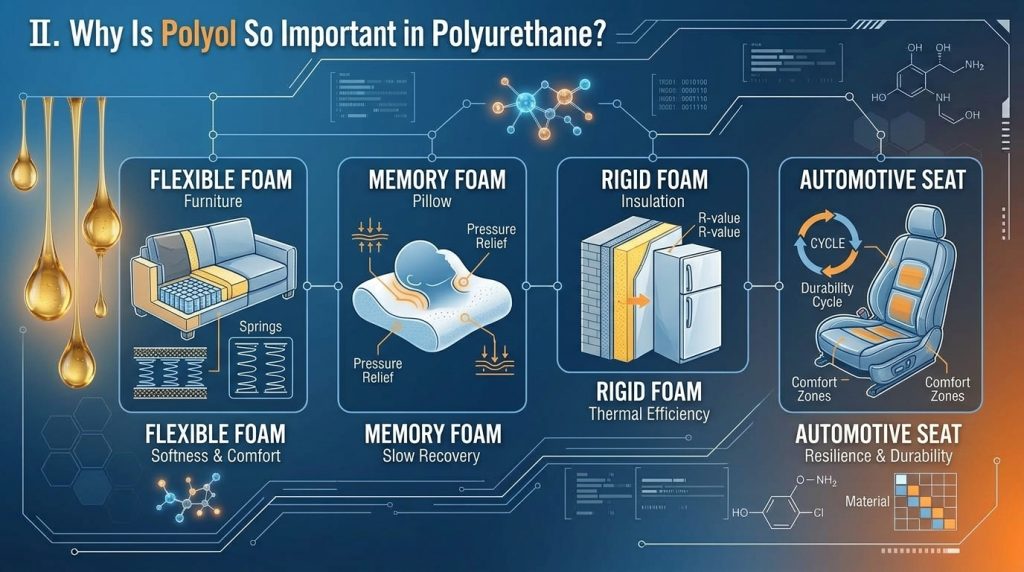
Polyol helps determine the “character” of a polyurethane material.
For example, flexible polyurethane foam typically requires polyols designed to provide softness, elasticity, and comfort. Rigid polyurethane foam usually uses polyols with higher functionality to create a stronger crosslinked structure.
Different applications require different polyol systems.
A memory pillow needs controlled recovery and pressure relief.
An automotive seat needs durability and resilience.
A refrigerator insulation system needs excellent thermal insulation.
A spray foam system needs fast and stable reaction performance.
This means there is no single “best polyol.” The right choice depends on the application and the desired performance.
3,How Does Polyol Work?
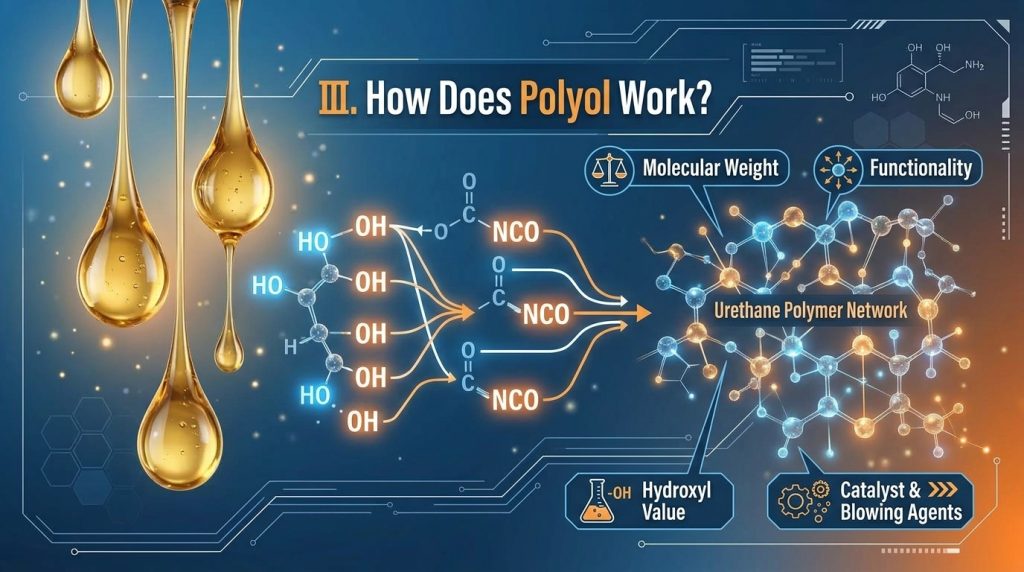
During polyurethane production, the hydroxyl groups in polyol react with the isocyanate groups (-NCO) in isocyanates.
This chemical reaction creates urethane bonds, gradually building a polyurethane polymer network.
The final structure depends on several factors, including:
- Polyol type
- Molecular weight
- Functionality
- Hydroxyl value
- Isocyanate type
- Water content
- Catalyst system
- Blowing agents
- Additives and surfactants
These components must work together in balance.
For example, changing the polyol structure may affect foam hardness, while adjusting the catalyst may change reaction speed. Even a small formulation adjustment can influence foam density, cell structure, resilience, dimensional stability, or processing performance.
That is why polyurethane formulation is not simply about mixing raw materials—it is about controlling the entire chemical reaction system.
4,Common Problems Related to Polyol
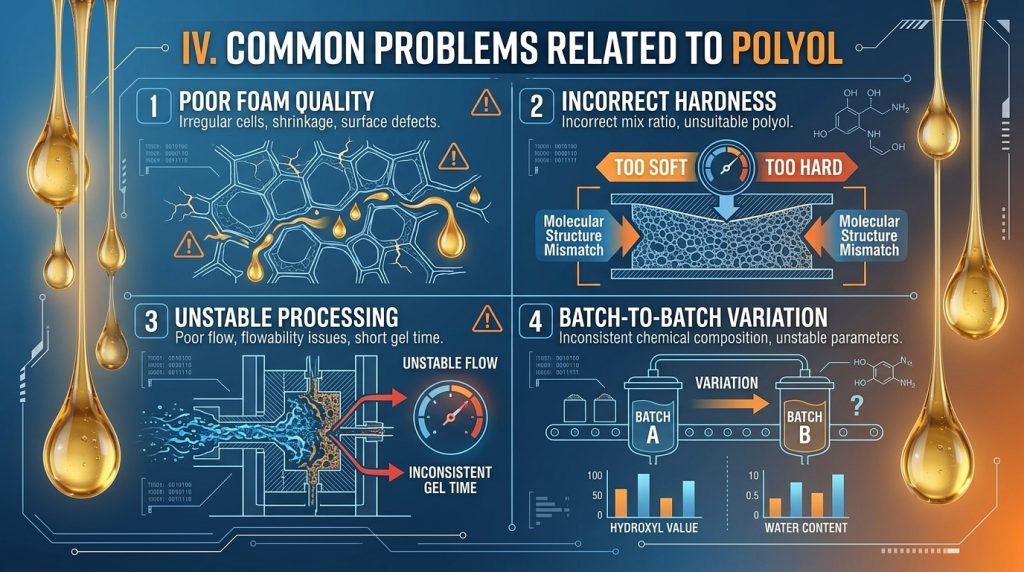
Using the wrong polyol or an improperly designed formulation can lead to several production problems.
1. Poor Foam Quality
The foam may have irregular cells, shrinkage, collapse, or poor surface quality.
Possible causes:
Incorrect polyol selection, poor formulation balance, or unstable processing conditions.
2. Incorrect Hardness or Resilience
The final product may be too soft, too hard, or unable to meet performance requirements.
Possible causes:
The molecular structure or ratio of the polyol system may not match the target application.
3. Unstable Foam Processing
Problems such as inconsistent reaction time, poor flow, or difficult mold filling may occur.
Possible causes:
Poor compatibility between raw materials or an unbalanced catalyst and blowing system.
4. Batch-to-Batch Performance Variation
The same formulation may produce different results during different production batches.
Possible causes:
Raw material variation, inaccurate dosing, moisture contamination, or insufficient process control.
5,How Can These Problems Be Solved?
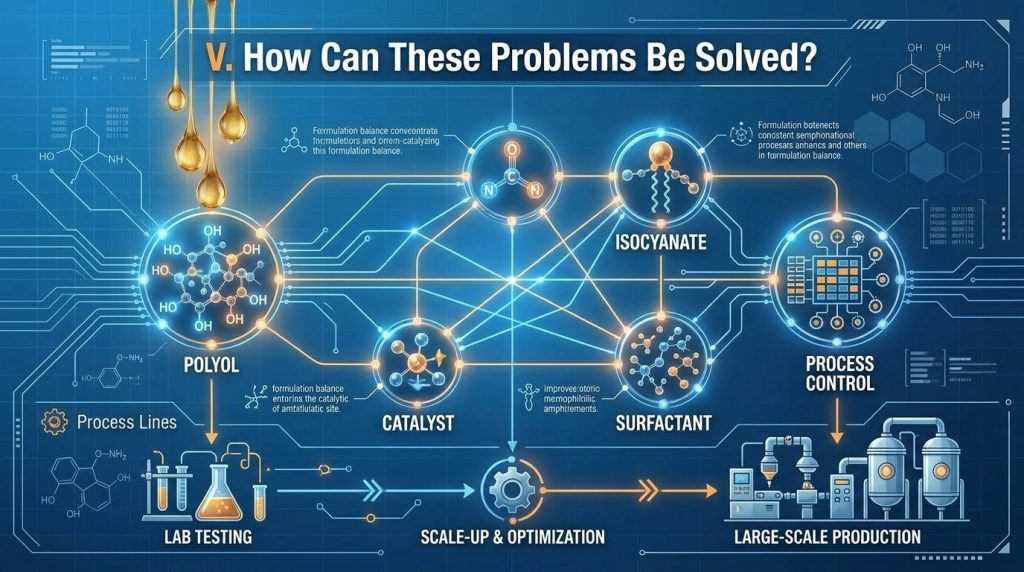
The solution is usually not as simple as replacing one raw material.
A reliable polyurethane system requires the right combination of:
Polyol + Isocyanate + Catalyst + Surfactant + Additives + Process Control
The formulation should be developed according to the customer’s specific application, equipment, production process, and performance requirements.
For example, a formulation designed for laboratory testing may need further adjustment before large-scale production.
This is why technical support and formulation experience are extremely important in polyurethane manufacturing.
6,How Can GST Help?
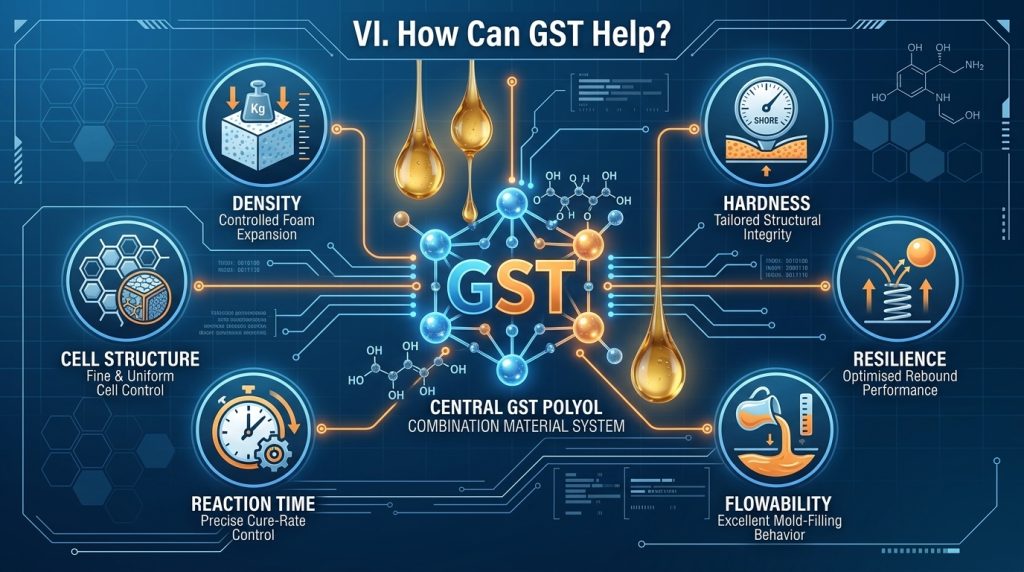
GST provides more than polyurethane raw materials.
We provide polyurethane combination materials, customized formulations, application development, and technical solutions for different polyurethane applications.
Based on customer requirements, our technical team can help optimize factors such as:
- Foam density
- Hardness
- Resilience
- Recovery performance
- Reaction time
- Flowability
- Cell structure
- Surface quality
- Processing stability
Whether you are developing flexible foam, memory foam, high-resilience foam, rigid insulation foam, self-skinning polyurethane, or customized PU products, GST can provide application-oriented polyurethane system solutions.
Instead of asking customers to select and mix multiple raw materials themselves, a properly designed PU combination material system can simplify production and improve formulation consistency.
From laboratory formulation development and sample testing to production optimization, GST focuses on helping customers turn polyurethane chemistry into practical and stable manufacturing solutions.
Final Thoughts
Polyol is one of the essential building blocks of polyurethane.
But successful polyurethane production depends on much more than choosing a polyol. The real challenge is understanding how different materials interact and how to balance the entire formulation.
The right polyurethane system can improve product performance, production efficiency, and consistency.
At GST, we combine polyurethane formulation experience, customized PU combination materials, and technical support to help customers develop more reliable polyurethane products and processes.
Looking for the right polyurethane formulation or PU combination material for your application? GST is ready to provide customized material and technical solutions.
CATEGORIES
LATEST NEWS
- Polyether Polyol vs Polyest...
- What Is Polyester Polyol?
- What Is Polyether Polyol?
- What Is Polyol?
- Why Is Reaction Balance Cri...
- Blowing Reaction vs Gelling...
- How Molecular Structure Det...
- Soft Segment vs Hard Segmen...
- What Is Crosslinking in Pol...
- What Is Polyurethane Polyme...
CONTACT US
Tel:+86 18688691634
Email:sam@1688pu.com
Add:No. 91 Central East Rd, Luxi Village, Gaobu Town, Dongguan 523283, China.