What Is MDI?
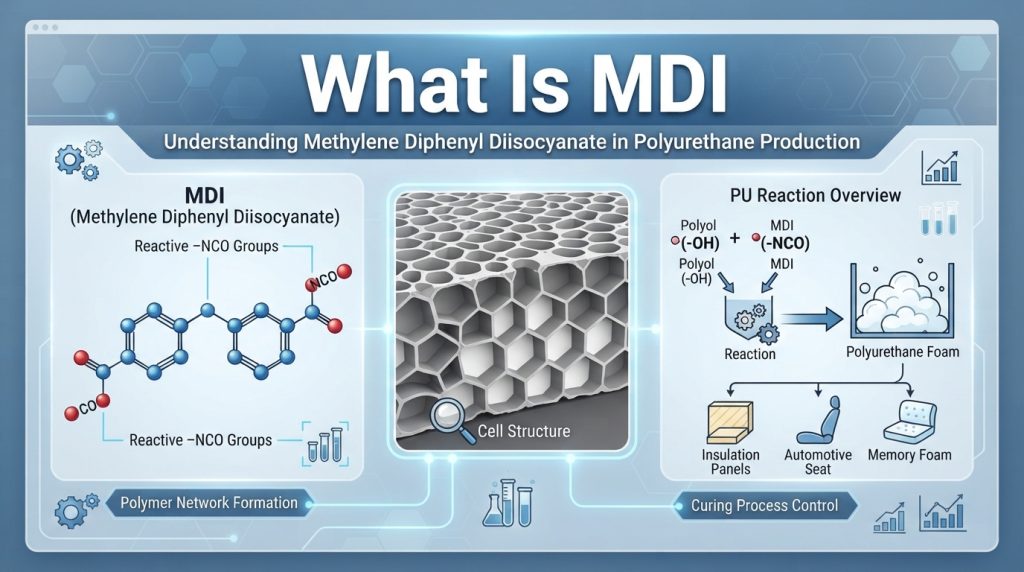
In polyurethane manufacturing, few raw materials are as important as MDI. From memory foam pillows and automotive seats to rigid insulation panels and self-skinning products, MDI helps determine how polyurethane reacts, cures, and performs.
But what exactly is MDI? Why is it essential? And why do experienced PU manufacturers focus on the entire formulation, not just the MDI itself?
Let’s explore.
1,What Is MDI?
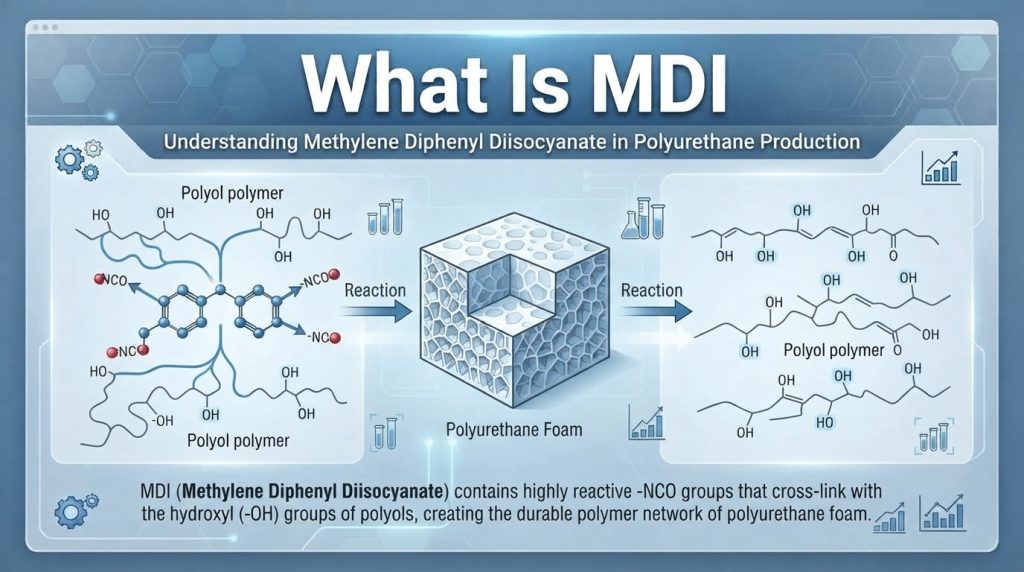
MDI (Methylene Diphenyl Diisocyanate) is one of the most widely used isocyanates in the polyurethane industry. It contains highly reactive –NCO groups, which react with the hydroxyl groups (–OH) in polyols to create polyurethane.
Think of it this way:
- Polyol provides flexibility and foam characteristics.
- MDI provides the reactive building blocks.
- Together, they create the polyurethane network that gives foam its strength, resilience, and durability.
Without MDI, conventional polyurethane foam simply cannot be formed.
2,Why Is MDI So Important?
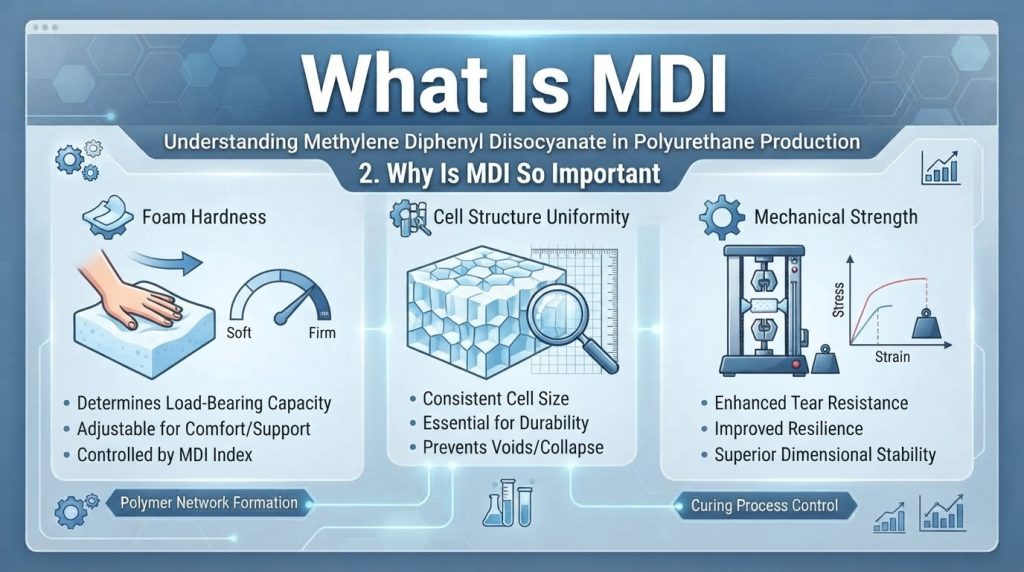
MDI is much more than a raw material—it directly influences the quality of the finished product.
A properly selected MDI system helps control:
- Foam hardness and softness
- Slow rebound or high resilience
- Cell structure uniformity
- Density consistency
- Mechanical strength
- Dimensional stability
- Production efficiency
For example, a memory foam pillow requires a completely different reaction profile than a rigid insulation board, even though both are polyurethane. The difference comes from the formulation—and MDI is one of its key components.
3,How Does MDI Work?
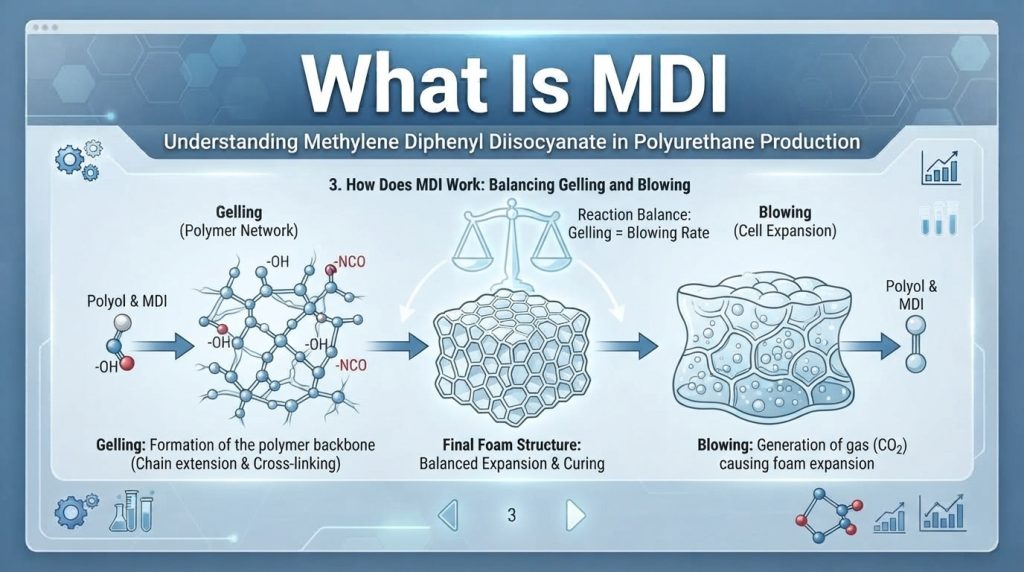
The basic polyurethane reaction is surprisingly simple:
Polyol (-OH)+MDI (-NCO)→Polyurethane\text{Polyol (-OH)} + \text{MDI (-NCO)} \rightarrow \text{Polyurethane}Polyol (-OH)+MDI (-NCO)→Polyurethane
However, industrial foaming is much more complex.
During production, MDI reacts with the polyol while catalysts, silicone surfactants, blowing agents, and processing conditions work together to control the reaction. The balance between gelling and blowing determines whether the foam develops the correct structure.
A well-balanced system produces:
- Fine, uniform cells
- Stable density
- Excellent resilience
- Consistent physical performance
An unbalanced system may lead to shrinkage, collapse, or unstable quality.
4,Common MDI Problems
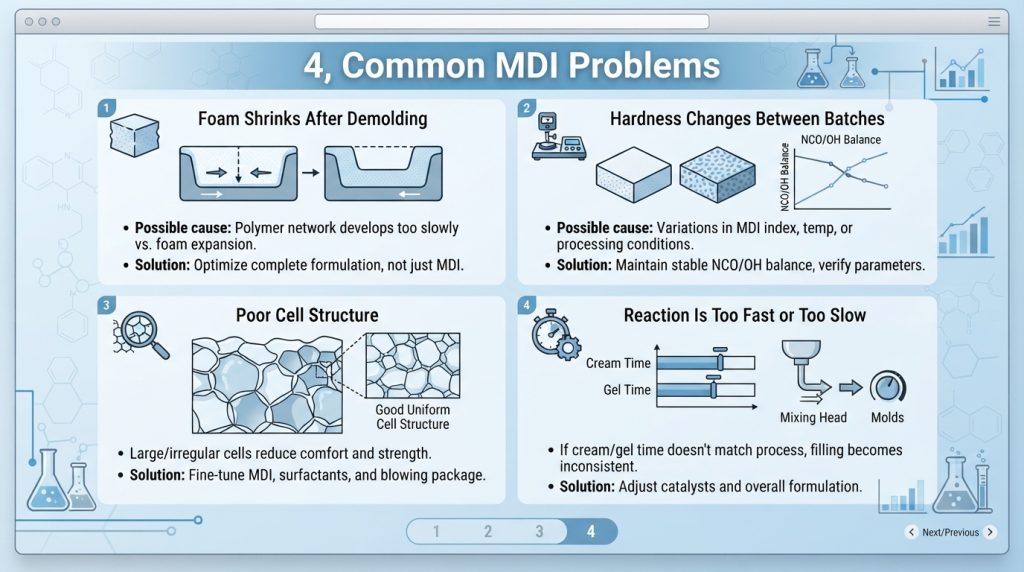
- . Foam Shrinks After Demolding
Possible cause: The polymer network develops too slowly compared with foam expansion.
Solution: Optimize the complete formulation rather than increasing MDI alone.
- . Hardness Changes Between Batches
Possible cause: Variations in MDI index, raw-material temperature, or processing conditions.
Solution: Maintain a stable NCO/OH balance and verify processing parameters before adjusting the formulation.
- . Poor Cell Structure
Large or irregular cells often reduce comfort and mechanical strength.
Solution: Fine-tune the MDI system together with surfactants and the blowing package to achieve a more stable foam structure.
- . Reaction Is Too Fast or Too Slow
If cream time or gel time doesn’t match the production process, filling and molding become inconsistent.
Solution: Adjust catalysts and the overall formulation instead of relying on MDI dosage alone.
A good PU formulation solves the system—not just one raw material.
5,Why Combination Materials Matter
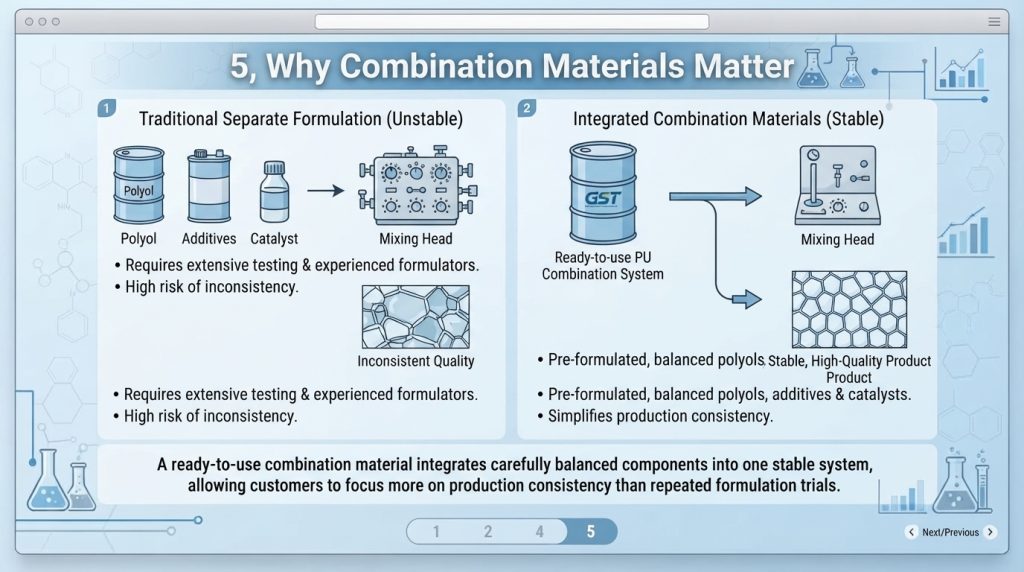
Many manufacturers purchase individual raw materials and attempt to develop formulas internally. While this is possible, it often requires extensive testing, experienced formulators, and continuous optimization.
A ready-to-use PU combination material simplifies this process by integrating carefully balanced polyols, additives, catalysts, and formulation technology into one stable system, allowing customers to focus more on production consistency than repeated formulation trials.
6,How GST Supports Your Production
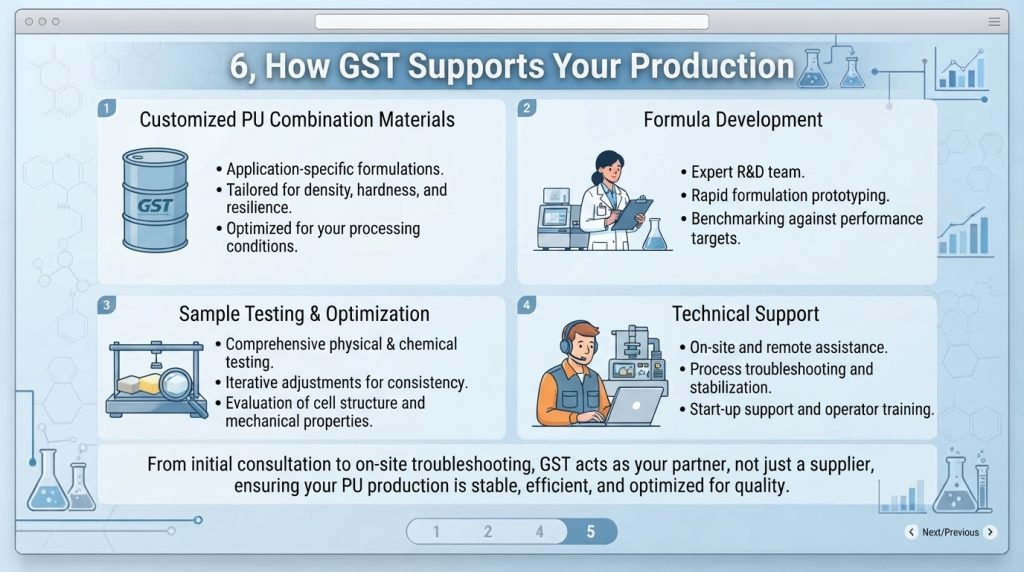
GST focuses on polyurethane combination materials and formulation development, providing practical solutions for manufacturers instead of simply supplying chemicals.
Customized PU Combination Materials
We develop systems for applications including:
- Memory foam pillows
- High-resilience seat cushions
- Furniture foam
- Rigid insulation
- Self-skinning products
- Bio-based polyurethane systems
Formula Development
Every factory has different molds, machines, densities, and production conditions. GST customizes formulations according to your product requirements to achieve stable foaming and consistent quality.
Sample Testing & Optimization
Have an existing foam sample? GST can help evaluate density, hardness, resilience, cell structure, and reaction behavior to optimize the formulation for your production line.
Technical Support
From material selection to production trials, GST provides technical guidance, remote foaming support, and troubleshooting to reduce development time and improve manufacturing efficiency.
Conclusion
MDI is the core reactive material that makes polyurethane possible—but outstanding PU products are never created by MDI alone.
The best results come from the right balance between MDI, polyol, catalysts, additives, and processing technology.
At GST, we combine PU combination materials, customized formulations, and technical support to help manufacturers produce stable, high-performance polyurethane products with greater efficiency.
Looking for the right MDI-based PU system for your application? Contact GST for customized polyurethane solutions.
PREVIOUS:What Is Isocyanate?
CATEGORIES
LATEST NEWS
- What Is TDI?
- What Is Polymeric MDI (pMDI)?
- What Is MDI?
- What Is Isocyanate?
- How to Select the Right Pol...
- How Does Polyol Affect Foam...
- What Is Hydroxyl Value (OH ...
- What Is Polyol Functionality?
- BASF Ludwigshafen Incident:...
- What Is Polyol Molecular We...
CONTACT US
Tel:+86 18688691634
Email:sam@1688pu.com
Add:No. 91 Central East Rd, Luxi Village, Gaobu Town, Dongguan 523283, China.