Amine Catalysts vs Metal Catalysts
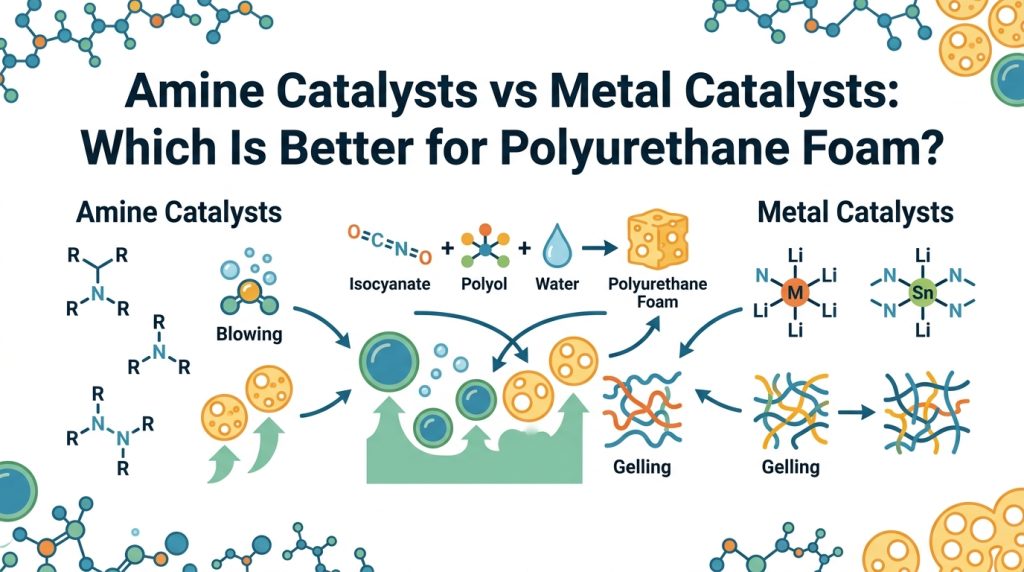
In polyurethane (PU) foam production, choosing the right catalyst can make a significant difference to reaction speed, foam stability, cell structure, and final performance.
Two common catalyst categories are amine catalysts and metal catalysts. But what is the difference, and how do you choose the right one for your formulation?
What Are Amine Catalysts and Metal Catalysts?
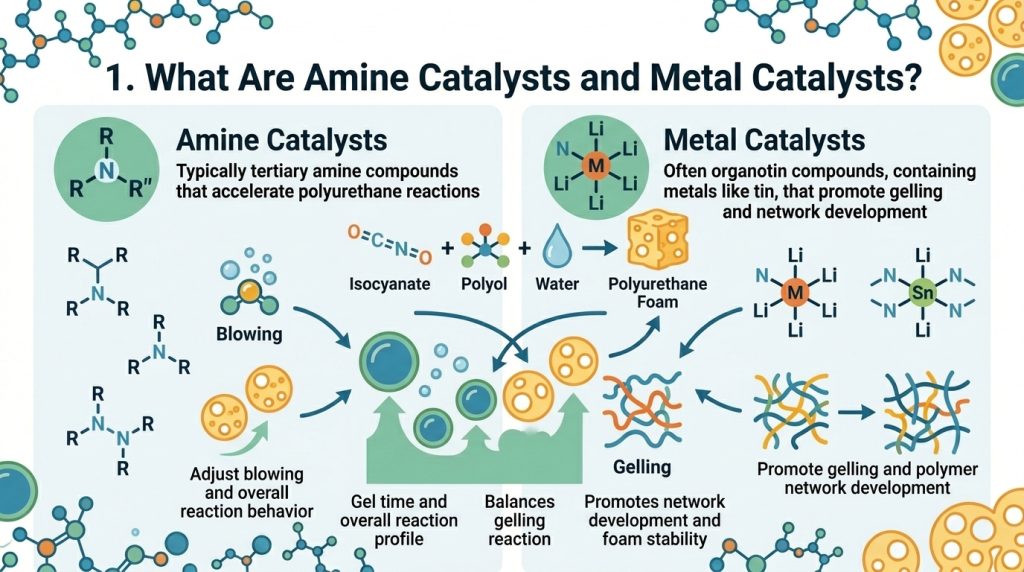
Amine catalysts are typically tertiary amine compounds that accelerate polyurethane reactions. Different amines can influence the reaction between isocyanate and polyol, as well as the reaction between isocyanate and water.
Metal catalysts are catalysts containing metals, commonly organotin compounds in traditional PU foam formulations. They are often used to promote the gelling reaction, helping the polymer network develop.
Both catalyst types help control the foaming process, but their catalytic activity and effects depend on their chemical structure and the overall formulation.
Why Are They Needed?
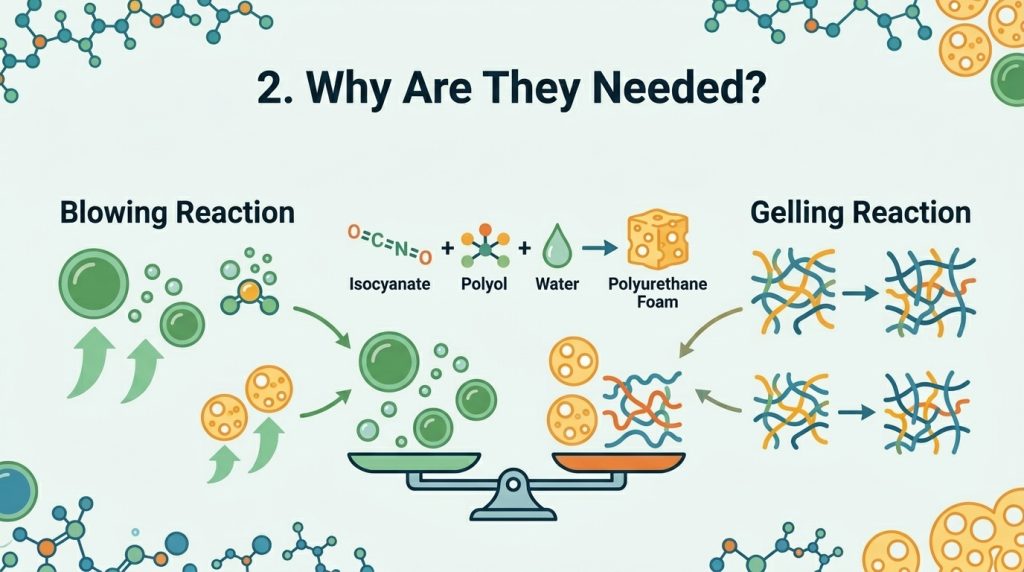
PU foam requires a balance between two key reactions:
- Blowing reaction: Isocyanate reacts with water to generate carbon dioxide, expanding the foam.
- Gelling reaction: Isocyanate reacts with polyol to build the polymer network that supports the foam structure.
Amine catalysts are often selected to adjust blowing and overall reaction behavior, while many metal catalysts are particularly effective at promoting gelling.
Using the right catalyst—or a carefully balanced combination—helps control rise time, gel time, cell structure, and curing.
The best catalyst is not necessarily the fastest one. It is the one that provides the right reaction balance for your application.
How Do They Work?
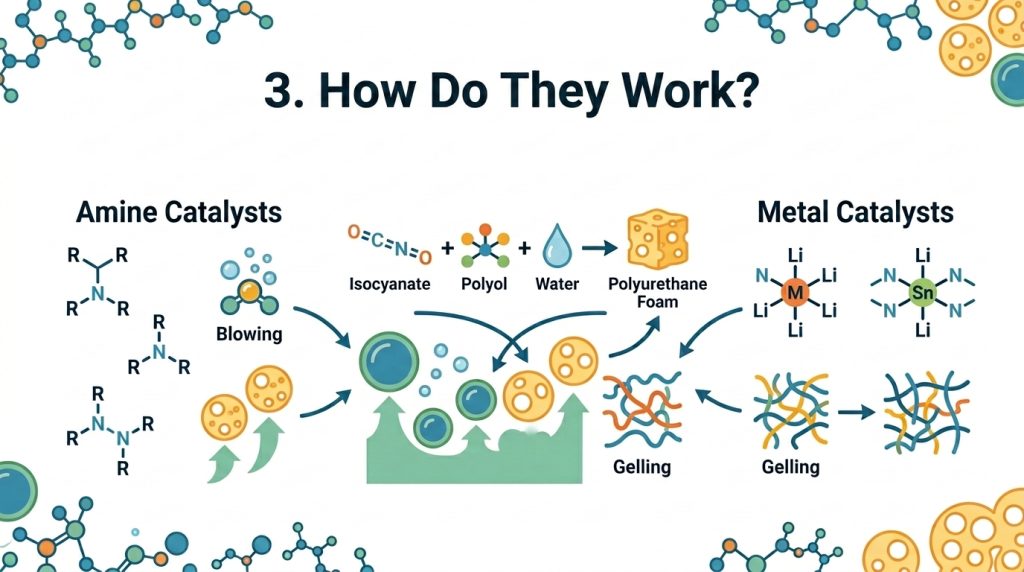
Amine catalysts typically accelerate reactions by activating the chemical species involved in polyurethane formation. Depending on the catalyst, they can have different effects on blowing and gelling reactions.
Metal catalysts, such as certain organotin catalysts, can strongly promote the reaction between isocyanate and polyol, helping the foam develop structural strength.
In practice, their performance depends on catalyst type, dosage, polyol and isocyanate chemistry, water content, surfactants, temperature, and processing conditions.
For this reason, many formulations use a catalyst package rather than relying on a single catalyst.
Common Problems and How to Solve Them
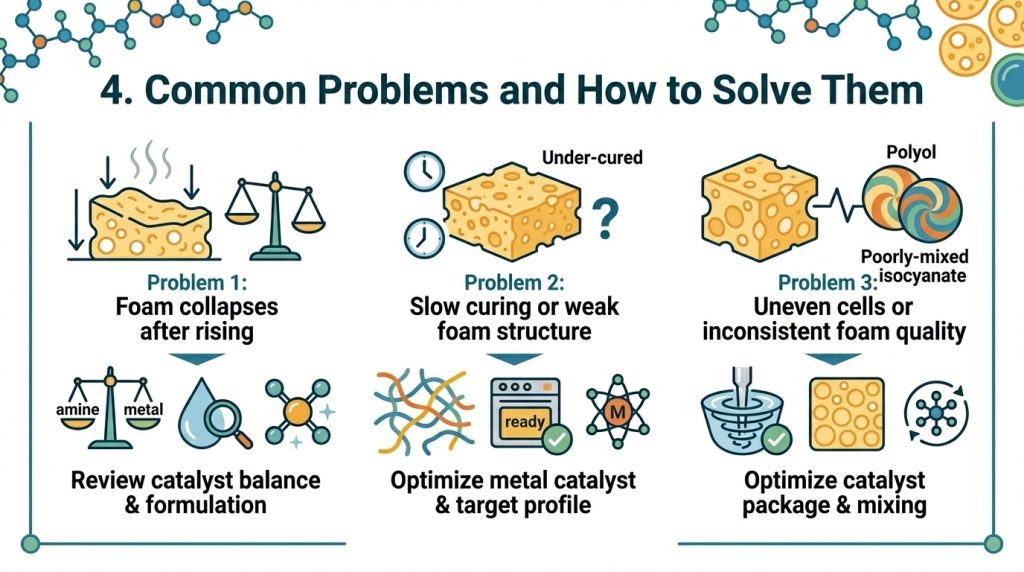
Problem 1: Foam collapses after rising
The blowing reaction may be too fast relative to the development of the polymer network, or foam stabilization may be insufficient.
Solution: Review the amine-to-metal catalyst balance, water content, surfactant selection, and overall formulation.
Problem 2: Slow curing or weak foam structure
Gelling may be too slow for the selected system, although raw-material properties and processing conditions can also contribute.
Solution: Evaluate the metal catalyst type and dosage alongside the polyol-isocyanate system and target curing profile.
Problem 3: Uneven cells or inconsistent foam quality
An unsuitable catalyst combination, poor mixing, temperature variations, or changes in raw-material properties may affect foam consistency.
Solution: Optimize the catalyst package together with mixing conditions, surfactants, and other formulation variables.
Important: Simply increasing catalyst dosage may create new problems, including an excessively short processing window or unstable foaming.
How Can GST Help Optimize Catalyst Selection?
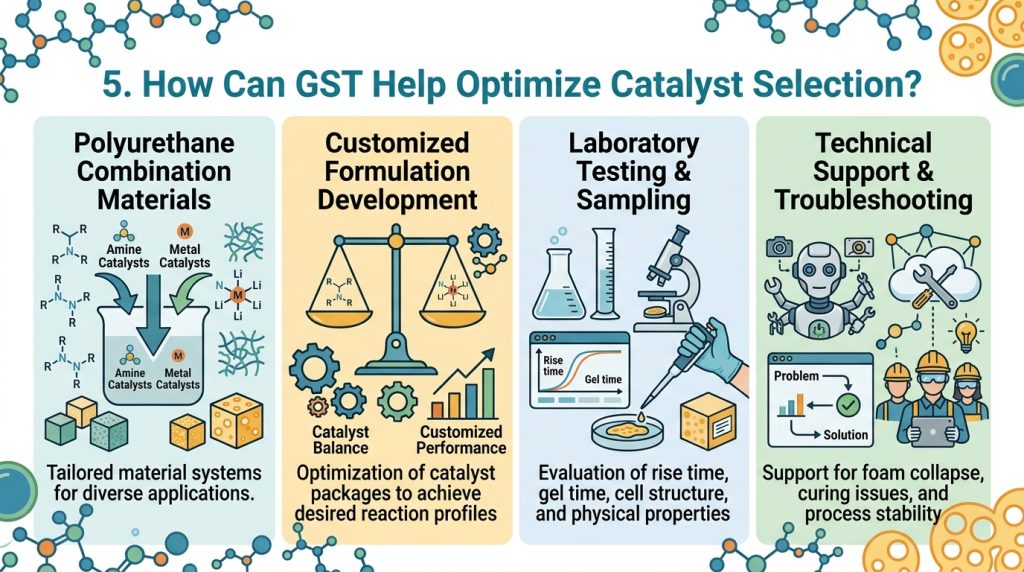
At GST, we understand that catalyst selection is part of complete polyurethane formulation development—not an isolated decision.
As a polyurethane combination material supplier, GST provides:
- PU combination materials: Formulated systems tailored to different foam applications and production requirements.
- Customized formulation development: Optimization of amine and metal catalyst combinations to achieve the desired reaction profile.
- Laboratory sampling and testing: Evaluation of rise time, gel time, cell structure, density, and relevant physical properties.
- Technical troubleshooting: Support for addressing foam collapse, slow curing, uneven cells, and other production challenges.
- Production support: Practical recommendations to improve foaming stability and batch-to-batch consistency.
Whether you manufacture flexible foam, high-resilience foam, memory foam, or rigid PU foam, GST can help develop a catalyst strategy suited to your materials, equipment, and performance targets.
Conclusion
Amine catalysts and metal catalysts play different but complementary roles in polyurethane foam production. The right choice depends on the required balance between blowing, gelling, processing time, and final foam properties.
Better foam performance starts with the right catalyst balance—and a formulation designed around your application.
Looking for reliable PU combination materials or help optimizing your catalyst system?
Contact GST for customized formulation development, laboratory samples, and technical support.
GST — Your Trusted Partner in PU Material Solutions
Website: https://www.gstpu.com
CATEGORIES
LATEST NEWS
- What Is a Two-Component PU ...
- What Is Polyol Blend?
- What Is a Polyurethane System?
- How to Select Catalysts for...
- What Are Flame Retardants i...
- What Is a Silicone Surfactant?
- What Are Delayed-Action Cat...
- Balanced Catalysts for Poly...
- Blowing Catalysts in PU Foam
- Gelling Catalysts in PU Foam
CONTACT US
Tel:+86 18688691634
Email:sam@1688pu.com
Add:No. 91 Central East Rd, Luxi Village, Gaobu Town, Dongguan 523283, China.