Why Does Polyurethane Need Catalysts?
In polyurethane (PU) foam production, having the right raw materials is only part of the equation. The reactions must also happen at the right speed.
If the foam rises too quickly, it may collapse. If the reaction is too slow, production efficiency can suffer. This is why polyurethane catalysts are essential for controlling reaction speed and balancing foam formation.
What Is a Polyurethane Catalyst?
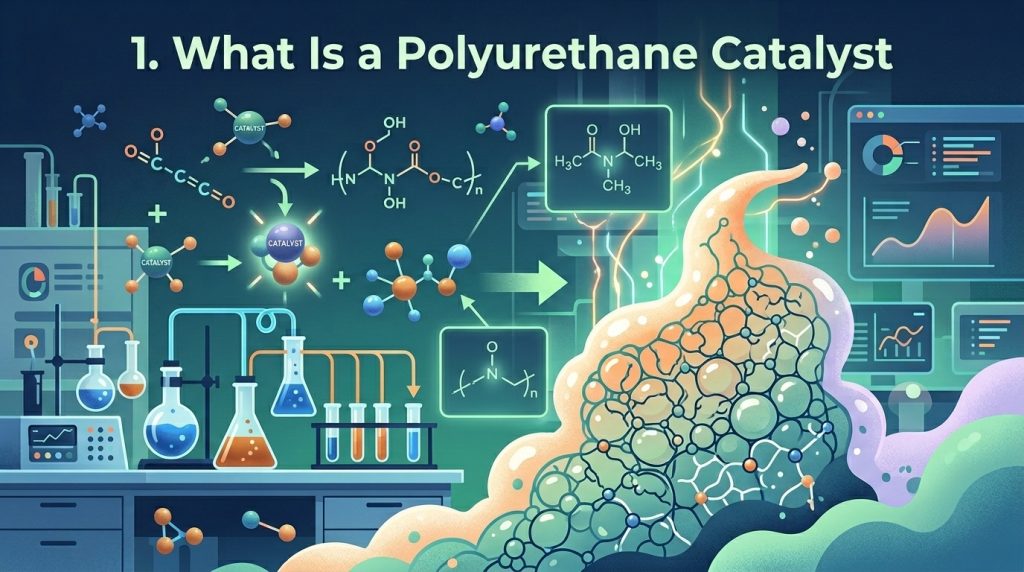
A polyurethane catalyst is a substance that accelerates specific chemical reactions involved in polyurethane formation without being consumed in the overall reaction in the same way as the main reactants.
Common PU catalysts include tertiary amine catalysts and organometallic catalysts, such as certain tin-based catalysts. Different catalysts influence different reactions and offer different levels of catalytic activity.
The goal is not simply to speed up the reaction, but to achieve the right balance for the intended PU application.
Why Does Polyurethane Need Catalysts?
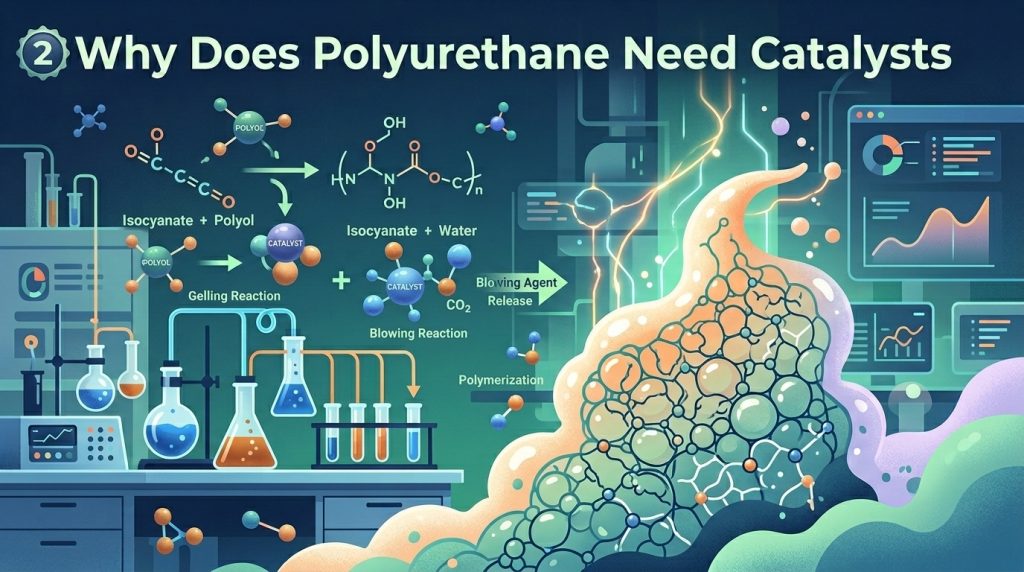
During PU foaming, two important reactions must work together:
- Gelling reaction: Isocyanate reacts with polyol to build the polyurethane polymer network.
- Blowing reaction: Isocyanate reacts with water to generate carbon dioxide, which expands the foam.
Without suitable catalytic control, these reactions may proceed too slowly, too quickly, or at an unsuitable relative rate.
A properly designed catalyst system helps manufacturers control rise time, gel time, cell structure, curing, and production consistency. The ideal balance depends on the foam type, target density, raw materials, and processing conditions.
How Do Polyurethane Catalysts Work?
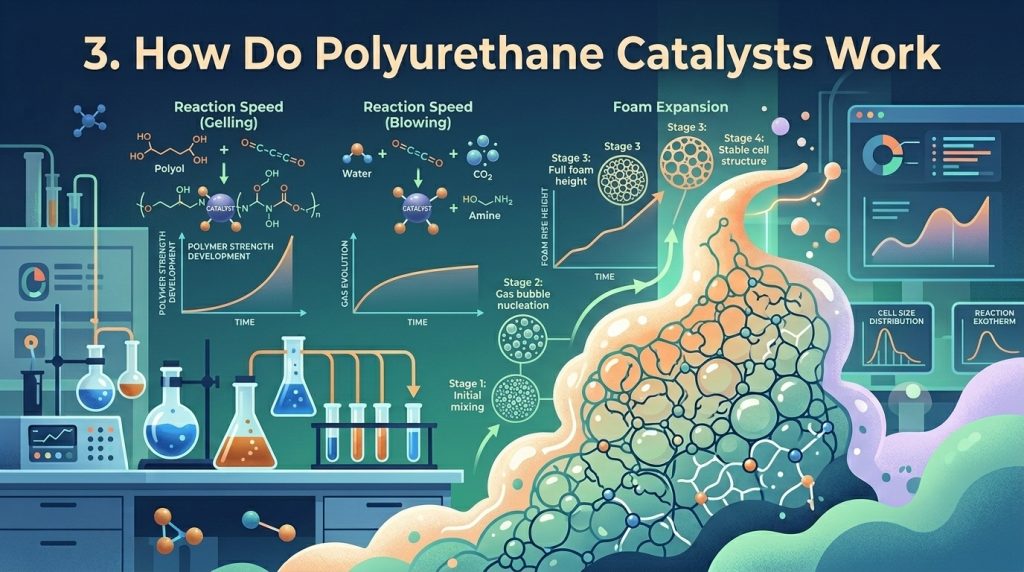
Catalysts accelerate specific reaction pathways and influence how quickly the foam expands and develops structural strength.
For example, if the blowing reaction is too fast relative to the gelling reaction, gas may form before the foam has sufficient strength to retain its structure, increasing the risk of collapse.
On the other hand, if gelling proceeds too quickly, the foam may not expand adequately, potentially resulting in poor rise or uneven cells.
Successful PU foaming depends on balancing gas generation with polymer network development.
Catalyst selection and dosage must therefore be considered alongside polyol properties, isocyanate type, water content, surfactants, material temperature, and mixing conditions.
Common Problems and How to Solve Them
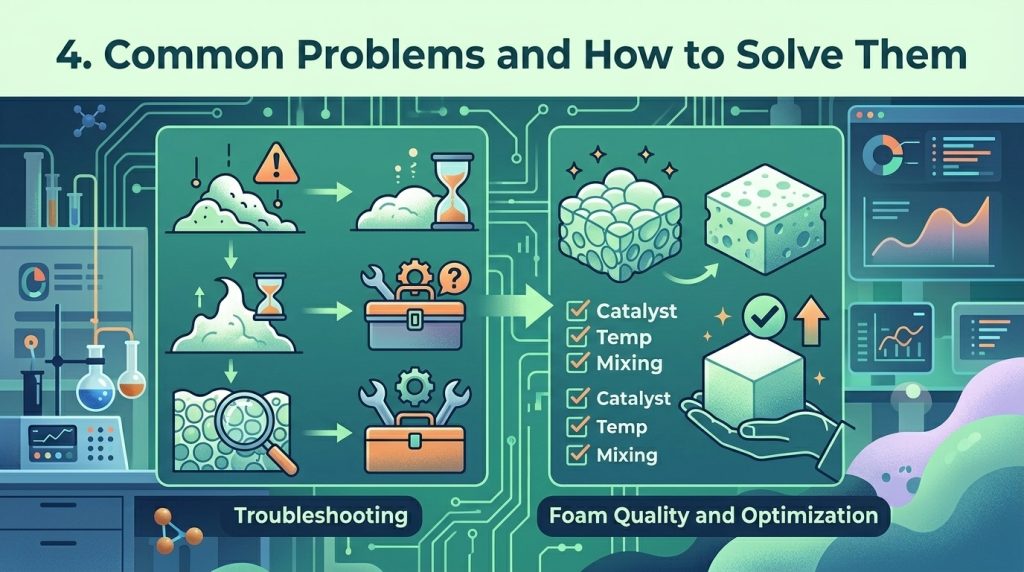
Problem 1: Foam collapses after rising
The blowing reaction may be too fast relative to the development of the polymer network. Insufficient foam stabilization or an unsuitable overall formulation may also contribute.
Solution: Review catalyst balance, water content, surfactant selection, and the complete formulation.
Problem 2: Foam rises too slowly or cures too late
Catalyst activity may be insufficient for the selected formulation, or processing temperatures may be too low.
Solution: Check catalyst type and dosage, material temperature, and raw-material reactivity before making controlled adjustments.
Problem 3: Uneven cells or inconsistent foam quality
An unsuitable reaction profile, poor mixing, temperature fluctuations, or inadequate foam stabilization may affect cell structure.
Solution: Evaluate the catalyst system together with mixing conditions, surfactants, and production parameters.
Important: Adding more catalyst is not always the answer. Excessive catalytic activity can narrow the processing window and create new defects.
How Can GST Help Optimize PU Catalyst Systems?
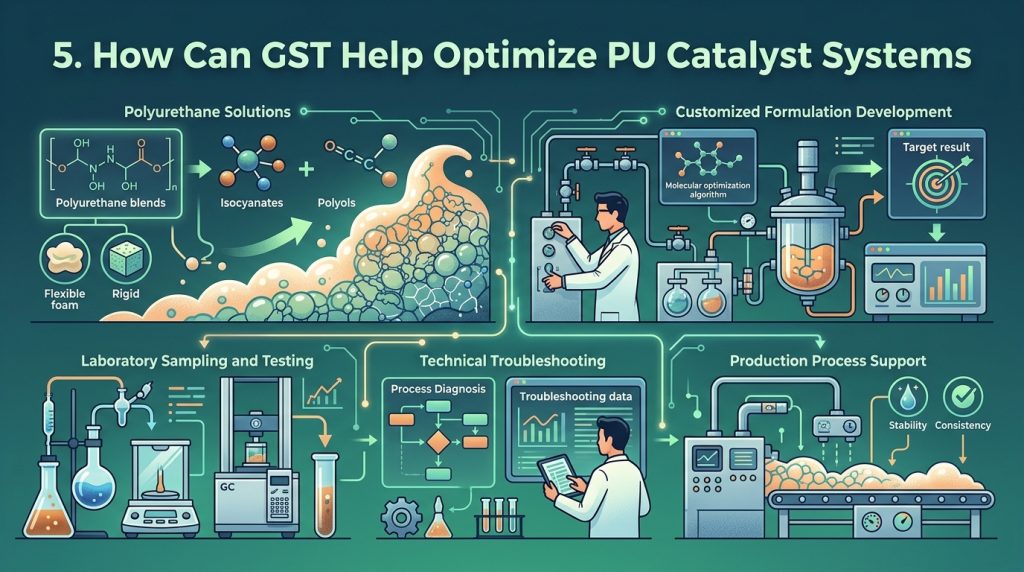
At GST, we understand that reliable polyurethane production requires more than choosing a catalyst. It requires a formulation designed around the target product and manufacturing process.
As a polyurethane combination material supplier, GST provides:
- PU combination materials: Formulated systems for different foam applications and performance requirements.
- Customized formulation development: Optimization of catalyst type and dosage alongside polyols, isocyanates, water, and additives.
- Laboratory sampling and testing: Evaluation of reaction times, foam rise, cell structure, density, resilience, and other relevant properties.
- Technical troubleshooting: Support for diagnosing foam collapse, slow curing, uneven cells, and other production challenges.
- Production process support: Practical guidance to help improve foaming stability and batch-to-batch consistency.
Whether you manufacture flexible foam, high-resilience foam, memory foam, or rigid PU foam, GST can help develop formulation solutions tailored to your application.
Conclusion
Polyurethane needs catalysts because reaction speed and balance directly influence foam processing and final performance. The right catalyst system helps coordinate blowing and gelling reactions to achieve stable foam formation and consistent product quality.
Instead of adjusting catalyst dosage through trial and error alone, consider the complete formulation and production conditions.
Looking for reliable PU combination materials or help solving foaming problems?
Contact GST for customized formulation development, laboratory samples, and technical support.
GST — Your Trusted Partner in PU Material Solutions
Website: https://www.gstpu.com
PREVIOUS:What Is a Polyurethane Catalyst?
CATEGORIES
LATEST NEWS
- What Is a Two-Component PU ...
- What Is Polyol Blend?
- What Is a Polyurethane System?
- How to Select Catalysts for...
- What Are Flame Retardants i...
- What Is a Silicone Surfactant?
- What Are Delayed-Action Cat...
- Balanced Catalysts for Poly...
- Blowing Catalysts in PU Foam
- Gelling Catalysts in PU Foam
CONTACT US
Tel:+86 18688691634
Email:sam@1688pu.com
Add:No. 91 Central East Rd, Luxi Village, Gaobu Town, Dongguan 523283, China.