How Does Polyol Affect Foam Hardness and Resilience?
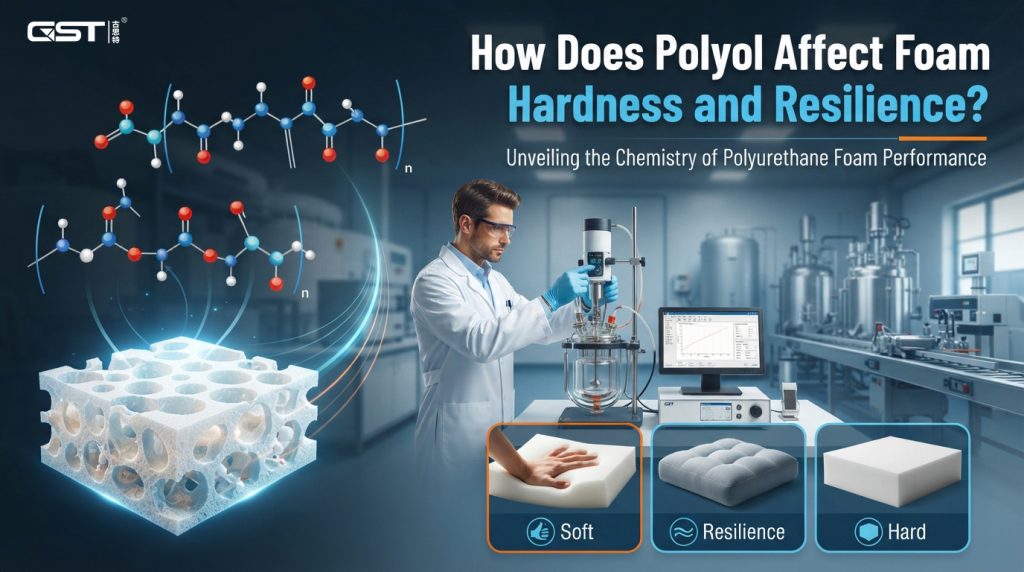
When polyurethane foam feels too soft, too hard, or loses its resilience too quickly, the problem may not be the foam density alone.
Polyol selection and formulation balance play a major role in determining foam hardness, resilience, flexibility, and overall performance.
So, how exactly does polyol affect polyurethane foam?
Ⅰ,What Is Polyol?
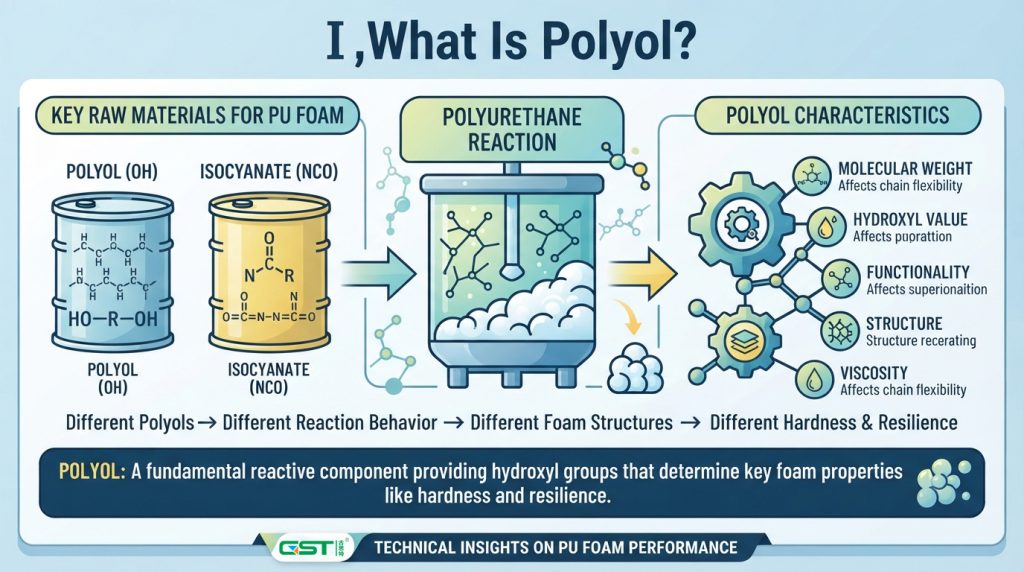
Polyol is one of the two main reactive components used to produce polyurethane foam, together with isocyanate.
In a polyurethane formulation, polyol provides the reactive hydroxyl groups that participate in the polyurethane reaction. Different polyols can have different molecular weights, hydroxyl values, functionalities, structures, and viscosities, which can significantly change the final foam properties.
Simply put:
Different polyols → different reaction behavior → different foam structures → different hardness and resilience.
Ⅱ,Why Does Polyol Matter for Foam Hardness and Resilience?
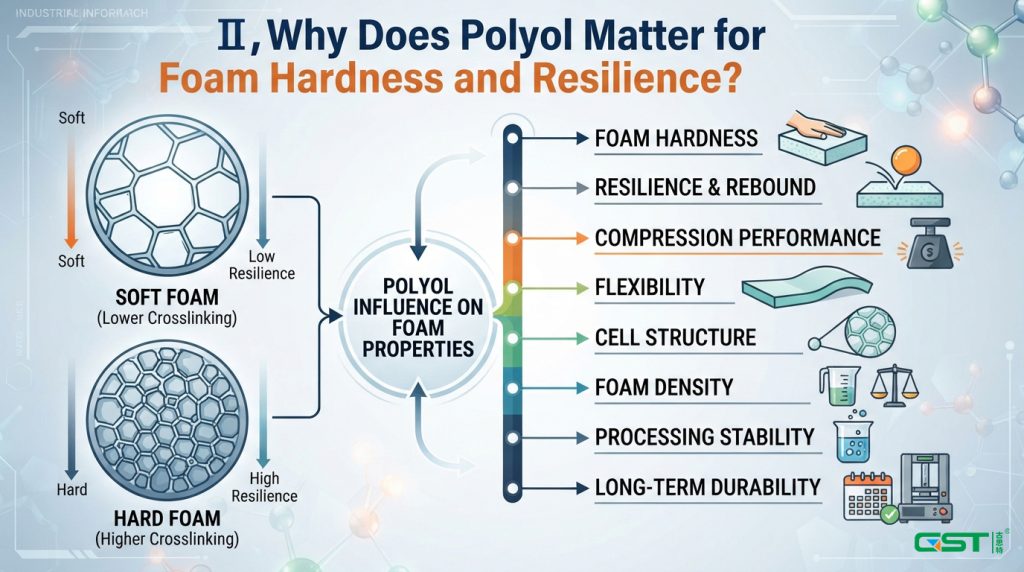
Foam hardness and resilience are closely related to the internal polymer structure and cell structure.
Polyol selection can influence:
- Foam hardness
- Resilience and rebound
- Compression performance
- Flexibility
- Cell structure
- Foam density
- Processing stability
- Long-term durability
For example, a formulation designed for a high-resilience automotive seat requires a different balance from one designed for a soft mattress or cushioning product.
Using the same polyol system for every application may therefore lead to inconsistent results.
Ⅲ,How Does Polyol Affect Foam Performance?
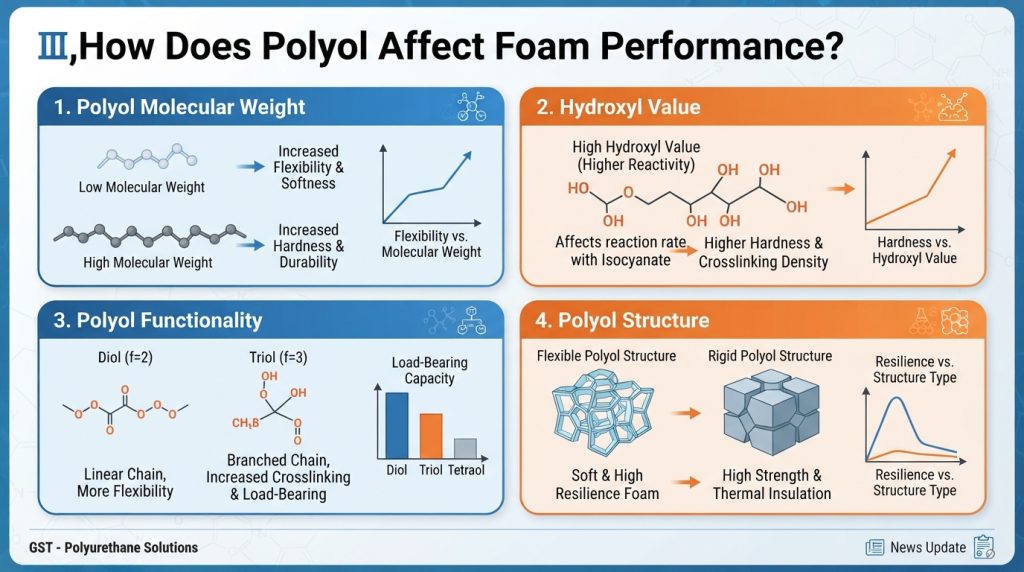
1. Polyol Molecular Weight
Molecular weight affects the flexibility of the polyurethane polymer chain.
Generally, polyols with different molecular weights can produce different balances between softness, flexibility, hardness, and resilience.
The key is not simply choosing a higher or lower molecular weight—it is finding the appropriate combination for the target application.
2. Hydroxyl Value
Hydroxyl value indicates the amount of reactive hydroxyl groups in the polyol.
It affects the reaction balance with isocyanate and therefore influences the polymer network.
An unsuitable hydroxyl value can contribute to foam that is:
- Too hard
- Too soft
- Brittle
- Low in resilience
- Unstable during production
3. Polyol Functionality
Functionality describes the average number of reactive groups available in the polyol molecule.
It can affect the degree of crosslinking and the resulting foam structure.
This is particularly important when developing formulations that require a specific combination of hardness, resilience, load-bearing capacity, and durability.
4. Polyol Structure and Formulation Balance
Polyol is only one part of the formulation.
Catalysts, silicone surfactants, blowing agents, isocyanate index, additives, water content, density, and processing conditions all interact with the polyol system.
That is why simply changing one raw material does not always solve a foam-performance problem.
The real challenge is formulation balance.
Ⅳ,Common Problems and How to Solve Them
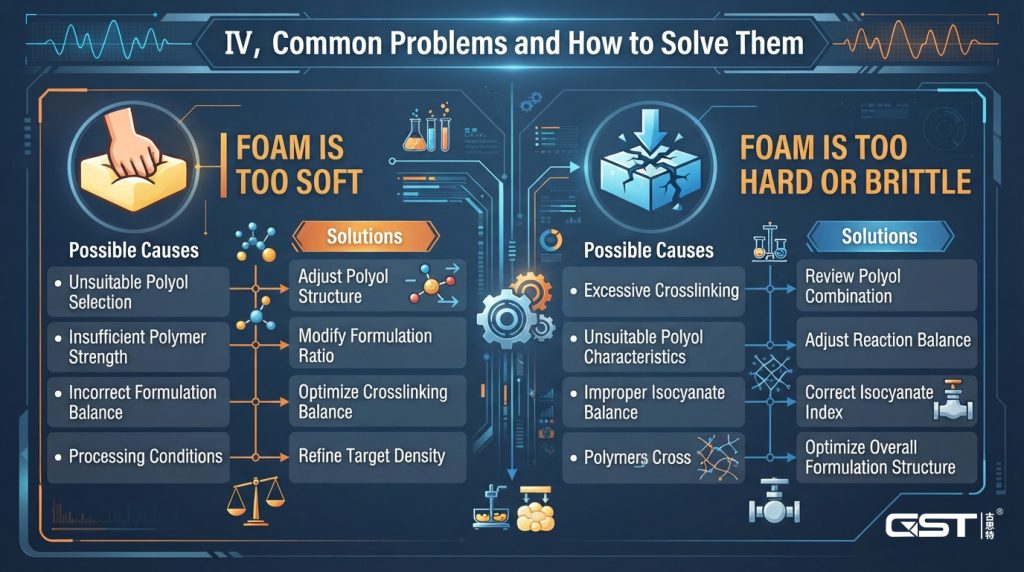
Foam Is Too Soft
Possible causes include unsuitable polyol selection, insufficient polymer strength, incorrect formulation balance, or processing conditions.
Solution: Adjust the polyol structure, formulation ratio, crosslinking balance, or target density according to the application requirements.
Foam Is Too Hard or Brittle
Excessive crosslinking, unsuitable polyol characteristics, or an improper isocyanate balance may contribute to excessive hardness.
Solution: Review the polyol combination, reaction balance, isocyanate index, and overall formulation structure.
Low Resilience
Low rebound can result from inappropriate polyol selection, cell structure, catalyst balance, or formulation design.
Solution: Optimize the polyol system together with catalyst and surfactant levels, then verify the foam through physical-property testing.
Foam Properties Are Inconsistent
Even when the formulation looks correct on paper, differences in raw-material batches, temperature, mixing, equipment, or processing conditions can affect the final foam.
Solution: Establish a controlled formulation window and production process, supported by laboratory testing and production trials.
Ⅴ,How Can GST Help?

At GST, we don’t simply supply polyol or polyurethane raw materials.
We focus on developing application-oriented polyurethane system solutions.
Based on the customer’s target hardness, resilience, density, processing method, and end-use application, our technical team can help with:
1. PU Combination Materials
GST can provide customized polyurethane combination materials for applications such as high-resilience foam, automotive seating, furniture cushioning, soft foam, rigid foam, and other PU products.
2. Formulation Development
Our R&D team can optimize the relationship between polyol, isocyanate, catalysts, surfactants, blowing agents, and additives to achieve the required foam performance.
3. Laboratory Sampling & Testing
We can conduct laboratory trials and adjust the formulation according to foam hardness, resilience, density, cell structure, compression performance, and other physical requirements.
4. Formula Replication & Optimization
If you already have a foam sample but do not have the original formulation, GST can analyze the target performance and develop a corresponding formulation direction.
5. Technical Production Support
From laboratory testing to production trials, GST can provide technical guidance on formulation adjustment, reaction behavior, foaming conditions, and process optimization.
The Bottom Line
Polyol is not simply a raw material—it is a key part of the performance design of polyurethane foam.
The right polyol system can help achieve the required balance of hardness, resilience, flexibility, density, and durability.
But there is no universal “best polyol.”
The right solution depends on the application, target properties, production process, and formulation system.
GST combines PU raw materials, combination materials, formulation R&D, laboratory testing, and technical support to help manufacturers turn specific foam requirements into practical polyurethane solutions.
Need a specific foam hardness or resilience?
Contact GST for PU combination materials, customized formulations, sample development, and technical support.
Tags: High Resilience Polyurethane Foam, Hydroxyl Value, Polyol, Polyol for Foam Hardness, Polyol for Foam Resilience, Polyol Functionality, Polyol in Polyurethane Foam, Polyol Molecular Weight, Polyurethane Foam Formulation, Polyurethane Foam Hardness, Polyurethane Foam Resilience, PU Combination Material, PU Combination Materials, What Is Polyol
PREVIOUS:What Is Hydroxyl Value (OH Number)?
CATEGORIES
LATEST NEWS
- What Is TDI?
- What Is Polymeric MDI (pMDI)?
- What Is MDI?
- What Is Isocyanate?
- How to Select the Right Pol...
- How Does Polyol Affect Foam...
- What Is Hydroxyl Value (OH ...
- What Is Polyol Functionality?
- BASF Ludwigshafen Incident:...
- What Is Polyol Molecular We...
CONTACT US
Tel:+86 18688691634
Email:sam@1688pu.com
Add:No. 91 Central East Rd, Luxi Village, Gaobu Town, Dongguan 523283, China.