What Is Hydroxyl Value (OH Number)?
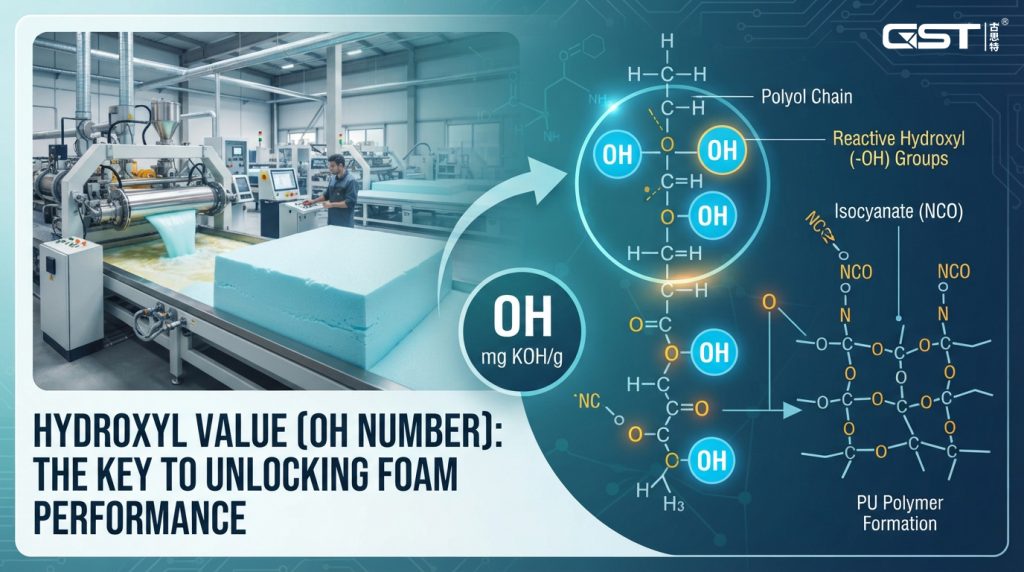
In polyurethane foam production, small changes in raw materials can create big differences in foam performance.
One important parameter behind these changes is Hydroxyl Value (OH Number).
But what exactly is hydroxyl value? Why does it matter? And how can it affect the final polyurethane foam?
Let’s make it simple.
Ⅰ,What Is Hydroxyl Value?

Hydroxyl Value (OH Number) indicates the amount of reactive hydroxyl (-OH) groups present in a polyol.
It is commonly expressed as:
mg KOH/g
In simple terms, the hydroxyl value helps us understand how much reactive OH functionality is available for polyurethane reactions.
A higher hydroxyl value generally means more hydroxyl groups are available per unit weight of polyol. A lower hydroxyl value means fewer reactive hydroxyl groups.
However, OH Number should never be evaluated alone. Molecular weight, functionality, water content, catalyst level, isocyanate index, and other formulation parameters also influence the final foam.
Ⅱ,Why Does Hydroxyl Value Matter?

Polyurethane foam is created through carefully controlled reactions between polyols and isocyanates.
The hydroxyl value helps determine how much isocyanate is required to achieve the desired reaction balance.
If the OH value changes but the formulation is not adjusted accordingly, several properties may change, including:
- Reaction speed
- Cream and rise time
- Foam cell structure
- Density
- Hardness
- Resilience
- Compression performance
- Dimensional stability
That is why two polyols that look similar can produce very different foam results.
Same polyol family. Different OH value. Different foam behavior.
Ⅲ,How Does Hydroxyl Value Work in PU Formulation?

Think of OH value as one of the key numbers used to calculate the reaction balance.
When the polyol contains more reactive hydroxyl groups, the formulation may require a different amount of isocyanate to maintain the target NCO/OH balance.
For example, if a polyol is replaced with another grade having a different OH value, simply using the same formulation ratio may change the isocyanate requirement.
This can influence the overall polymer network and therefore the physical properties of the foam.
In practical PU formulation development, engineers normally consider:
OH Value + Functionality + Molecular Weight + Isocyanate Index + Water + Catalyst + Silicone + Processing Conditions
The goal is not simply to choose a “high” or “low” OH value.
The goal is to find the right OH value for the required application and performance.
Ⅳ,Common Problems Caused by OH Value Changes

1. Foam becomes too hard or too soft
An incorrect reaction balance can change the polymer structure and final hardness.
Solution: Recalculate the formulation based on the actual OH value and adjust the isocyanate ratio and formulation balance.
2. Reaction speed changes
Different OH values can affect the reaction balance and processing behavior.
Solution: Re-optimize catalysts, water, silicone and other additives instead of changing only one ingredient.
3. Foam structure becomes unstable
Changes in formulation balance can influence cell structure, rise profile and dimensional stability.
Solution: Check the complete formulation rather than focusing only on the polyol.
4. Physical properties do not meet the target
Resilience, tensile strength, compression set or hardness may change after switching polyol grades.
Solution: Conduct laboratory trials and adjust the formulation according to the target physical properties.
Ⅴ,How Can GST Help?

At GST, we believe polyurethane formulation is not simply about supplying raw materials.
It is about matching materials, formulation and processing conditions to the customer’s application.
As a polyurethane system supplier, GST can provide:
Customized PU Combination Materials
We can develop polyurethane combination materials according to different applications and performance requirements, including soft foam, high-resilience foam, memory foam, rigid foam and other PU systems.
Formulation Development
OH value is only one part of the formulation.
Our R&D team can evaluate the interaction between polyol, isocyanate, catalysts, silicone, blowing agents and other components to develop a balanced formulation.
Laboratory Testing & Sample Development
Before mass production, formulations can be tested for reaction behavior, density, hardness, resilience, compression performance, cell structure and other application-specific requirements.
Technical Troubleshooting
If your foam suddenly becomes too hard, too soft, slow to rise, unstable, or fails physical-property requirements, the problem may not come from one raw material alone.
GST can help analyze the formulation and processing conditions to identify the potential cause and develop an adjustment strategy.
Application-Based Technical Solutions
Different products require different PU systems.
Whether you are producing automotive seats, motorcycle seats, cushions, furniture, mattresses, industrial components or insulation products, GST can work with you to develop a suitable combination material and formulation solution.
Final Thoughts
Hydroxyl Value is more than just a number on a polyol specification sheet.
It is an important parameter that helps engineers understand the reactive OH content of polyols and maintain the required polyurethane reaction balance.
But successful PU foam production requires more than calculating OH value.
The right raw materials + the right formulation + the right processing conditions = consistent foam performance.
That is where formulation development and technical support become critical.
Need help selecting a PU system or optimizing your formulation?
GST provides PU combination materials, customized formulations, laboratory sampling and application-focused technical solutions.
Let’s turn your performance requirements into a workable polyurethane solution.
PREVIOUS:What Is Polyol Functionality?
CATEGORIES
LATEST NEWS
- What Is TDI?
- What Is Polymeric MDI (pMDI)?
- What Is MDI?
- What Is Isocyanate?
- How to Select the Right Pol...
- How Does Polyol Affect Foam...
- What Is Hydroxyl Value (OH ...
- What Is Polyol Functionality?
- BASF Ludwigshafen Incident:...
- What Is Polyol Molecular We...
CONTACT US
Tel:+86 18688691634
Email:sam@1688pu.com
Add:No. 91 Central East Rd, Luxi Village, Gaobu Town, Dongguan 523283, China.