What Is Polymer Polyol?
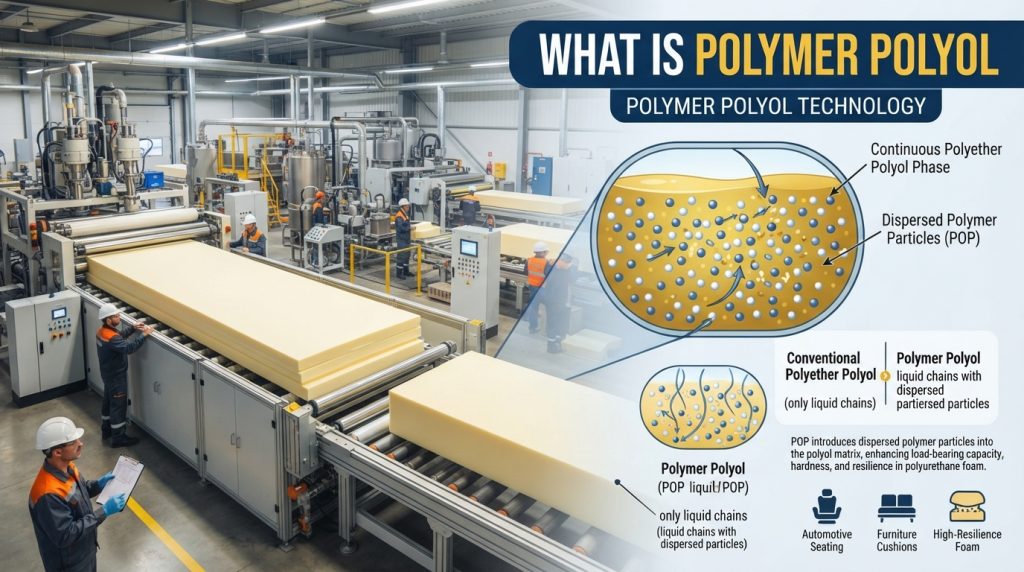
In polyurethane foam production, foam performance is not determined by polyether polyol alone.
When manufacturers need higher hardness, better load-bearing capacity, improved resilience, or stronger support, Polymer Polyol (POP) becomes an important component of the formulation.
But what exactly is Polymer Polyol, why is it needed, and how does it improve polyurethane foam?
Let’s take a practical look.
Ⅰ,What Is Polymer Polyol?
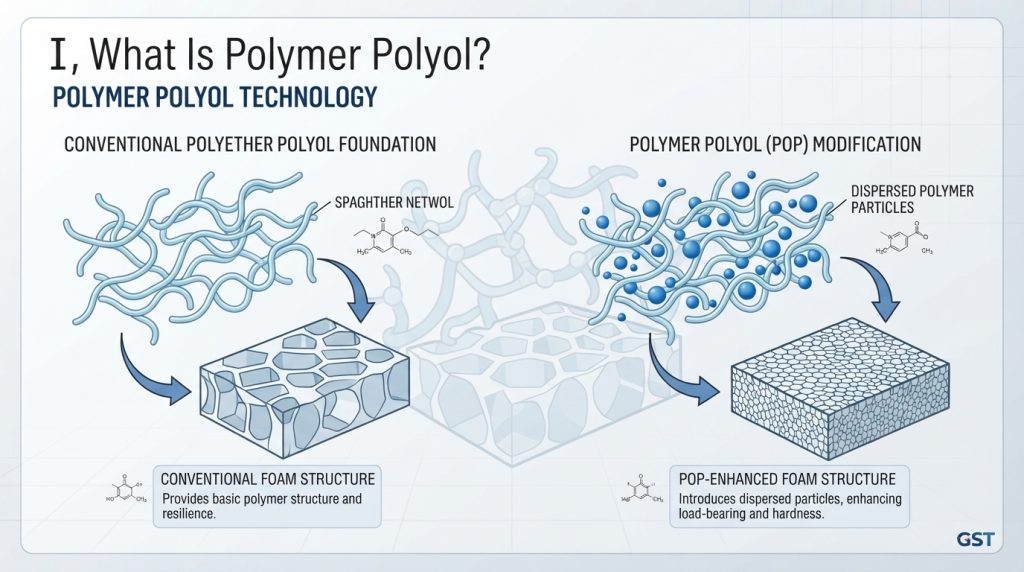
Polymer Polyol (POP) is a modified polyether polyol containing finely dispersed polymer particles.
Unlike conventional polyether polyol, which mainly provides the basic polymer structure, Polymer Polyol introduces a dispersed polymer phase into the polyol.
This gives the polyurethane system additional load-bearing and hardness-enhancing capability.
POP is widely used in high-resilience foam, flexible foam, automotive seating, furniture cushions, mattresses, and other applications where support and mechanical performance are important.
In simple terms:
Polyether Polyol provides the foundation. Polymer Polyol helps build stronger foam performance.
Ⅱ,Why Do We Need Polymer Polyol?
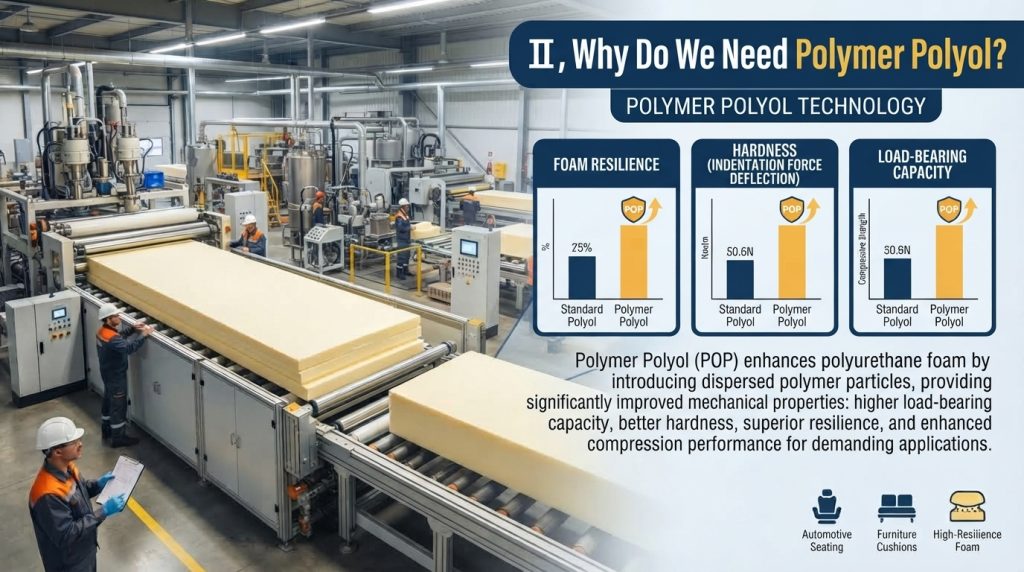
A common challenge in flexible polyurethane foam is finding the right balance between softness, resilience, hardness, and load-bearing capacity.
Increasing foam density alone does not always provide the desired mechanical performance.
Polymer Polyol can help manufacturers achieve:
- Higher load-bearing capacity
- Improved hardness and support
- Better foam resilience
- Improved compression performance
- More controllable foam structure
- Better performance in high-resilience applications
For example, in automotive seats or high-resilience cushions, the foam needs to support body weight while maintaining good recovery after repeated compression.
This is where POP becomes particularly valuable.
Ⅲ,How Does Polymer Polyol Work?
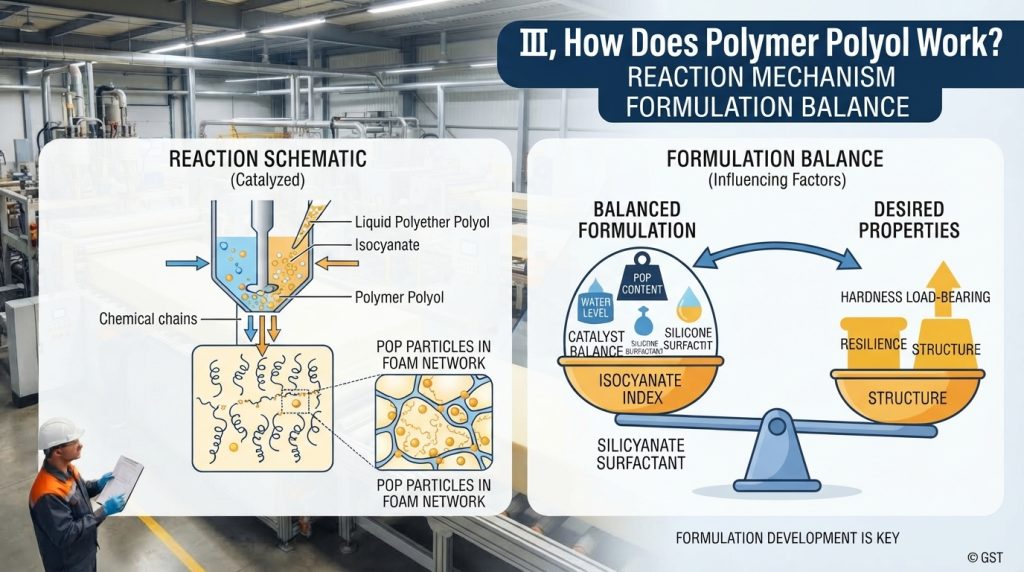
During polyurethane foaming, Polymer Polyol participates in the reaction between polyols and isocyanates.
The polymer particles dispersed within the polyol phase influence the developing polymer network and foam cell structure.
The result is a foam with improved hardness, support, and load-bearing performance.
However, simply adding more POP does not automatically produce better foam.
The formulation must be carefully balanced.
Factors such as:
POP content + polyol selection + water level + catalyst balance + silicone surfactant + isocyanate index + density
can all influence the final foam properties.
This is why formulation development is often more important than simply selecting a high-POP material.
Ⅳ,Common Problems When Using Polymer Polyol
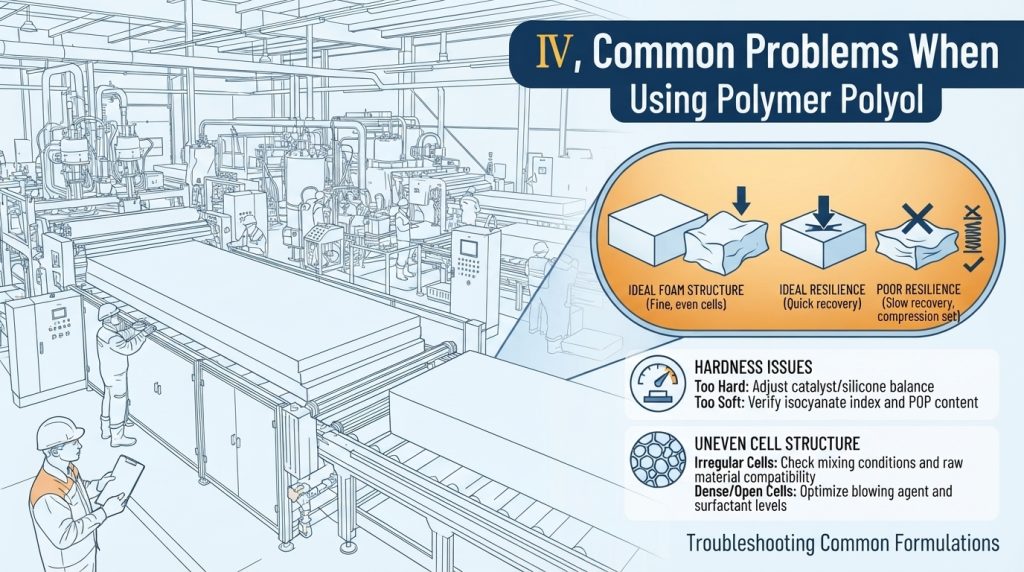
1. Foam Shrinkage or Poor Dimensional Stability
An unbalanced formulation can cause the foam to shrink after foaming.
Possible solution:
Optimize the blowing balance, surfactant level, catalyst system, and POP/polyol ratio.
2. Foam Is Too Hard or Too Soft
The final hardness may not match the customer’s target.
Possible solution:
Adjust POP content and combine it with suitable base polyols and additives instead of changing only one component.
3. Poor Resilience
High hardness does not necessarily mean high resilience.
Possible solution:
Optimize the complete reaction system, including polyol structure, POP, catalysts, silicone surfactant, and isocyanate index.
4. Uneven Cell Structure
Poor processing conditions or an unsuitable formulation can lead to irregular cells, poor surface quality, or inconsistent foam density.
Possible solution:
Control raw-material compatibility, mixing conditions, cream time, rise time, and catalyst balance.
Ⅴ,Polymer Polyol Is About Balance
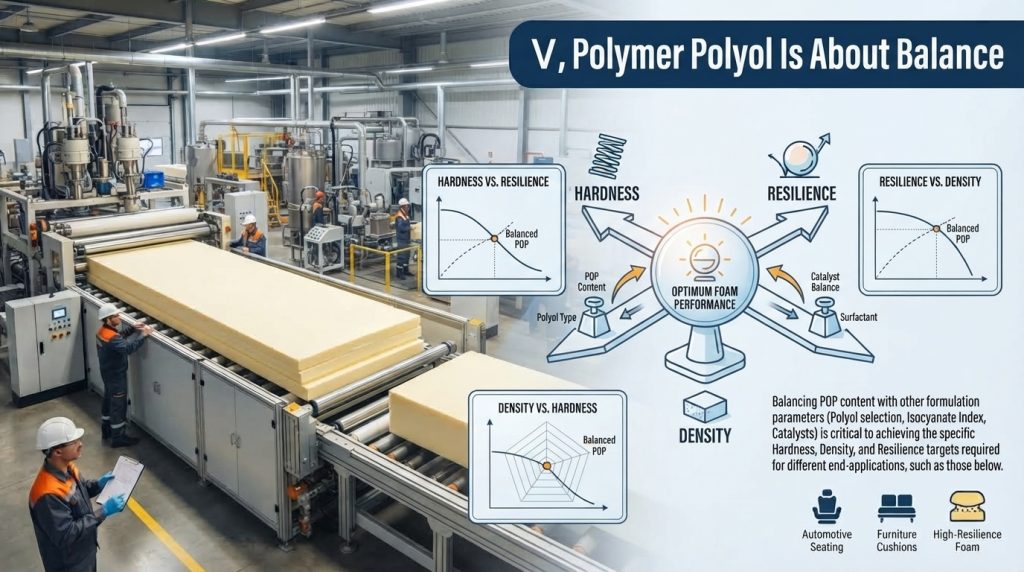
One of the biggest misunderstandings about POP is that more POP does not always mean better foam.
The correct formulation depends on the target application.
For example, a motorcycle seat, automotive seat, mannequin, furniture cushion, and high-resilience molded foam may require completely different combinations of:
- Hardness
- Density
- Resilience
- Tensile strength
- Elongation
- Compression performance
- Processing characteristics
The goal is not simply to increase polymer polyol content.
The goal is to achieve the right performance at the right cost with stable production.
Ⅵ,How Can GST Help?
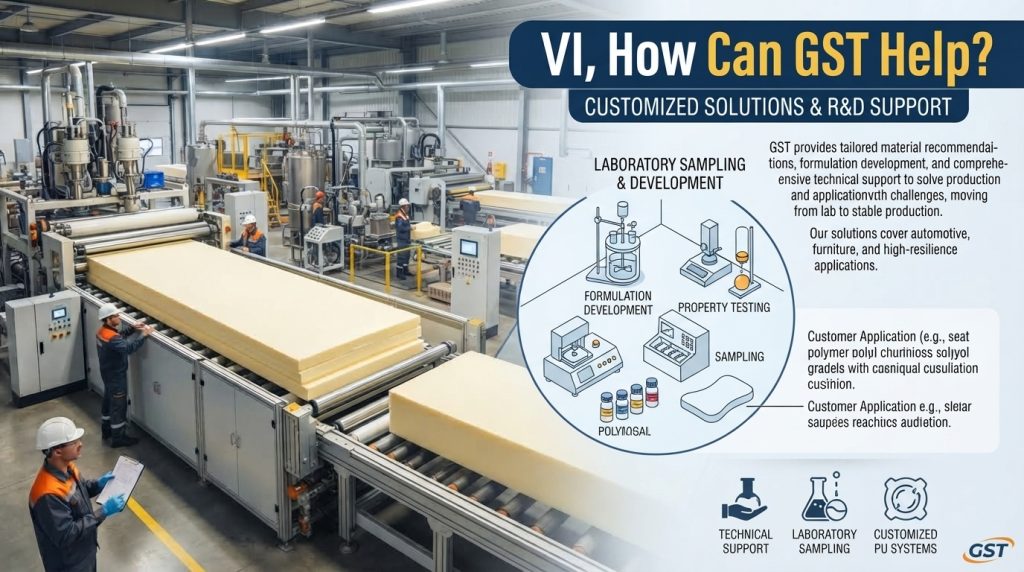
At GST, we focus not only on supplying polyurethane combination materials, but also on helping customers solve real production and formulation challenges.
Our PU application solutions can include:
1. Customized PU Combination Materials
We can develop polyurethane systems according to the customer’s product requirements, equipment, density, hardness, and processing conditions.
2. Formulation Development
Our R&D team can optimize the balance between polyol, POP, catalysts, silicone surfactants, blowing agents, and isocyanate to achieve the required foam performance.
3. Laboratory Sampling & Testing
Before mass production, customers can conduct laboratory trials and sample testing to verify foam density, hardness, resilience, and other physical properties.
4. Technical Support
When customers encounter problems such as shrinkage, poor resilience, unstable density, uneven cells, or hardness deviation, GST can help analyze the formulation and processing conditions.
5. Customized Application Solutions
From automotive seats and motorcycle cushions to furniture, mannequins, and other polyurethane foam products, GST can provide application-oriented material recommendations and technical solutions.
More Than a Raw Material Supplier
Polymer Polyol is only one part of a successful polyurethane formulation.
The real challenge is how to make raw materials, formulation, equipment, processing conditions, and final product performance work together.
That is where formulation experience matters.
GST provides PU combination materials + formulation development + laboratory sampling + technical support, helping polyurethane manufacturers move from raw materials to stable production.
Need a Polymer Polyol-Based PU Solution?
If you are looking for high-resilience PU systems, Polymer Polyol-based formulations, customized PU combination materials, or technical support for your foam production, contact GST.
GST — Your Trusted Partner in PU Material Solutions.
PREVIOUS:Polyether Polyol vs Polyester Polyol
CATEGORIES
LATEST NEWS
- What Is Polymer Polyol?
- Polyether Polyol vs Polyest...
- What Is Polyester Polyol?
- What Is Polyether Polyol?
- What Is Polyol?
- Why Is Reaction Balance Cri...
- Blowing Reaction vs Gelling...
- How Molecular Structure Det...
- Soft Segment vs Hard Segmen...
- What Is Crosslinking in Pol...
CONTACT US
Tel:+86 18688691634
Email:sam@1688pu.com
Add:No. 91 Central East Rd, Luxi Village, Gaobu Town, Dongguan 523283, China.